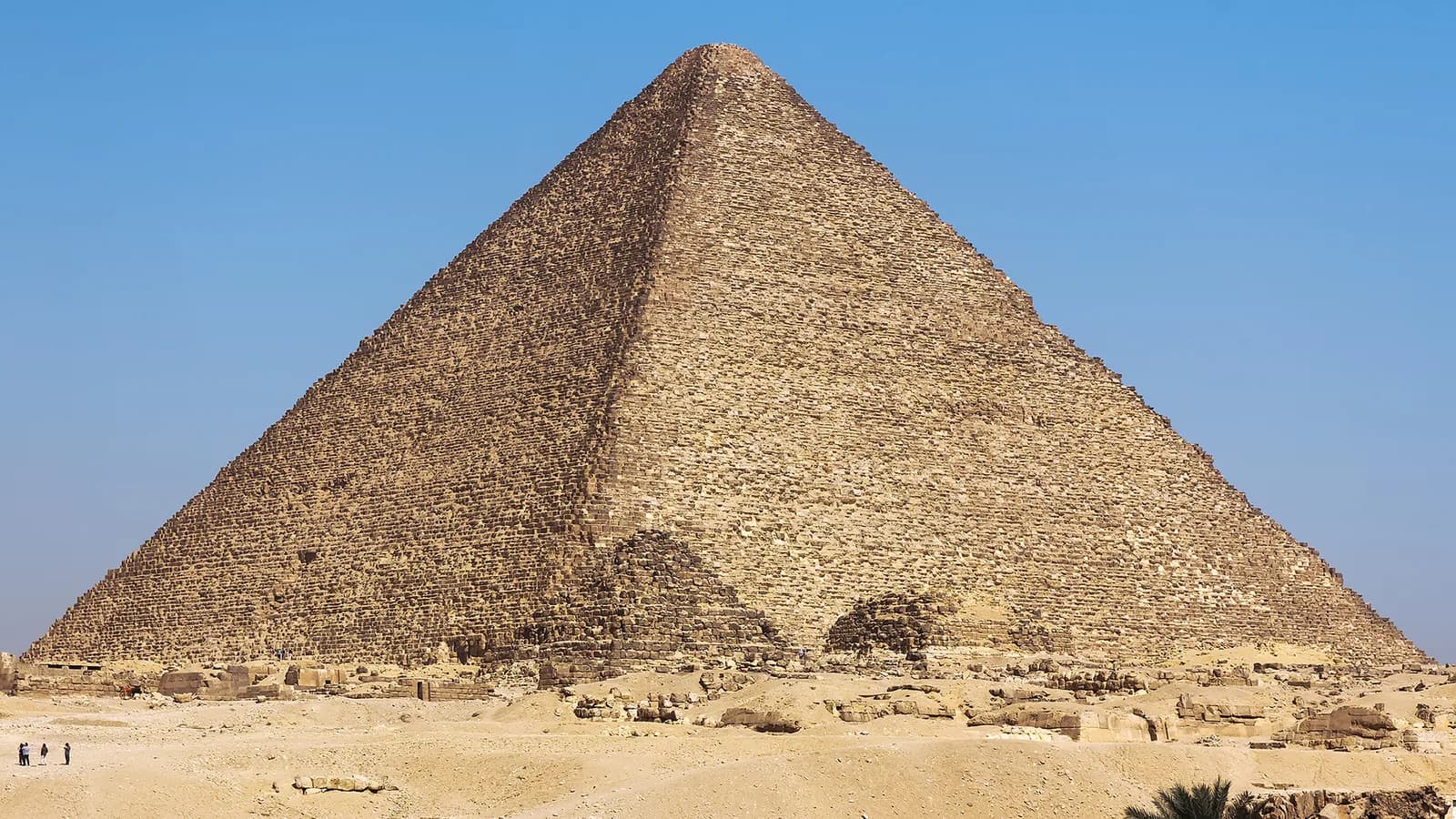
Stand at the foot of the Great Pyramid and look up. Every block above you was cut and lifted into place about 4,500 years ago.
The builders left us a logbook, a town and a quarry ramp. I keep looking for the record of how the stone reached the top.
The traditional view
Egyptologists say organized labor built the Great Pyramid for the pharaoh Khufu. The evidence for that labor is good.
The Ancient Egypt Research Associates have excavated a large settlement near the pyramids. It had craft workshops, bakeries, kitchens, warehouses, small houses and buildings for the officials who ran the site.
Egyptologists also describe workers' villages, administrative records, graffiti left by construction gangs and bread ovens.
Papyri found in 2013 at Wadi al-Jarf on the Red Sea coast add a second line of evidence. They are the logbook of an inspector named Merer and they are the oldest inscribed papyri found in Egypt. The entries date to the 26th and 27th years of Khufu's reign.
The logbook follows Merer's crew as they haul stone at the Tura quarries, load it onto boats and sail it to Akhet-Khufu. That is the Egyptian name for the Great Pyramid. One entry records a shipment of bread arriving from Heliopolis for the crew.
The Problem with the Pyramids
In Earthly Enigmas I take this labor model seriously and I call it a legitimate framework. None of this proves an exotic origin for the pyramid.
I give the measurements in the book. The pyramid covers 13.1 acres and stands 146.5 meters tall. It was the tallest structure on earth for 3,800 years. It holds about 2.3 million blocks that average 2.5 tons, and the largest weigh between 25 and 80 tons. The granite came from Aswan, 800 kilometers away.
The base is level to within 2.1 centimeters. The sides are aligned to true north with an average deviation of 3 minutes 6 seconds of arc. The Greenwich Meridian Building of 1851, built for the purpose, is aligned to 3 minutes 45 seconds. The casing stones fit with a tolerance under one millimeter.
I stay curious about the method. No ramp model has been demonstrated at full scale and the mechanism has only been partly reconstructed.
The shafts of the King's and Queen's Chambers add a second puzzle. Rudolf Gantenbrink surveyed them with a robot in 1993 and a second robotic mission followed in 2002. In the book I write that no authorization has been given to continue the investigation.
I also think Kate Spence's explanation of how the builders found north works. Other explanations have been proposed. Every one of them needs sophisticated astronomical observation and mathematical application.
What Has Not Been Demonstrated
Both views lean on questions the evidence cannot yet answer. Three of them stand out.
Where is the ramp?
The best ramp evidence comes from a quarry. At Hatnub in the Eastern Desert, archaeologists from the University of Liverpool and the French Institute for Oriental Archaeology found a central ramp. It has a staircase on each side and the staircases are lined with post holes.
Yannis Gourdon explains that a sled tied to ropes on those posts could be pulled up slopes of 20 percent or more. The team dates the ramp to the reign of Khufu. Roland Enmarch calls the find an exciting possibility for understanding pyramid logistics.
A 2026 paper in npj Heritage Science proposes a different ramp model for the pyramid and tests it by computer. It says the steep gradients at Hatnub and their limited capacity "preclude them as a sole solution for Khufu." The paper's own model makes predictions that excavation could test.
The ramp that survives does not settle it. What did the builders use at Giza?
How old is the Great Pyramid?
Kate Spence writes in Nature that the pyramids at Giza "have never been accurately dated," although they were built approximately around the middle of the third millennium BC. The dates come from lists of kings and the lengths of their reigns. She says those lists are "rare, seldom complete and contain known inconsistencies and errors."
The chronologies are accurate "only to about ±100 years," and radiocarbon dating cannot improve on that.
Spence then offers her own answer. She argues that the builders aligned the pyramids to north by using the simultaneous transit of two circumpolar stars. Modeling the precession of those stars, she says, gives a start date for the Great Pyramid that is accurate to ±5 years.
Glen Dash tested that idea in a 2015 working paper. He notes that Spence's dates run on average 74 years later than the accepted chronologies. He writes that he believes the data "neither confirms nor refutes" her hypothesis. His conclusion is that the available evidence, viewed collectively, "does not support it." He thinks the builders may have found north by another method as their surveying improved.
The first date comes from king lists with known errors. The second comes from a model that Dash questions. I would like to see a date that depends on neither.
What would settle the date without the king lists or the alignment model?
What is the empty space inside?
In 2017 a team using cosmic-ray muons reported a large void inside Khufu's Pyramid. Their paper in Nature describes a cross-section similar to that of the Grand Gallery and a minimum length of 30 meters.
One report on the discovery says experts do not know whether the void is a purpose-built interior structure or a space left open during construction.
Was the void planned?
The questions I can't put down
Some questions need more room than one article gives them. Two of them keep pulling me back.
How did the builders find north so exactly? Spence's method is one proposal and other proposals exist. I follow that question through Earthly Enigmas, where I look at what astronomical knowledge each method assumes.
Where is the record of the lift? I read the full translation of Merer's logbook. It records hauling, loading, sailing and bread deliveries, and it has no entry about raising stone into place. It covers only part of one season, so it shows what survives and cannot show what never existed. You can read a free sample of the book before you decide. The articles section has more subjects in the same format.
Sources
- Ancient Egypt Research Associates: The Lost City of the Pyramid Builders
- Pierre Tallet, Les papyrus de la mer Rouge I: Le Journal de Merer (2017), English translation as reproduced by Roger Pearse
- University of Liverpool: Ancient quarry ramp system may have helped workers build Egypt's Great Pyramids (2018)
- Rosell Roig, npj Heritage Science 14 (2026)
- Spence, Nature 408 (2000)
- Glen Dash, Simultaneous Transit and Pyramid Alignments (2015 working paper)
- Morishima et al., Nature 552 (2017)