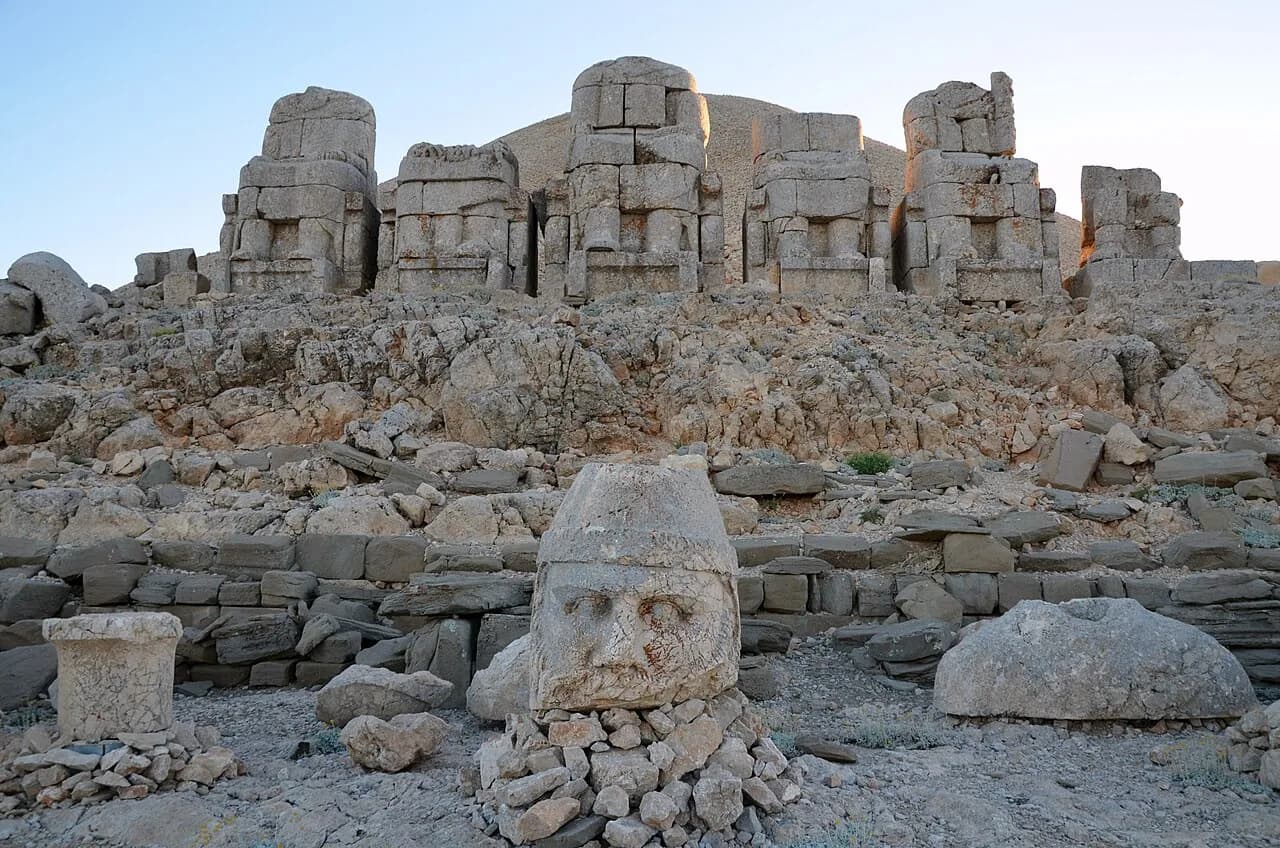
At the top of a mountain in southeastern Turkey, five giant stone gods sit in a row beside a hill of crushed rock. Their heads lie lower down, on the terrace in front of them.
The king who built the place put his own face among the gods. His inscription also says where his body would rest.
The traditional view
UNESCO calls Nemrut Dağ a Hierotheseion, "temple-tomb and house of the gods." It was built by King Antiochos I of Commagene, who reigned from 69 to 34 B.C., "as a monument to himself."
The mound is 145 meters across and 50 meters high. UNESCO describes it as a funerary mound of stone chips with terraces on the east, west and north sides. Five giant seated limestone statues face outward on the east and west terraces, with a lion and an eagle at each end. UNESCO says the heads "have fallen off to the lower level."
Two rows of sandstone stelae carry reliefs of the king's Persian ancestors on his father's side and Macedonian ancestors on his mother's side. The west terrace also holds a stele with a lion and stars. UNESCO calls it a lion horoscope "believed to be indicating the construction date of the cult area."
The king left a long law, the nomos, carved on the backs of the thrones. In the translation posted by the International Nemrud Foundation he writes that he took forethought "to lay the foundation of this sacred tomb, which is to be indestructible by the ravages of time." He says he has "consecrated the features of my own form" among the gods. He also names two days for festivals, the day of his birth and the day of his accession to the throne.
National Geographic reports that a German engineer, Karl Sester, brought the site to the wider world in 1881. A systematic excavation began in 1953 under the American archaeologist Theresa Goell and the German epigrapher Friedrich Karl Dörner.
UNESCO lists the threats today. They include temperature swings, freezing and thawing, wind and snow. It adds that the site lies in a first degree earthquake zone close to the East Anatolian Fault.
What the Evidence Does Not Settle
In Earthly Enigmas I do not discuss Nemrut Dağ. I do write about temples and stone circles that line up with the sky, including Angkor, Stonehenge and Newgrange in Chapter 5.
The Date, the Tomb and the Heads
Both views lean on questions the evidence cannot yet answer. Three of them stand out.
Which year does the lion show?
The researchers agree that the lion slab shows a sky. They do not agree on which one.
The International Nemrud Foundation says that Otto Neugebauer proposed the 7th of July 62 B.C. It adds that "most archaeologists are not aware that according to Neugebauer it can be also the 6th July." The foundation's Maurice Crijns proposes the 14th of July 109 B.C. He writes that it is more logical to assume the reliefs commemorate the coronation of the king's father, Mithridates.
In a 2022 article in BABESCH, Crijns writes that the other proposed configurations "are all look-alikes, ignoring one or more of the astronomical data of the relief." He dates the five colossal statues to the 29th of January 91 B.C. I read the page on Academia and not the printed journal.
Juan Antonio Belmonte and César González-García reach a third answer from the way the terraces face. In their summary of the 2010 paper the eastern statues face sunrise on July 23, 49 B.C., "commemorating Antiochos' ascent to the throne." The western statues face sunset on December 23 of the same year. They conclude that the lion horoscope "should consequently be redated to July 12 49 B.C." I have not read the paper itself.
National Geographic notes that some scholars favor 109 B.C. and that others suggest different dates. The proposals run from 109 to 49 B.C.
Which year does the lion show, and which king was it made to honor?
Where is the king?
The law says the king's body will lie in the tomb. He writes that "the fortunately preserved outer form of my person" will "rest through immeasurable time" near the heavenly throne. UNESCO calls the mound a funerary mound.
National Geographic says Goell and Dörner "tried without success to locate the hidden funerary chamber of Antiochus I." It adds that the thousands of stones in the mound have kept archaeologists out. It says the body is likely where it was laid.
A guidebook text on Turkish Archaeological News describes it differently. It says Goell drilled boreholes in the mound and that traces of dynamite can still be seen behind the statues on both main terraces. It reports geophysical work in 1987 to 1989 and concludes that the location of the tomb "remains a mystery."
The same text says some researchers, among them Tom Utecht, lean toward a tomb under the mound or in another place nearby. It says the chamber in the Karakuş Tumulus, another Commagene monument, turned out to be empty. It even suggests the great tombs may have been a ruse to mislead grave robbers. I have not checked any of those three claims.
Is the king inside the mound, beneath it or somewhere else?
What took the heads off?
UNESCO records that the heads of the statues "have fallen off to the lower level." It does not say when or why. It does say the site is vulnerable to earthquakes and to freezing and thawing.
The guidebook text says the most frequently repeated explanations are earthquakes and strong winds. It reports that Goell recorded the statue of the goddess of Commagene as nearly whole until the 1960s and that she lost her head to lightning. Crijns writes that only the statue of Commagene on the east terrace "was intact until 1964." The guidebook adds that broken noses may point to deliberate damage. It names early Christians or Muslims as possible actors. I have not checked that.
The heads have also been moved in recent times. National Geographic says that in 2002 Turkish and Dutch archaeologists placed the heads on stone plinths to protect them from damp and frost. The guidebook text says the Turkish ministry withdrew the Dutch team's permit after the 2003 season. It names the most serious charge as the arbitrary transfer of the heads on the east terrace from the places where they had lain since the nineteenth century. The International Nemrud Foundation describes the same work as minimum intervention and maximum protection.
What brought the heads down, and where did each one lie before the work began?
The questions I can't put down
Some questions need more room than one article gives them. Two of them keep pulling me back.
How was it built? UNESCO says a highly developed technology was used for the statues and stelae, "the equal of which has not been found anywhere else for this period." Some of the blocks weigh up to nine tons. The king says he made his own image "from one and the same quarry" as the gods. I have not found where that quarry was. In the book I follow the placement of the giant blocks at Baalbek, which is a related question. I follow it through Earthly Enigmas.
Why face the sky at all? Crijns reads the west terrace as looking at sunset on the shortest day of the year. Belmonte and González-García read it as sunset on the king's birthday. In the book I argue that long-cycle sky alignments at Stonehenge, Newgrange and other sites took generations of observation. At Nemrut Dağ the nomos names the days. The Carnac article sets out the same kind of question. You can read a free sample before you decide. The articles section has more subjects in the same format.
Sources
- UNESCO World Heritage Centre: Nemrut Dağ
- CIMRM 32, Inscriptions on throne-backs, Nemrud Dag (translation from the International Nemrud Foundation)
- International Nemrud Foundation: Lion Horoscope
- International Nemrud Foundation: 2001-2003 Results
- Crijns, The Discovery of the Colossal Coronation Horoscope of Antiochus I (BABESCH 97, 2022), page on Academia
- Belmonte and González-García, Antiochos's Hierothesion at Nemrud Dag Revisited (Journal for the History of Astronomy 41, 2010), project summary at the Instituto de Astrofísica de Canarias
- National Geographic: The eighth wonder of the ancient world may have an untouched tomb (2024)
- Turkish Archaeological News: Mount Nemrut (guidebook excerpt, secondary)