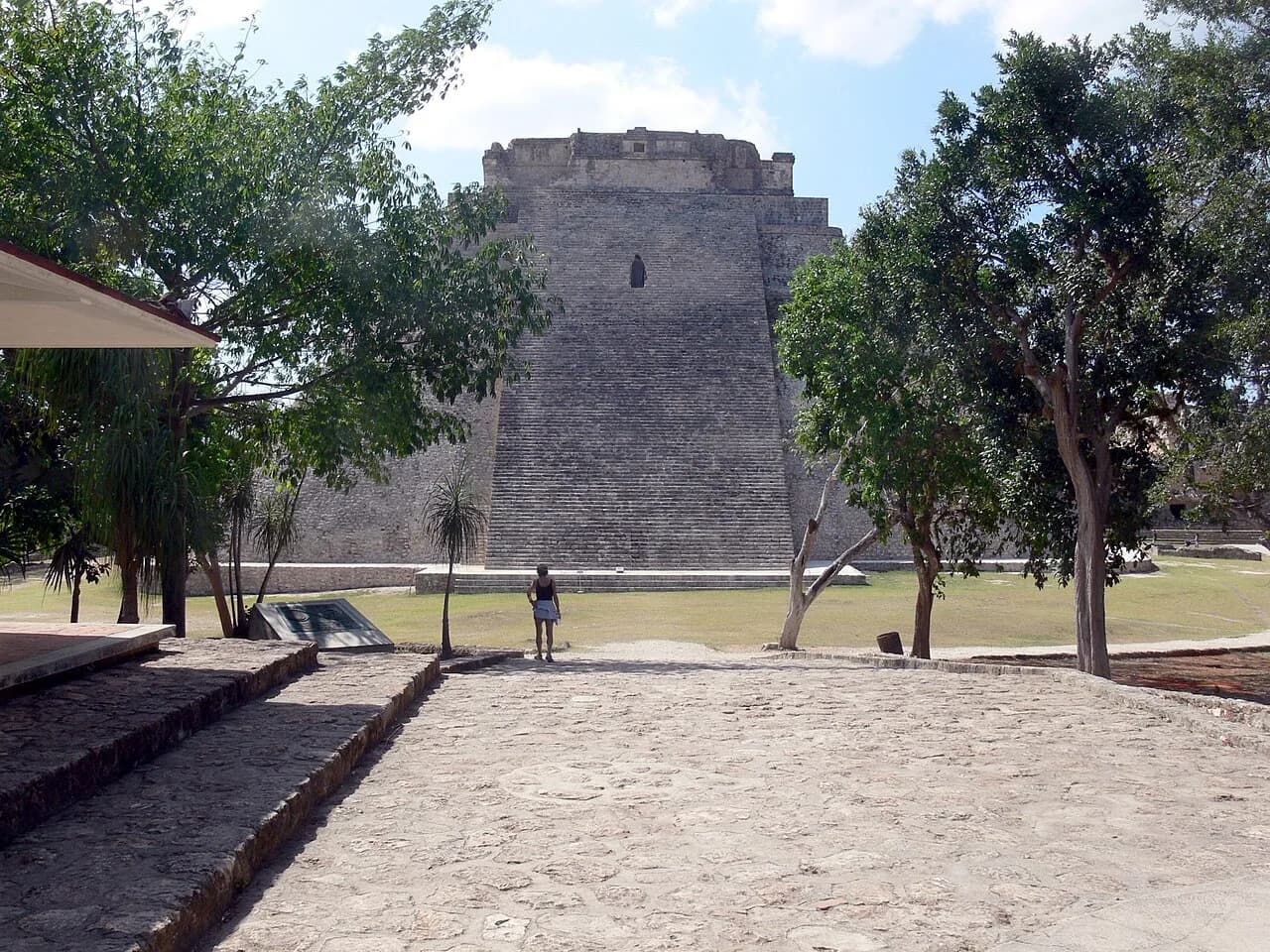
In 1840 John Lloyd Stephens sat in the doorway of a small stone temple at the top of a rounded mound in the Yucatan. A local man told him a story about a dwarf who built the whole structure in one night. Stephens measured the mound and wrote that it was "built up solid from the plain."
Later excavators found temples inside it. The count is five.
The traditional view
UNESCO says archaeological work and radiocarbon dating suggest the main structures at Uxmal were built between the 8th and 10th century. It says the city grew into "a political and administrative centre with up to 20,000 inhabitants." It also says the city is not laid out geometrically and that its space "is organized in relation to astronomical phenomena, such as the rising and setting of Venus."
The pyramid is the first building UNESCO names. INAH, the Mexican institute that manages the site, gives its height as 35 meters and says it was built in five stages. Smithsonian Magazine describes it as "five different temples built in succession." The oldest temple is exposed at the base on the west side. The newer temples sit on top of it and inside it.
The sources do not agree on the height. Stephens measured 88 feet to the top of the mound and 105 feet to the top of the building. The 1999 photogrammetry team led by Lawrence Desmond gives about 30 meters. Britannica gives 27.6 meters.
The historian Jeff Kowalski, quoted by Smithsonian, calls the west stairway "a cave portal to a sacred creation mountain." He also says the later upper temples show some of the finest cut-stone sculpture in the Maya world. INAH reads the masks of the rain god Chaac on the pyramid as the thirteen levels of the Maya sky.
The name changes by source, since UNESCO uses Soothsayer, Smithsonian uses Magician and INAH uses Adivino. Stephens recorded two names from local people, the House of the Dwarf and the House of the Diviner. He wrote that the second name came "from its overlooking the whole city."
Stephens also wrote down the story. In his version the governor orders the dwarf to build "a house in one night higher than any in the place." The next morning the dwarf "found himself in this lofty building." Smithsonian sets this against the archaeology and says the evidence from the earliest temple points to construction beginning around the 6th century.
What the Evidence Does Not Settle
The book does touch two ideas that meet this site. In Chapter 5 I write that history books treat the ancient world as a series of isolated experiments. In Chapter 7 I write that the Maya calendar tracks Venus "to within seconds of arc." The book gives no source for that figure and I have not checked it here.
The Uxmal literature on Venus concerns the orientation of one building, and the calendar is a separate subject. The three questions below stay with that literature and with the pyramid itself. They sit beside the Teotihuacan article, which looks at another city of pyramids with sky lines of its own.
Three Questions the Stones Leave Open
When was the first temple built?
Smithsonian says "hard evidence from the earliest temple" points to the 6th century. Wikipedia quotes Kowalski, from his 1987 book on the Governor's Palace, giving the Lower West Temple a radiocarbon date of "AD 560 ± 50." I located that line through Wikipedia and I have not read Kowalski's book.
UNESCO places the main structures between the 8th and 10th century. It adds that the Books of Chilam Balam, a Maya text written down in the 16th century, "dates the foundation of Uxmal to the later 10th century." Ringle and colleagues report that well over 90 percent of the visible Puuc features date to about AD 600 to 950.
The sources also disagree on what dated the temple. One non-institutional site says the date was inscribed on a lintel. Wikipedia says an inscribed date and radiocarbon. I have seen a claim that the radiocarbon date was later revised and that Kowalski thinks it too early. I have not checked that.
A radiocarbon date, a building style and a written tradition give three different starting points. What stood at Uxmal while the first temple was going up?
Which Venus does Uxmal point to?
Victoria and Harvey Bricker write in the Cambridge Archaeological Journal that the Governor's Palace "is aligned to an infrequently occurring extreme position of Venus on the horizon." They add that the inscription over its central doorway relates "specifically to the concern with Venus and other celestial phenomena."
Ivan Šprajc writes in the Handbook of Archaeoastronomy and Ethnoastronomy that "two opposing interpretations have been forwarded." One links the orientation "with the southernmost rising point of the morning star." The other "suggests it refers to the northerly extremes of the evening star." I have read only his abstract. Search summaries credit the first reading to Anthony Aveni and I have not read Aveni.
Several non-specialist pages say the entrances of the upper temples on the pyramid face the summer solstice sunset. I found no INAH or journal source for that. I have not checked it.
Two specialist readings of the same building point to opposite ends of the planet's path. Which event on the horizon was Uxmal set to, and does the pyramid share it?
Why cover a temple instead of leaving it?
Each of the five temples was built over the one before. The oldest is still visible at the base on the west side. Stephens described the mound in 1841 and again in 1843. In the second account he wrote that it was "apparently solid from the plain."
The literature describes the stages and their styles in detail. I did not find a source that says why a builder covered a working temple with the next one and left part of the older facade in view. Kowalski's phrase about a cave portal and INAH's reading of the thirteen sky levels concern what the pyramid meant. They do not address the burial of earlier temples as a decision.
The sources describe construction over several centuries. Why build over the old temple, and why leave part of it showing?
The questions I can't put down
Some questions need more room than one article gives them. Two of them keep pulling me back.
What did the people who built it call it? Every name in use today comes from Stephens, who wrote them down in 1840 from the people he met. In Chapter 16 I write that Diego de Landa burned Mayan books in 1562 and that fewer than 20 of an estimated 400 codices survive. The book gives no source for the 400 figure. I follow that question through Earthly Enigmas.
Who carried the load? UNESCO gives Uxmal up to 20,000 inhabitants. Smithsonian says the Governor's Palace alone would need 1,200 workers laboring for 33 years. Ringle and colleagues write that the Puuc had no natural surface water and relied on cisterns. Britannica describes cenotes in the city, which the other sources do not. In Chapter 18 I write that the revised Maya population estimates are now mainstream. You can read a free sample of the book before you decide. The articles section has more subjects in the same format.
Sources
- UNESCO World Heritage Centre, Pre-Hispanic Town of Uxmal (791)
- INAH, Templo de Chenes en la Pirámide del Adivino
- Smithsonian Magazine, The Maya Ruins at Uxmal Still Have More Stories to Tell (2020)
- Ringle et al., Lidar survey of ancient Maya settlement in the Puuc region of Yucatan, Mexico (PLOS ONE, 2021)
- Desmond et al., Stereo-Photogrammetric Documentation of the Adivino Pyramid at Uxmal (1999 summary report)
- Bricker and Bricker, Astronomical References in the Throne Inscription of the Palace of the Governor at Uxmal (Cambridge Archaeological Journal, 1996, abstract only)
- Šprajc, Governor's Palace at Uxmal (Handbook of Archaeoastronomy and Ethnoastronomy, abstract only)
- John Lloyd Stephens, Incidents of Travel in Central America, Chiapas, and Yucatan (1841) on the Internet Archive
- John Lloyd Stephens, Incidents of Travel in Yucatan, vol. 1 (1843) on the Internet Archive
- Hanksville, El Adivino (non-institutional page; used for the west-side detail and the lintel date)
- Britannica, Uxmal
- Wikipedia, Pyramid of the Magician (used to locate the Kowalski radiocarbon line only)