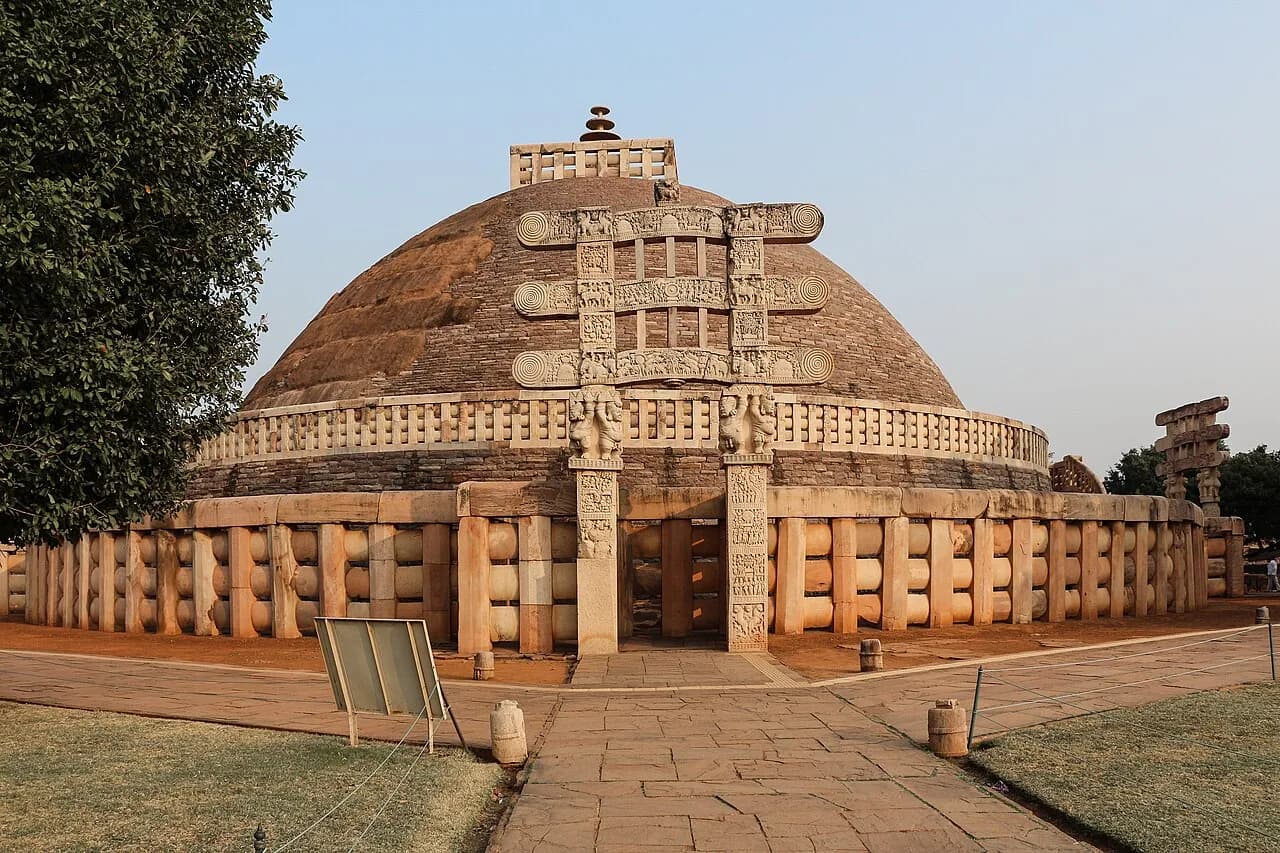
A stone dome sits on a hilltop near Bhopal in central India. Four carved gateways face roughly the cardinal points around it, and a smaller brick dome lies buried inside.
UNESCO places the first brick core in the third century BCE and the last additions in the fifth century CE. The sources do not fully agree on who built which part in between.
The traditional view
UNESCO lists the Buddhist Monuments at Sanchi as a group of stupas, temples and monasteries. Its short description calls Sanchi the oldest Buddhist sanctuary in existence and a major Buddhist center until the 12th century CE. Its longer text says Sanchi remained an important seat of Buddhism until the 13th century CE.
The longer text credits the Mauryan emperor Ashoka with the start of Sanchi as a sacred center in the third century BCE. A brick stupa stood beside his polished stone pillar. UNESCO says the stupa was later increased in scale in the Sunga dynasty, from 184 to 72 BCE, and covered with a stone veneer. It adds railings, stairs and four gateways, and it says the gateways were ornamented under the Satavahanas in the first century CE. The Gupta dynasty added four shrines in the fifth century CE.
John Marshall directed the clearing and repair of the site from 1912 and wrote its guidebook in 1918. His guide shows how the view changed. Earlier writers had supposed that the Great Stupa went up as it stands in Ashoka's reign. Marshall wrote that these suppositions "have proved to be erroneous." He held that the original stupa was "a structure of brick of about half the diameter of the present stupa." He dated the stone casing about a century later.
Marshall wrote that the original stupa was "most probably built by Asoka at the same time as the column was erected." Julia Shaw reports the basis in her 2007 book. Marshall dated the brick core to Ashoka's reign because its surrounding floor shared the stratigraphic level of the foundations of the Ashokan pillar. He also cited bricks of typical Mauryan size and a polished Chunar sandstone parasol found in the debris.
Marshall says Sanchi was left deserted from the 13th century onward. General Taylor visited in 1818 and found the monuments in a "remarkably good state of preservation." UNESCO says the site lay abandoned for about 600 years. Marshall blames treasure seekers and amateur excavators for much of the later damage, and UNESCO says the three main stupas were restored in the early 20th century.
What the Record Leaves Open
The nearest thread is Chapter 3, where I describe the Indian megalithic tradition as "substantially underweighted" by the standard narrative.
UNESCO's own text for Sanchi mentions megaliths. It says the railings and gateways "bear witness to the continued use of the primitive forms of megalithic tumuli covered with an outer layer and surrounded by a palisade."
What Nobody Has Settled
Three questions stand out.
Who built which part, and when?
The sources give the gateways different dates. UNESCO places their ornamentation in the first century CE. Marshall wrote in 1918 that the gateways went up in "the latter part of the first century before the Christian era." Shaw's summary of Marshall's later phasing puts the carved gateways in the first to third century CE, with the southern gateway inscription at about 25 CE.
That inscription records the gift of an architrave by a foreman of the artisans of the Andhra king Sri Satakarni. Marshall wrote that "the title of Satakarni was borne by many members of the dynasty." He added that "it is not practicable to determine which particular one is here designated." He judged that the king reigned in the middle or latter half of the first century BCE.
The label for the middle phase is also disputed. UNESCO assigns the stone casing to the Sunga dynasty. Shaw writes that "it is inaccurate to refer to the post-Mauryan monuments at Sanchi as Sunga." She says the king Pusyamitra was "reputedly animical to Buddhism." She adds that most donative inscriptions of the period "attest to predominantly collective and non-royal modes of sponsorship."
Marshall also wrote that "of the form and construction of the original stupa little is known." Who built each part of the Great Stupa, and when?
What is inside?
Marshall describes a stone box at the summit, with a lid 5 feet 7 inches across, "in which the relics were once preserved." He also writes that Captain Johnson in 1822 "opened the Great Stupa from top to bottom on one side, and left a vast breach in it." The passage I read does not say what Johnson found.
The relics of two of the Buddha's disciples came from a different monument. Marshall says Alexander Cunningham found them in Stupa 3, in two stone boxes inscribed with the names Sariputa and Mahamogalana.
Shaw writes about the main stupas at Sanchi and at nearby Satdhara. She says "no relics have been retrieved from the main stūpas at these sites." She adds that there are "strong suggestions that they originally contained, and perhaps still do, the relics of the Buddha himself." I have not checked whether anyone has published a different account.
What, if anything, still lies inside the Great Stupa?
Why this hill?
UNESCO says "Buddha never visited the site during any of his former lives or during his earthly existence." UNESCO adds that Sanchi is also considered to be the Cetiyagiri of the Sri Lankan Buddhist chronicles. Marshall tells the story of Ashoka marrying a banker's daughter from nearby Vidisha. He then notes that another version makes the missionary Mahendra Ashoka's brother and never connects him to Vidisha. In Marshall's words "it would manifestly be unsafe" to draw conclusions from the chronicle about the age or origin of the monuments.
Marshall found good evidence that Buddhists settled at Sanchi in Ashoka's lifetime. Shaw points to the Ashokan schism edict on the pillar. She says it "does provide suggestions of some kind of pre-Mauryan Buddhist presence in the area." Elsewhere she lists the question among those that "remain unanswered." She asks why these hilltop sites were "chosen by the incoming saṅgha."
Shaw also notes that the main stupa is visible from as far away as Bighan to the north. She suggests this intervisibility "may have been an important way of maintaining linkages between key ritual sites."
Why was this hill chosen?
The questions I can't put down
Some questions need more room than one article gives them. Two of them keep pulling me back.
How did a pillar that long get to Sanchi? Marshall writes that the sandstone "came from the quarries of Chunar several hundred miles away." He puts the block at "over forty feet in length and weighing almost as many tons." He supposes the engineers used rafts in the rainy season up the Ganges, Jumna and Betwa rivers. I have not checked his weight or his route. He also writes that the finished pillar was "polished to a remarkable lustre from top to bottom." In the book I follow how heavy stones were cut and moved at other sites, and the Puma Punku article takes up one of them. I follow that question through Earthly Enigmas.
What links a stupa to the megalithic tradition? UNESCO says the railings and gateways recall megalithic tumuli. In Chapter 3 I walk through the menhir fields of South India, where the Mudumal team reports solstice alignments and an Ursa Major star map. You can read a free sample before you decide. The Borobudur article looks at another Buddhist monument built around a stupa, and the articles section has more subjects in the same format.
Sources
- UNESCO World Heritage Centre: Buddhist Monuments at Sanchi
- John Marshall, A Guide to Sanchi (Calcutta, 1918), Internet Archive scan (OCR full text read)
- Julia Shaw, Stūpas, Monasteries and Relics in the Landscape: Typological, Spatial, and Temporal Patterns in the Sanchi Area (2009; UCL Discovery copy)
- Julia Shaw, Buddhist Landscapes in Central India: Sanchi Hill and Archaeologies of Religious and Social Change (2007), read through a third-party copy of the text