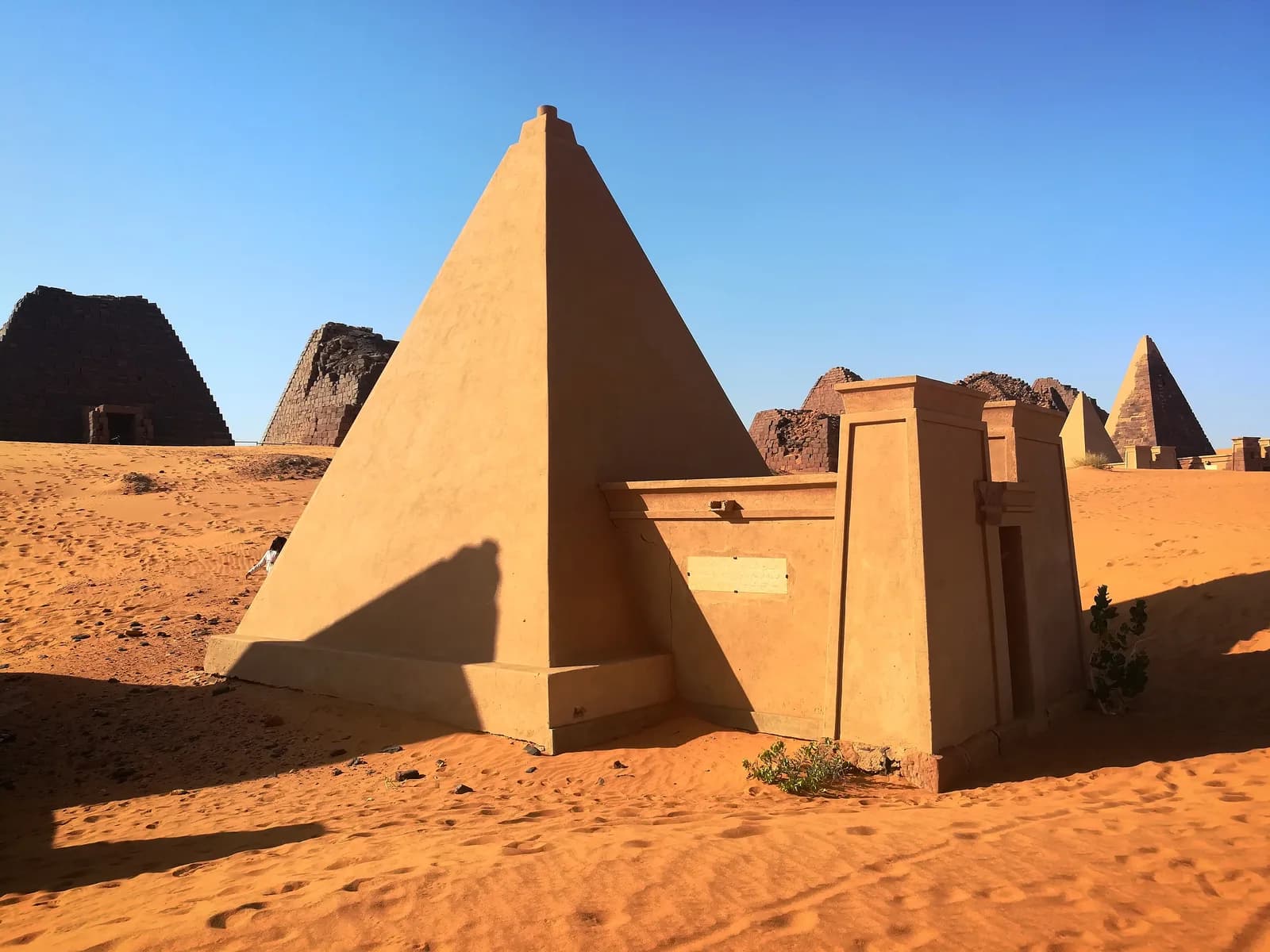
In 1834 an Italian doctor took the top off the largest pyramid at Meroe in Sudan. He was looking for treasure.
The Egyptian Museum of Berlin says he found a small hidden chamber in the upper part of the pyramid. Inside was a pot filled with jewelry.
The traditional view
UNESCO calls the Island of Meroe "the heartland of the Kingdom of Kush". It says Kush was a major power from the 8th century BCE to the 4th century CE. From the 3rd century BCE onward Meroe was the site of most royal burials.
The World Heritage property has three parts. They are the capital with its town and cemetery, and the two religious centers of Musawwarat es-Sufra and Naqa. UNESCO lists pyramids, temples, palaces and industrial areas among the architecture.
National Geographic counts some 255 pyramids in Sudan, "more than twice the number Egypt constructed next door." Janice Yellin, writing in the Journal of Ancient Egyptian Interconnections, refers to "the forty-one royal pyramids at Meroe".
The Kushite design differs from the Egyptian one. National Geographic writes that "Nubian burial chambers sit below the pyramids, not inside them." Peter Lacovara observed the early pyramids at El-Kurru and reports slopes of about 55 to 60 degrees. He says they are gentler than the later Meroitic pyramids.
The form came to Kush by way of the Twenty-Fifth Dynasty. The Lanier Center for Archaeology at Lipscomb University says those rulers "reintroduced pyramid building at sites such as El-Kurru and Nuri." George Reisner excavated El-Kurru in 1918 and 1919. Lacovara writes that Reisner placed the first pyramid in the reign of Piye.
The pyramids have been damaged. UNESCO writes that "inappropriate interventions which reduced the integrity of the site have not occurred since the treasure hunting of Ferlini in the 1830s." It adds that Ferlini's work "was very deleterious to some of the pyramids in the Meroe cemeteries."
UNESCO also says some conservation work at temples and pyramids "was based on large-scale reconstructions", which "affected the authenticity of these features."
Pyramids Beyond Egypt
In Earthly Enigmas I write that "Egypt does not have a monopoly on pyramids." In the chapter on the American pyramids I ask whether several civilizations reached the same monumental form by independent invention, by shared knowledge "or something else".
Where the Accounts Don't Meet
The sources agree on the basic facts. Three questions stay open between them.
Whose tomb is it?
Yellin opens her paper with a problem. She writes that "the absence of securely dated texts and monuments has been an obstacle in establishing the sequence and dating of Meroitic rulers." The solution has been to match rulers to a relative sequence of pyramids. She says this "has led to a degree of circular reasoning in the creation of Meroe's chronology."
Lacovara raises a smaller case at El-Kurru. Dows Dunham assigned tomb Ku. 8 to King Kashta, and Lacovara notes there is "no documentary evidence for this assertion." He describes tomb Ku. 17 of Piye as the first king's tomb where the owner is named in an inscription, from the stairway and the burial chamber.
The largest pyramid at Meroe is tied to its owner through the jewelry found inside. The Berlin museum says the pieces belonged to Queen Amanishakheto, who ruled in the 1st century BCE. Ferlini took the top off that pyramid to reach them.
The sources disagree on how much he removed. The English Wikipedia article on Ferlini says he describes dismantling five, possibly six, pyramids. I used that article only to locate this, and I have not checked it against his book. It also quotes the German scholar Richard Lepsius, who visited in 1844. He wrote that "the discovery of Ferlini is in everybody's head still, and has brought many a pyramid to ruin." Other writers give a figure above forty. I have not checked where that number comes from.
If the king list rests on the pyramids and the pyramids rest on the king list, what would count as an independent date for a single tomb?
Where did the pyramid come from?
Reisner read the El-Kurru tombs as a sequence from mound to mastaba to pyramid, as he had for Egypt. Lacovara writes that "many of Reisner's interpretations of the evidence were, however, affected by an Egyptocentric viewpoint."
Lacovara reaches a different reading. He concludes that "the evolution of the royal Kushite tomb proceeded directly from a traditional Nubian tumulus grave to a pyramidal form, without an intervening mastaba stage as was postulated by Reisner." He thinks the change may have happened "at a fairly rapid rate."
He also points to Egyptian pyramids built in Nubia during the New Kingdom. The ones at Aniba, he writes, "closely correspond in size and plan to the early Kurru pyramids."
An essay on African History Extra adds that Egyptian kingship had given up pyramid building for over eight centuries before these Nubian tombs appeared. I have not checked that figure against a specialist source.
Lacovara also notes that earlier scholars proposed a much longer time span for these tombs, back into the New Kingdom. He calls those suggestions "unfounded". He names Kendall, Hakem and Török. I have not read their papers.
How did the pyramid pass from Nubian tombs built under Egyptian rule to a Kushite king's burial, and how long did it take?
What do the texts say?
Claude Rilly's entry in the UCLA Encyclopedia of Egyptology says Meroitic is known "from more than two thousand inscriptions found in northern Sudan and Egyptian Nubia." It says the scripts were deciphered between 1907 and 1911 by Francis Llewellyn Griffith. It adds that "knowledge of the language itself remains incomplete."
He is plain about why. "The reason for our poor knowledge of the language is the lack of bilingual texts and, until recently, the isolated position of Meroitic among the African languages." He reports that the language belongs to the Northern East Sudanic branch of the Nilo-Saharan phylum, which was established only recently.
Half of the published corpus is funerary. Rilly writes that the longest documents are royal inscriptions, and that "no more than two dozen of these have thus far been recovered."
So the signs can be sounded out. Rilly's own words for the language are "only superficially known". Another undeciphered system is the subject of the Indus seal article.
If a bilingual text were found, what would we first want to learn about the people in these tombs?
The questions I can't put down
Some questions need more room than one article gives them. Two of them keep pulling me back.
How does anyone tell borrowing from reinvention? At Meroe the trail is unusually clear. The form came out of Nubian tombs and Egyptian models, and Lacovara can follow it step by step. In the book I ask the same question of pyramids on other continents, where the trail is much harder to find. I follow that question through Earthly Enigmas.
How did people live at Naqa and Musawwarat es-Sufra? UNESCO says the two centers "raise questions as to their viability in what is today an arid zone devoid of permanent human settlement." In the book I take up a climate question of my own at the Sphinx, where I write about the African Humid Period. You can read a free sample before you decide. The articles section has more subjects in the same format.
Sources
- UNESCO World Heritage Centre, Archaeological Sites of the Island of Meroe (1336)
- UNESCO, Sudan: UNESCO calls for the protection of the World Heritage Site of the Island of Meroe (19 January 2024)
- Peter Lacovara, From Tumulus to Pyramid: The Development of the Kushite Royal Tomb, JAEA 3 (2018)
- Janice W. Yellin, The Chronology and Attribution of Royal Pyramids at Meroe and Gebel Barkal (abstract only), Journal of Ancient Egyptian Interconnections
- Claude Rilly, Meroitic, UCLA Encyclopedia of Egyptology (2016)
- Egyptian Museum of Berlin, The Ancient Sudan
- National Geographic, These mighty pyramids were built by one of Africa's earliest civilizations (2022)
- Lanier Center for Archaeology, Lipscomb University, Kingdom of Kush
- African History Extra, The pyramids of ancient Nubia and Meroe (newsletter essay, secondary)
- Wikipedia, Giuseppe Ferlini (used to locate sources and for the Lepsius quote; secondary)