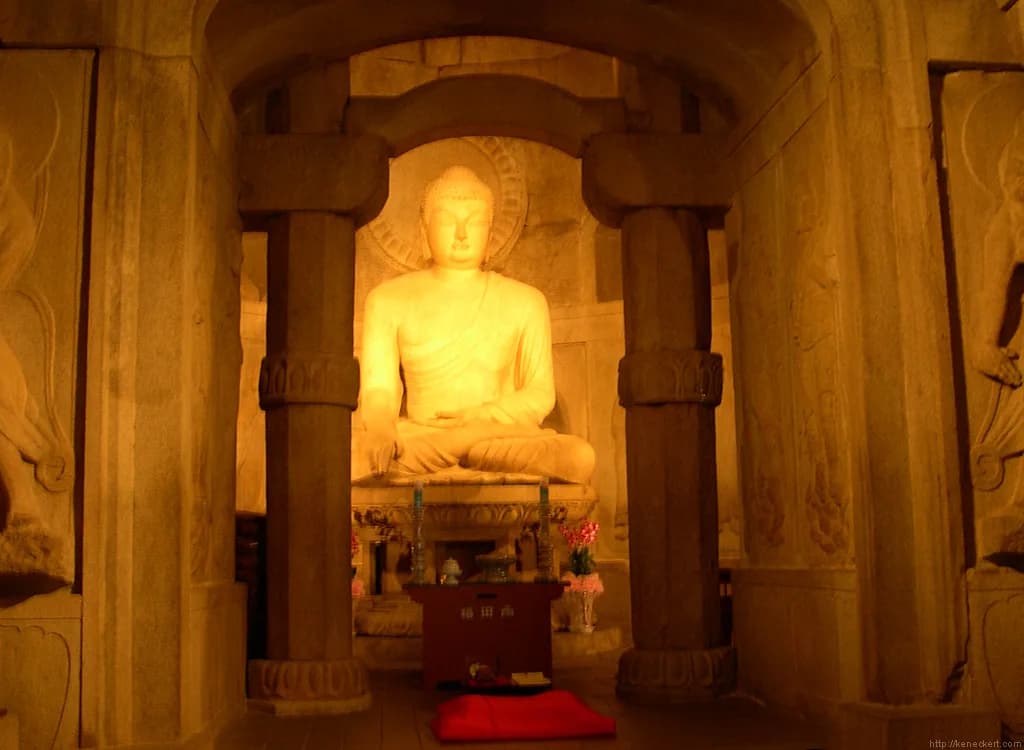
A seated Buddha looks out toward the East Sea from inside a stone chamber on Mount Toham. UNESCO says the domed ceiling of the rotunda and the entrance corridor used more than 360 stone slabs.
The chamber was dismantled and rebuilt in the last century. Specialists still argue about what the builders left us.
The traditional view
UNESCO places Seokguram Grotto and Bulguksa Temple in the 8th century under the Silla Dynasty. It describes the grotto as an artificial structure of granite with an antechamber, a corridor and a main rotunda. It names Prime Minister Kim Dae-seong as the man who "initiated and supervised the construction of the temple and the grotto."
The central figure is a monumental statue of the Sakyamuni Buddha. UNESCO says it faces the sea with the left hand in the mudra of concentration and the right hand in the earth-touching mudra. Devas, bodhisattvas and disciples surround it in high and low relief. UNESCO calls the whole a "masterpiece of East Asian Buddhist Art."
The dates come from a later text. In a translation quoted by the writer Dale Quarrington, the Samguk Yusa says Kim Daeseong began Bulguksa in 751 and died in 774 before it was finished. The state then completed the work. Quarrington notes that the text gives no completion date for the grotto and that scholars disagree about it.
UNESCO also lists the damage. It names moisture and condensation as the most significant threats, with mold, mildew and moss. A concrete dome went up between 1913 and 1915. A second concrete dome followed in the 1960s, with a 1.2 meter air space between the two. A wooden antechamber was added and a wall of glass now seals the interior.
What The Evidence Does Not Settle
In Earthly Enigmas I write that the same long-cycle sky awareness shows up at Stonehenge, Carnac, Callanish and Newgrange. Those sites sit in seven countries not in contact by any route mainstream archaeology accepts. I also write that phi appears in the Great Pyramid, the Parthenon, Angkor Wat, Palenque, Gothic cathedrals and Shinto gates. In the book the ancient builders encoded such ratios in their structures.
The Grotto Behind The Glass
Both views lean on questions the evidence cannot yet answer. Three of them stand out.
What did the builders finish?
UNESCO is direct about the twentieth century. Its authenticity statement says that "as a result of the partial collapse of the rotunda ceiling, the entire grotto was dismantled and rebuilt, and covered with a concrete dome between 1913 and 1915." It adds that these measures "have diminished the authenticity of the form of grotto, and to a lesser extent its materials, although they were acceptable in their time."
It also says the main statue and most of the stone sculptures "preserved their original form." It says the 1913 to 1915 alterations and the later fixes "require further study."
The Kyunghyang Shinmun reported on a 2025 conference in Gyeongju. It writes that several papers argued the grotto we see today "is not the Seokguram completed in 751~774, but a 'modified Seokguram'." The paper ties that change to the repairs of 1958 to 1964. It says seventeenth and eighteenth century visitors described a stone structure covered with earth and mentioned no tiled building.
The 1960s repair team believed a wooden hall had stood in front. The Kyunghyang quotes their 1967 report. It also quotes scholars who say the evidence for the hall does not hold. One example is the Eight Legions reliefs, which the paper says were bent inward before the 1960s and were then set in straight lines. Kim Won-yong objected at the time. The paper quotes him as saying "We cannot straighten the Eight Legions images on inconclusive grounds." The supervising director, Hwang Soo-young, insisted on the straight layout.
UNESCO lists an antechamber as one of the grotto's three parts and also says a wooden antechamber was added. I have not worked out how the two relate.
What did the builders finish?
What was the orientation for?
Quarrington notes that the main Buddha faces east, and that temples in Korea tend to face south. He reports that Japanese-era scholars read the orientation as "following the natural terrain."
He then cites the scholar Nam Cheonu. Nam observed the winter solstice sunrise on December 22, 1969. Quarrington writes that "it was finally confirmed that the orientation of the main Buddha statue inside the Seokguram Grotto aligns with the sunrise azimuth over the East Sea." I have not read Nam's original.
Other scholars offer different reasons. Quarrington reports that Hwang Su-yeong read the east-facing Buddha as protection for Silla and that Nam called much of that thinking speculative. He reports that Kang Woobang links the direction to the Historical Buddha's enlightenment at dawn on the winter solstice, and adds that "more research is needed."
Some web sources I have only seen in search excerpts say first light at the equinoxes reaches the Buddha's forehead. That differs from the winter solstice reading. I have not checked either one.
The Wikipedia article on Seokguram says many historians believe the wooden superstructure now blocks the view of the sunrise over the ocean. That is a secondary source and I have not traced it.
What was the orientation for?
Where did the builders learn it?
The architect Kim Bong-ryeol, a former president of the Korea National University of Arts, wrote in the Korea JoongAng Daily that "no complete prototype comparable to Seokguram can be found anywhere along the Silk Road." He calls the dry stone dome, "assembled without adhesive," unprecedented for its time. He also writes that Korea's hard granite made excavating caves "virtually impossible," and that Seokguram was completed in 774 only after "numerous failed attempts." The paper says the article was translated from Korean with the help of generative AI tools and then edited.
UNESCO calls the dome and corridor construction "innovative."
Chaeshin Yoon and Yongchan Kwon published a study of the design in Buildings in 2025. I could read only the abstract. They write that earlier work relied on "geometric analyses based on irrational numbers, which lack a historical basis." Their own conclusion is that the grotto "follows a proportional system based on integer modules (with 12 cheok as the main module) and binary division." They also write that the designers worked "through an iterative process."
I have not checked which attempts failed or where the iteration took place. Where did the builders learn it?
The questions I can't put down
Some questions need more room than one article gives them. Two of them keep pulling me back.
Who paid for it? The Samguk Yusa names Kim Daeseong. Quarrington reports that the scholar Choi Wansu argues King Gyeongdeok was the patron and that a later king had Kim Daeseong named to erase the earlier line. Quarrington also reports an early eleventh century manuscript fragment from a pagoda at Bulguksa that names Kim Daeseong and predates the Samguk Yusa. I do not discuss Seokguram in the book. I ask who stands behind other monuments in Earthly Enigmas.
Why did the central stone split? The Kyunghyang quotes the Samguk Yusa story of a canopy stone that "suddenly split into three pieces" while it was being dressed. The paper says the canopy over the Buddha, 2.5 meters across, shows three fracture lines. It also says the pieces do not fall, because only compressive forces act at the crown of a dome. You can read a free sample of the book before you decide. The articles section has more subjects in the same format.
Sources
- UNESCO World Heritage Centre: Seokguram Grotto and Bulguksa Temple
- Kyunghyang Shinmun: "Seokguram was originally wet" (news report on the 2025 conference papers; the scholars named in it are not read in the original)
- Kim Bong-ryeol, Where did Seokguram grotto come from? (Korea JoongAng Daily, January 12, 2026) (translated with AI assistance, per the paper)
- Yoon and Kwon, Deconstructing Seokguram Grotto: Revisiting the Schematic Design, Buildings 15 (2025) (abstract only; the full text was blocked)
- Dale Quarrington, The History of the Seokguram Grotto in Gyeongju (secondary; quotes the Samguk Yusa and several Korean scholars)
- Dale Quarrington, The Location and Layout of the Seokguram Grotto in Gyeongju (secondary; quotes Nam Cheonu, Hwang Su-yeong and Kang Woobang)
- Wikipedia: Seokguram (secondary, used only for the sunrise-view point)