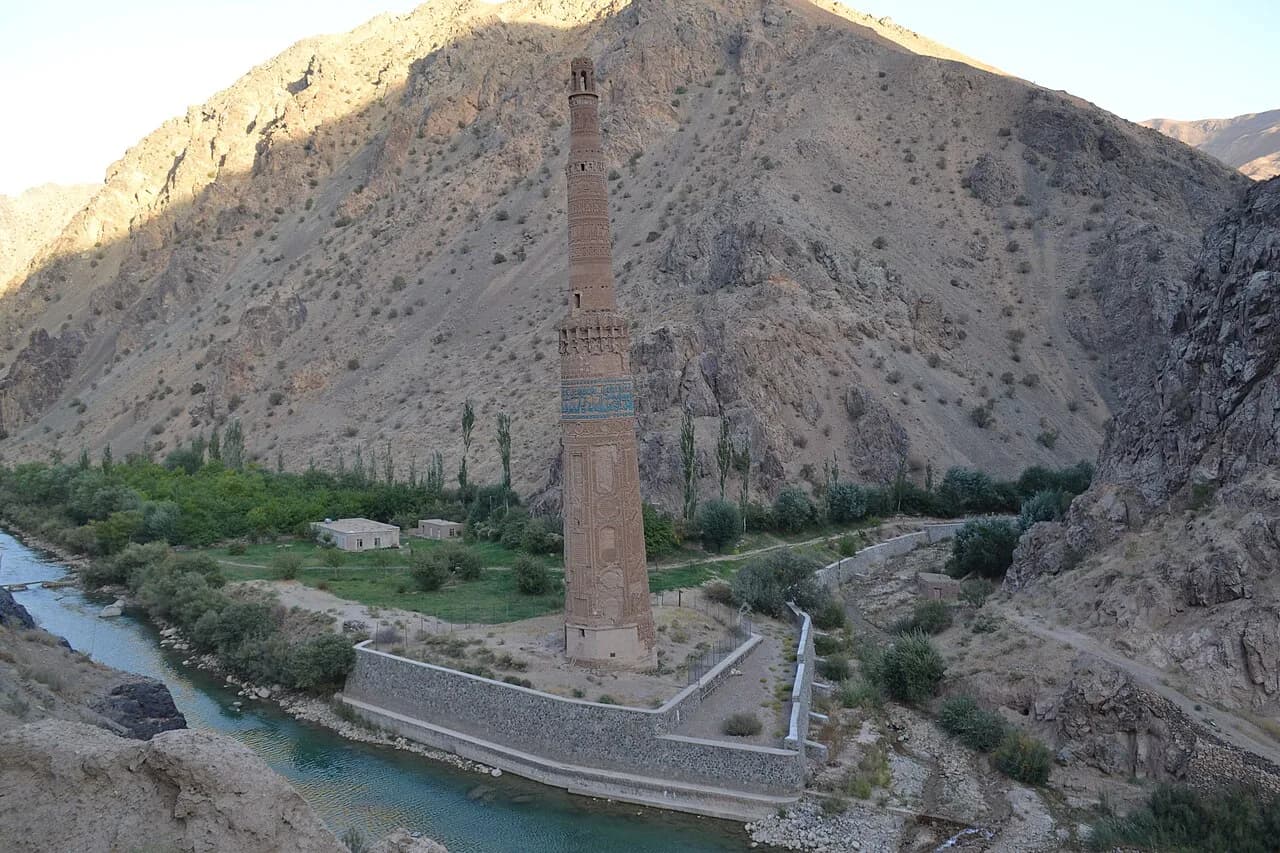
A brick tower rises 65 meters out of a river valley in central Afghanistan. It stands far from any town, at the point where two rivers meet.
How much stood around it, and what the place was, is still being argued.
The traditional view
UNESCO gives the height as 65 meters from a 9 meter octagonal base. It describes four tapering cylindrical shafts of fired brick, covered in geometric decoration with a Kufic inscription in turquoise tiles.
UNESCO adds that the tower was "Built in 1194 by the great Ghurid Sultan Ghiyas-od-din." It says the tower "probably marks the site of the ancient city of Firuzkuh," believed to have been the summer capital of the Ghurid dynasty. UNESCO inscribed the site in 2002 and placed it on the Danger list at once, because of its fragility.
The Ghurids ruled from the mountains of central Afghanistan. The Minaret of Jam Archaeological Project (MJAP) says their dynasty ran from about 1148 to 1222 and that their armies took Delhi in 1192. The Qutb Minar in Delhi is the monument UNESCO names as the tower's most visible echo.
Flood, writing in the Encyclopaedia Iranica, says the tower was reported in the 1880s and first published in depth in 1959. UNESCO says the remains were first documented by archaeologists in 1957.
Floods are the main threat today. UNESCO's 2022 report says seasonal flash floods are "one of the main risks." That year UNESCO supported work in which 60 community members from six villages cleared the riverbeds beside the tower.
What the Valley Has Not Said
What Has Not Been Settled
The tower is documented. The questions below sit around it. Three of them stand out.
Which date is right?
UNESCO writes 1194 and lists the Kufic inscriptions as evidence of "its early dating (1194)."
Flood gives a different account. He writes that the foundation text has been read as both 570 and 590 in the Islamic calendar, which is 1174 to 1175 or 1193 to 1194. He adds that "recent research has confirmed that the former is correct," citing Sourdel-Thomine's 2004 study. I have not read that study. Archaeology magazine also dates the tower to 1174.
A blog by the epigraphy researcher SquareKufic lists further readings of 1165 and 1195 and credits the 1195 reading to Pinder-Wilson. I have not checked that, and I have not seen Pinder-Wilson's own text.
The difference changes what the tower was for. Flood says the earlier date casts "doubt on the oft-cited idea that the monument was erected to commemorate Ghurid victories in India." He suggests it may mark the capture of Ghazna in 1174 instead.
Which reading of the foundation text is right, and what does the answer say the tower was for?
Is this really Firuzkuh?
Flood writes that the tower "is not mentioned in the medieval sources" and that it is "widely believed" to mark Firuzkuh. He notes "objections to this identification," naming a scholar called Leshnik. I have not found those objections.
The chronicler Juzjani says the Friday Mosque of Firuzkuh was destroyed by a flood. In 2005 the MJAP team reported a baked-brick pavement "beneath c. 1.05m of alluvium" beside the tower and called it "possibly the mosque Juzjani refers to." They wrote that Jam is "probably Firuzkuh."
In 2019 David Thomas, the project director, told Archaeology magazine that "layers of mud and gravel had been deposited by floodwater." He said this made it "almost certain the Minaret of Jam was once part of the Firuzkuh mosque." Thomas added that the chronicles mention the mosque but not the minaret.
The wording moves from "possibly" to "almost certain" across the same body of fieldwork. What would turn that into a settled identification?
How big was the city, and how much is left?
Warwick Ball, a former director of the British Institute of Afghan Studies, told Archaeology magazine "Like most, I viewed Jam as an isolated monument." He said Thomas's work "proved conclusively that there was a city, or at least an urban settlement."
That work came from holes that looters had dug. The MJAP 2005 report says the team limited itself to "surface collection and re-excavating robber holes." The team found houses, a kiln, fortification towers and a Jewish cemetery. Thomas says the sultans came only in summer. He adds "We think there were people in residence at the site year-round."
The same magazine says the site "has been inaccessible to researchers since MJAP's initial work." Rory Stewart, quoted by JSTOR Daily, says items from Jam were already on offer in London "described as Seljuk or Persian to conceal their Afghan origin." I have not read Stewart's original.
Thomas says the work "remains the most complete study of any Ghurid center in Afghanistan." What did the capital look like? How much of it was lost before anyone mapped it?
The questions I can't put down
Some questions need more room than one article gives them. Two of them keep pulling me back.
Why is an entire chapter of the Qur'an wrapped around the lowest shaft? Flood writes that the whole of sura 19, Maryam, is inscribed there and that "The form and content of this inscription are unusual." He suggests the verses may have been chosen to promote the doctrine of the Karramiya, a Sunni sect. He also reports an older reading, from Pinder-Wilson, that the verses against idolatry point at the Ghurids' Indian subjects, and he says the re-dating rules that reading out. Archaeology magazine reports that Thomas and others wonder whether a noblewoman commissioned the tower. These are three readings of a sacred text, and I make none of them my own.
Why are there two staircases that never meet? Flood writes that they "do not communicate" and that "the reason for this idiosyncratic arrangement is unclear." In Earthly Enigmas I ask this kind of question about other sites, and you can read a free sample or find the full text in Earthly Enigmas. The articles section has more subjects in the same format.
Sources
- UNESCO World Heritage Centre: Minaret and Archaeological Remains of Jam
- UNESCO: Afghanistan, UNESCO continues to protect the Minaret of Jam with local communities (2022)
- Finbarr Barry Flood, Jam Minaret, Encyclopaedia Iranica (2008)
- Thomas, Pastori and Cucco, The Minaret of Jam Archaeological Project, Antiquity Project Gallery (2005), Internet Archive copy
- Archaeology magazine, Minaret in the Mountains (September/October 2019)
- JSTOR Daily, Afghanistan's Ancient and Beautiful Minaret of Jam (2016) (secondary; used for the Stewart quotation)
- SquareKufic, Minaret of Jam: what it is and why it is important (2014) (blog; secondary)
- Wikipedia (search excerpt) was used only to locate sources. Nothing is quoted from it.