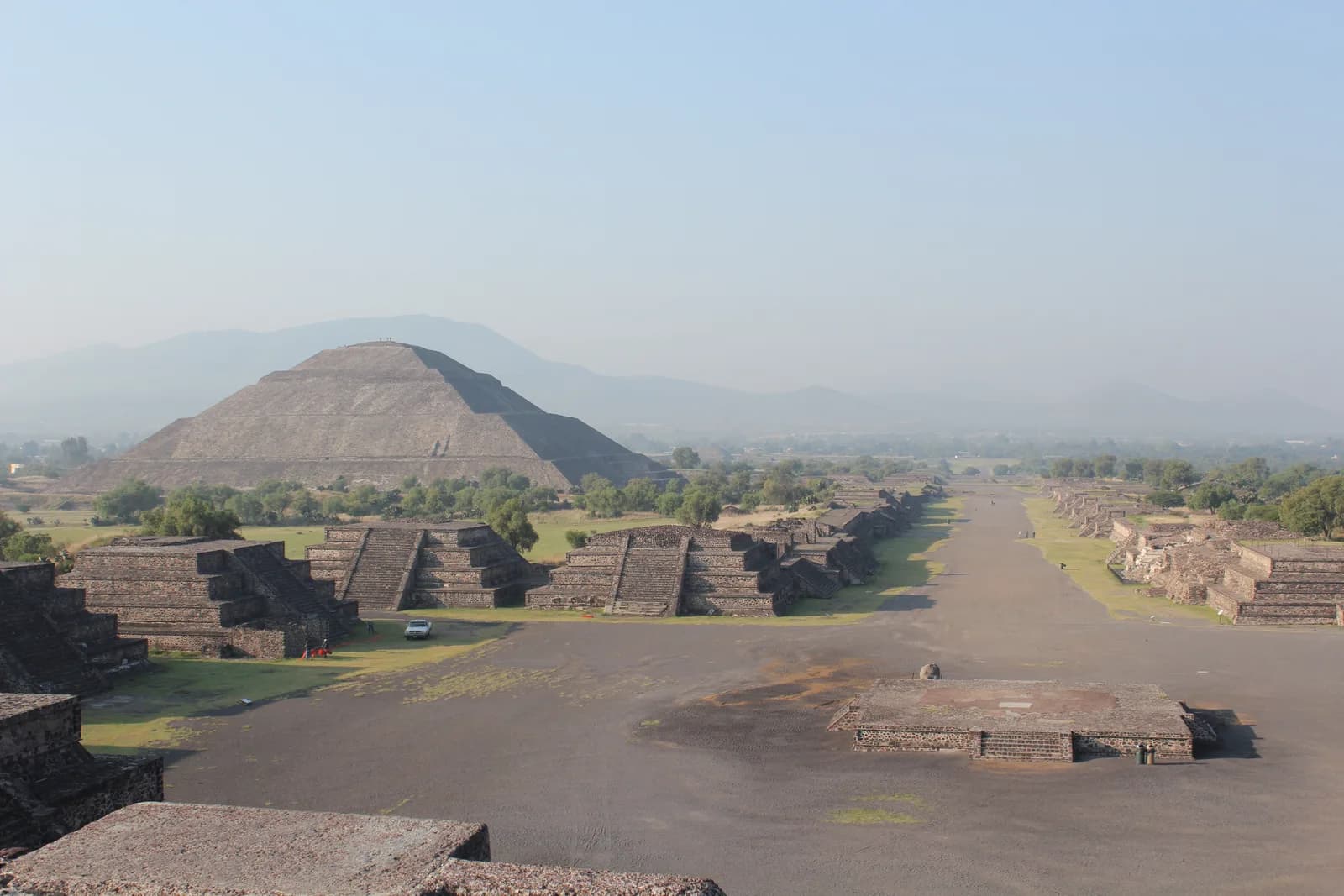
About 50 kilometers northeast of Mexico City a wide avenue runs between two of the largest pyramids in the Americas. The Aztecs found the city in ruins and gave it the name Teotihuacan.
We do not know what the builders called it. We do not know what they called themselves.
The traditional view
UNESCO lists the Pre-Hispanic City of Teotihuacan as built between the 1st and 7th centuries A.D. It says the settlement grew into one of the largest ancient cities in the Americas, with at least 25,000 inhabitants. Smarthistory puts the population at between 125,000 and 200,000 by the 6th century.
UNESCO describes the Avenue of the Dead as a north-south main axis lined with monumental buildings. The Pyramid of the Sun measures 225 by 222 meters at its base and stands 75 meters high. UNESCO adds that in the early twentieth century its discoverer Leopoldo Batres "arbitrarily reconstituted a fifth tier."
Archaeologists treat Teotihuacan as a planned and multiethnic city. The Berkeley Review of Latin American Studies summarizes the work of Linda Manzanilla. It describes migrants from the Valley of Mexico, Oaxaca, Michoacán and Veracruz, and ancient DNA at one neighborhood center that shows all four genetic haplogroups of Mesoamerica.
The Aztecs came much later. UNESCO says the ruins were "imbued with legend" after the city was destroyed and abandoned, and that the Aztec name means "the place where gods were created."
The American Pyramids
In Earthly Enigmas I place Teotihuacan among the American pyramids. I describe a city of about 125,000 people at its peak around 450 CE. I give the Avenue of the Dead as 15.5 degrees east of true north and the Pyramid of the Sun as 65 meters tall.
I write that the builders are unidentified. Who they were and why the city was abandoned remain an open question in the published literature. I put the end of the city at about 550 CE, after widespread burning.
I also write about a tunnel that runs about 100 meters into the bedrock beneath the Pyramid of the Sun. I say it predates the pyramid. The Aztecs arrived about 850 years after the peak, named the city and treated it as sacred.
I describe the proposal that the three main pyramids follow the pattern of the stars in Orion's Belt. I write that the alignment is documented and not disputed. The same pattern is proposed at Giza and, less firmly, at Xi'an in China. That gives three cultures and three pyramid complexes with no documented contact. In the book I allow that coincidence, or the plain prominence of Orion's Belt, are legitimate explanations. You can read more about the Giza side in the article on the pyramids of Giza.
The City Without a Name
Both views lean on questions the evidence cannot yet answer. Three of them stand out.
Who were the builders?
Smarthistory quotes the art historian Lauren Kilroy-Ewbank. "We don't know what language they spoke. We don't know what they called themselves." The same site says the governing system of Teotihuacan "remains largely elusive to scholars."
The Berkeley summary of Manzanilla's work says "To date, the remains of ruling elites have not been identified." It describes a city of neighborhoods with their own identities. It adds that the city may have been co-ruled by the elites of each neighborhood.
The Wikipedia article on Teotihuacan reports that Terrence Kaufman argued in 2001 that an important group in the city spoke a Totonacan or Mixe-Zoquean language. It adds that other scholars favor the Otomi as the largest group. I have not checked either claim in the original.
In the book I describe the identity of the builders as open. Who were the people who built it?
What ended the city?
UNESCO says the city "was razed by fire and subsequently abandoned during the 7th century." Anthony Aveni calls the fall "sudden and inexplicable" and places it in the sixth century. In the book I put the burning at about 550 CE.
A 2025 archaeomagnetic study sampled six burned structures along the Avenue of the Dead. It dates the last heating at those sites to about 400 to 500 AD. That is earlier than the traditional date for the great fire. The authors write that their findings "challenge the prevailing chronological framework."
The same paper recalls Manzanilla's sequence of burning, abandonment by the original inhabitants and later looting. The Berkeley summary adds that Manzanilla suggests the intermediate elite revolted against the rulers.
The dates run from the fifth century to the seventh. What ended the city?
What was the city lined up with?
Ivan Šprajc reports the measurements of the archaeologist Dow. The Pyramid of the Sun, the Avenue of the Dead and most buildings in the central area show "a clockwise deviation of about 15°25′ with respect to the cardinal directions." I have not checked the rest of that paper.
Aveni proposes that the Pleiades setting over the western horizon set the orientation of the whole city. He adds that excavations at the Pyramid of the Moon show the orientation was "established in stone as early as the third century bc." Šprajc argues that the pyramid's east-west axis pointed to sunrise on four dates of the tropical year.
The Orion reading has its own supporters. Robin Heyworth writes on the Uncovered History site that "the alignment at both sites clearly reflects the alignment of the three stars of Orion's Belt." Mark Carlotto tested the idea in a 2021 working paper. He concludes that "a correlation between the belt stars in Orion and the layout of Teotihuacan seems even less likely" than the one at Giza.
In the book I wrote that the alignment is not disputed. Carlotto disputes that claim in his paper. What was the city lined up with?
The questions I can't put down
Some questions need more room than one article gives them. Two of them keep pulling me back.
What is under the Pyramid of the Sun? UNESCO lists the cave under the pyramid among the spectacular discoveries of research since 1962. Smarthistory says the pyramid was built over a cave. Šprajc reports the archaeologist Barba's view that no natural process could account for a cavity on that spot. In the book I write that a tunnel runs about 100 meters into the bedrock and predates the pyramid. I have not checked that. I follow the tunnel through Earthly Enigmas.
What did the Aztecs know? Smarthistory says the Aztecs "had no contact with this earlier culture." The same page says much of our knowledge of the site "is derived from Aztec sources." Aveni quotes the Spanish chronicler Sahagún, who recorded the Aztec account that "giants still lived there then." In the book I note that the Aztecs treated the city as sacred centuries after its fall. You can read a free sample before you decide. The articles section has more subjects in the same format.
Sources
- UNESCO World Heritage Centre: Pre-Hispanic City of Teotihuacan
- Smarthistory: Teotihuacan
- Berkeley Review of Latin American Studies: Teotihuacan, A Multiethnic Metropolis (2015)
- Arreola Romero et al., Fire Along the Street of the Dead, Quaternary 8 (2025)
- Anthony Aveni, Bringing the Sky Down to Earth, History Today (2008)
- Ivan Šprajc, Astronomical Alignments at Teotihuacan, Mexico
- Robin Heyworth, Teotihuacan: The Pyramid of the Sun and the Orion Mystery
- Mark Carlotto, As Above, So Below: Testing Archaeo-Astronomical Correlations (2021 working paper)
- Wikipedia: Teotihuacan (secondary, for the Kaufman and Otomi points only)