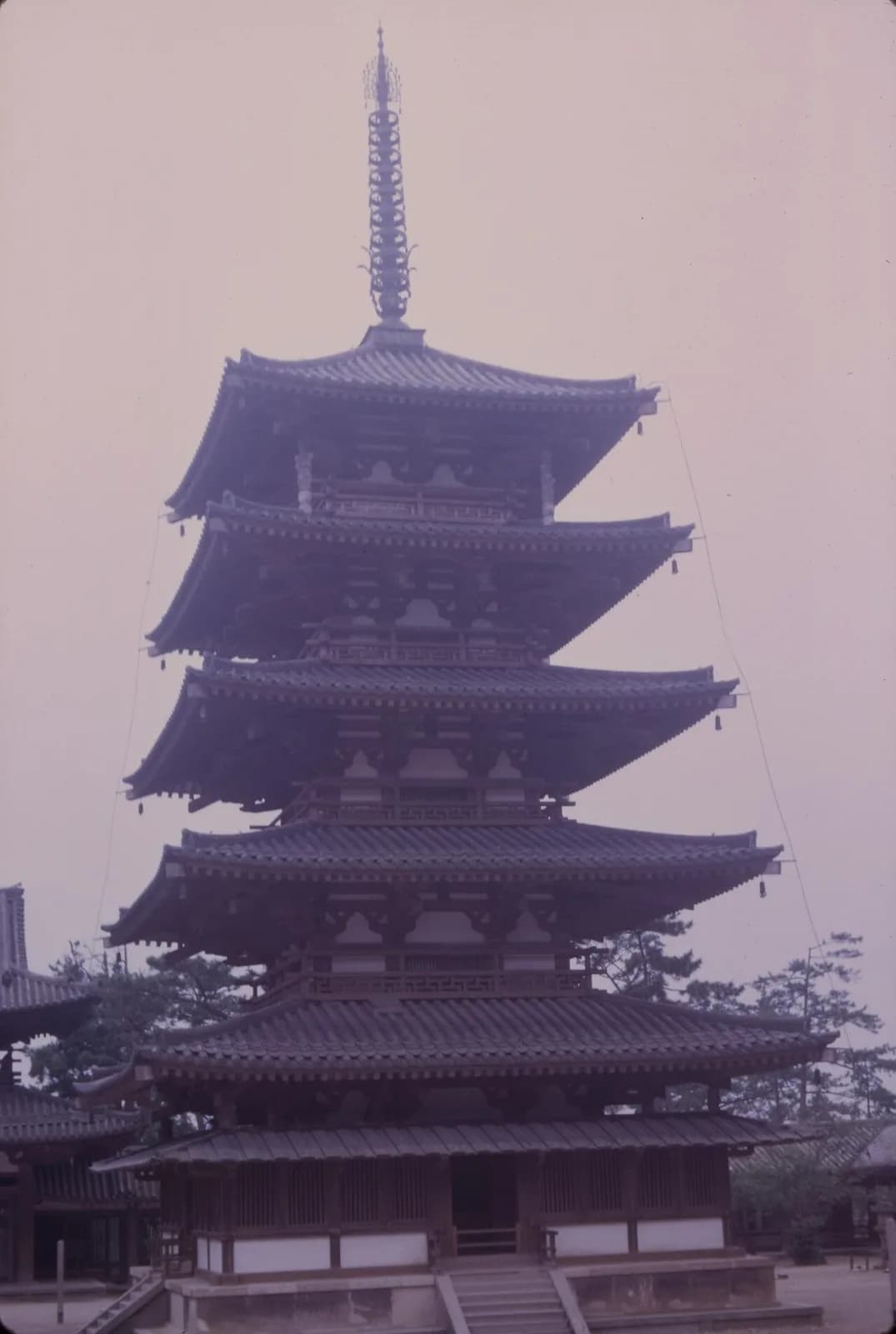
The five-story pagoda at Hōryū-ji rises about 32.5 meters above its base. The temple says its central pillar is a Japanese cypress that was felled in 594.
The temple's own history page says a fire in 670 left no building standing. Both statements sit on the same website.
The traditional view
UNESCO lists 48 ancient wooden structures in the Buddhist Monuments in the Horyu-ji Area. It says eleven of them date from the late seventh or eighth century, which makes them some of the oldest surviving wooden buildings in the world.
UNESCO adds that a fire destroyed the original Hōryū-ji buildings in 670. It says structural remains survive below ground in the precinct known as Wakakusa Garan. It says rebuilding began almost immediately and continued into the early years of the eighth century.
The temple's history page says the Nihon Shoki records a blaze on the night of April 30, 670 that left "not a single building" standing. The same page says historians in the latter part of the nineteenth century began to question whether the fire truly occurred. It adds that many questions remain unanswered to this day.
Web Japan lists the grounds for the rebuilding theory. The Nihon Shoki says the temple was burnt down. The old temple site, with signs of fire, was found in the 1930s about 100 meters southeast of the present western precinct. The Nara institute dates the roof tiles of the present buildings to the latter half of the seventh century and later. Web Japan adds that none date from an earlier period.
Web Japan says the generally held date for the rebuilding is around 711. Nakahara and colleagues write that the pagoda "was rebuilt around A.D. 711 after the original one was lost in a fire." The temple says the tower was raised to enshrine relics of the Buddha. It says the flexible wooden joints help the tower absorb the seismic energy of Japan's frequent earthquakes.
The same engineers report that no pagoda has suffered serious earthquake damage. They write that even in the Great Hanshin-Awaji Earthquake there were no reports of serious damage to wooden pagodas in Hyogo, Kyoto and Nara.
UNESCO describes the conservation work done since 1895 as meeting the highest standards. It says damaged wooden members are carefully replaced only when absolutely necessary.
What the Dates Leave Open
In February 2001 the Nara National Research Institute for Cultural Properties announced a date for the central pillar. Web Japan reports that X-ray photography combined with tree-ring dating "had established that the wood came from a tree felled in 594."
The institute's tree-ring specialist Takumi Mitsutani describes the sample in a short report in Japanese. The translation here is mine. The lower part of the pillar had rotted. During the dismantling repair of the 1940s workers cut off the base and spliced on new timber. The cut end gave a disk about 10 centimeters thick.
Mitsutani counted 351 rings and matched them to the cypress reference pattern with a t value of 11.7. The last ring fell in the year 591. He found three more rings farther out, which gave 594. He read the sapwood as nearly complete, so he took 594 to be the year the tree was cut.
He writes that the date makes the pillar about 100 years older than the accepted view of the present temple. He says the effect on archaeology, architectural history, art history and documentary history will be large.
Web Japan reports two explanations offered by archaeologists and others. One is that the pillar came from another temple and was reused here. The other is that the timber was stored unused for a long time.
Where the Accounts Do Not Meet
Both views lean on questions the evidence cannot yet answer. Three of them stand out.
Which date belongs to the pagoda?
UNESCO gives the late seventh or early eighth century. Nakahara and colleagues give about 711. The temple gives 594 for the pillar and 607 for the founding of the first temple.
An earlier summary from the same institute reached a different reading of the pillar. It says the pillar "had been extensively modified from the original tree trunk by largely removing the exterior portion and the central portion." It adds that it would be unlikely that only the outermost twenty rings were removed. It concludes that the pagoda was very unlikely to have been built around 610. I do not know the year of that summary, which was written before the X-ray work found the sapwood.
The same summary describes an earlier tree-ring reading by Hideo Nishioka, who concluded that the pillar was cut before 607. It says later scholars regarded his work as "hasty and imprecise." Mitsutani calls the method problematic and still significant.
Is the date of the wood the date of the tower?
What keeps it standing?
Nakahara and colleagues list researchers who each point to a different cause. Muto pointed to friction in the joints. Ishida described the center column as a bolt that fastens the whole structure. Ueda described each story as a balancing toy. Omori proposed that the center column and the main frame act as a compound pendulum.
The authors modeled seven effects together in a two-dimensional elastic frame, using the north-south record of the 1995 Kobe earthquake. Each effect alone left the sway above the collapse limit they set. All seven together cut the maximum response to 56 percent of a rigid frame and kept it under that limit.
They also write that the most effective factor "may be the efforts of the faithful who have preserved the structure for such a long period of 1,300 years." Their paper is one model of one pagoda.
Which of these effects does the work?
How much of it is original?
UNESCO says the Hōryū-ji monuments keep "a high level of authenticity" in form, materials, traditions and setting. It says that from 1934 onward the conservation work has included interventions involving dismantling and reconstruction.
Web Japan says the pagoda was dismantled for repair from 1943 to 1954, while Mitsutani gives 1941 to 1952. Both agree that this work removed a disk from the pillar. Mitsutani says the rotted base of the pillar was cut away and replaced with new timber.
According to the Wikipedia article on Hōryū-ji, about fifteen to twenty percent of the seventh century material remains in the main hall after its restoration. That figure covers the main hall and I have not checked it in the original.
How much of the standing tower is the material of its first builders?
The questions I can't put down
Some questions need more room than one article gives them. Two of them keep pulling me back.
Who carries the knowledge? The Cabinet Office of Japan profiled master carpenter Mitsuo Ogawa, the sole apprentice of Tsunekazu Nishioka, who descends from the craftsmen who oversaw Hōryū-ji. Ogawa says he spent 27 years with Nishioka and that his master "never taught me anything directly." In the book I describe oral tradition as a technology and I follow a chain of knowledge carried forward after the burial at Göbekli Tepe. I follow that question through Earthly Enigmas.
How should we read a record with no collapses? Fujita and colleagues write in an abstract that timber pagodas are believed to have high seismic performance because no document records one destroyed by an earthquake. I have only read the abstract. The Wikipedia article on the 1934 Muroto typhoon says a five-story pagoda at Shitennō-ji collapsed in that storm. I have not checked that. In the global network chapter I write that earthquake resistance does not require encoding pi. You can read a free sample before you decide. The articles section has more subjects in the same format.
Sources
- UNESCO World Heritage Centre: Buddhist Monuments in the Horyu-ji Area
- Horyuji Temple: Introduction (A Brief History of Horyuji)
- Horyuji Temple: Five-storied Pagoda
- Web Japan, Trends in Japan: 100 Years Older Than Supposed? (March 29, 2001)
- Mitsutani Takumi, 法隆寺五重塔心柱の年輪年代 (Nara National Research Institute for Cultural Properties, 2001, in Japanese)
- Nara National Research Institute for Cultural Properties: Monograph No. 48, Reading the Past in Tree Rings (English summary)
- Nakahara, Hisatoku, Nagase and Takahashi, Earthquake Response of Ancient Five-Story Pagoda Structure of Horyu-ji Temple in Japan (World Conference on Earthquake Engineering)
- Fujita, Hanazato and Sakamoto, Earthquake response monitoring and seismic performance of five-storied timber pagoda (2004, abstract only)
- Cabinet Office of Japan, Highlighting Japan (November 2018): A Life Dedicated to Wood and Community
- Wikipedia: Hōryū-ji (secondary, for the main hall figure only)
- Wikipedia: 1934 Muroto typhoon (secondary, search excerpt only)