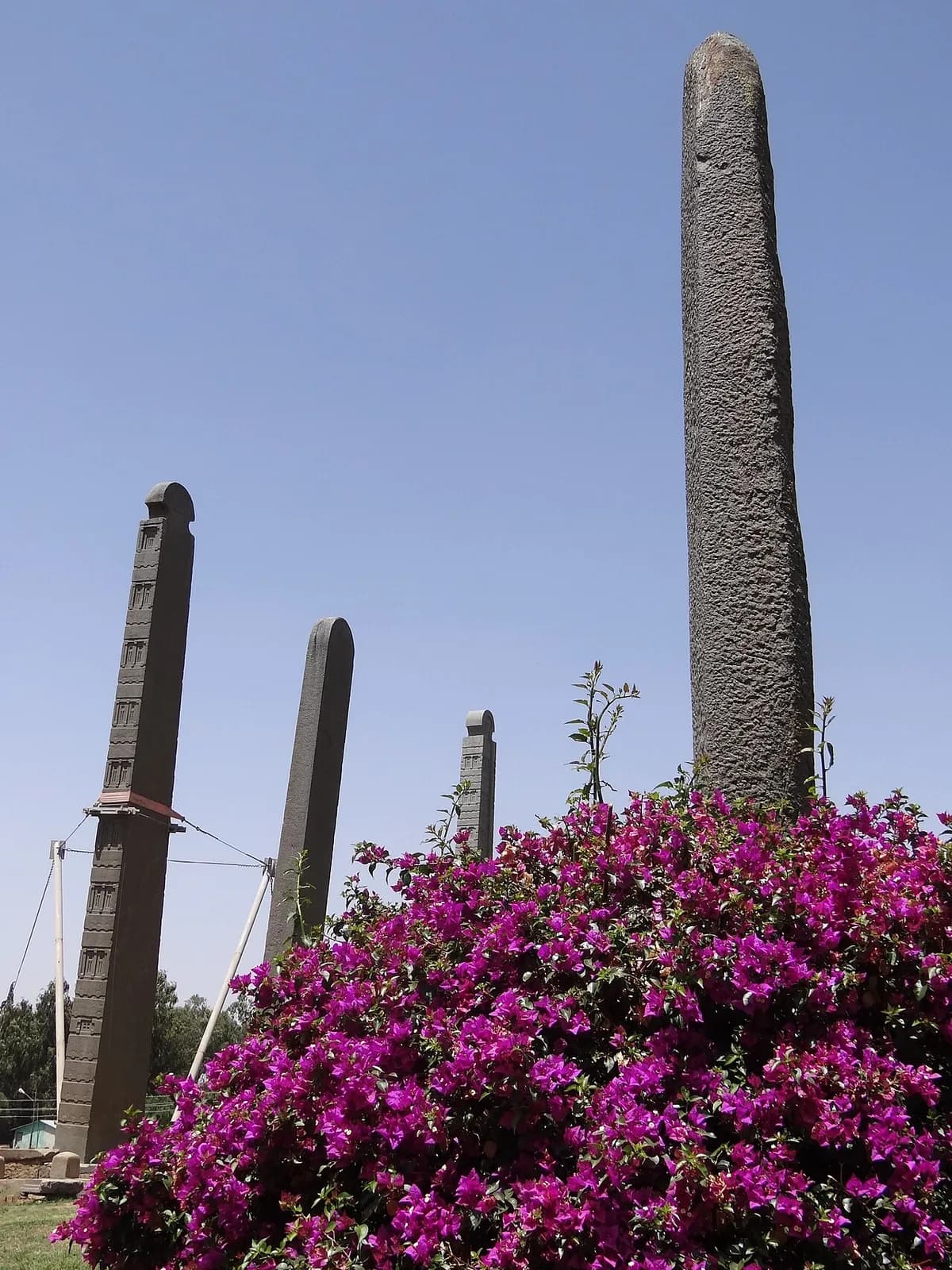
Stela 1 at Aksum is about 33 meters long and weighs about 520 tonnes. It lies broken on the ground where it fell.
Its face is carved like a thirteen-story house, with a door at the base and rows of windows above. Every door and window sits in low relief on a solid block of stone. Who tried to raise it, and what went wrong?
The traditional view
UNESCO places the stelae in the third and fourth centuries AD, inside a kingdom that lasted from the first to the eighth century. It says the largest stela "lies where it fell, perhaps during the process of erection." It adds that this stela is "possibly the largest monolithic stele that ancient human beings ever attempted to erect."
David Phillipson, who directed British excavations at Aksum in the 1990s, describes the stelae in Foundations of an African Civilisation. He writes that the largest were carved in imitation of multi-storeyed buildings from nepheline syenite, a granite-like rock. The quarries lie about 4 km west of central Aksum. He puts the weights at about 160 tonnes for Stela 3, 170 tonnes for Stela 2 and 520 tonnes for Stela 1.
Phillipson reads these stelae as markers of elaborate tombs. He writes that royal attributions for the largest "seem highly probable." The Metropolitan Museum of Art essay on the stelae agrees that the tallest "probably commemorated royalty."
Phillipson writes that the blocks were separated from the quarry rock with iron tools, most probably with wedges. He notes that the closest known parallels for this technology come from Roman Egypt, while most other Aksumite architecture shows only a general affinity with that region.
Stela 2 has the best known modern story. UNESCO says it was taken to Rome as a war trophy during the Italian occupation, returned to Aksum in 2005 and re-erected in 2008. The Metropolitan Museum essay calls these stelae the last of such a scale dedicated at Aksum.
What the Evidence Does Not Settle
In Earthly Enigmas I do not discuss Aksum. Two parts of the book bear on it.
In Chapter 4 I look at the largest stones people have moved. I write that the logistics of moving the 570-ton Western Stone at the Temple Mount have not been demonstrated. In "The Dating Game" I explain that stone cannot be radiocarbon dated, so organic material found near it is dated instead. I write that the inference is "frequently wrong."
Aksum has a 520-ton stone, a quarry that has been identified and a date that rests on objects found near the stone. The Göbekli Tepe pillars article looks at another set of quarried and carved stones.
Where the Accounts Part Ways
Both views lean on questions the evidence has not settled. Three of them stand out.
Who brought the giants down?
Phillipson writes that for Stela 1 "it appears that it fell and broke during the attempt to erect it." He credits the idea to Van Beek. He adds that the apex shattered against Nefas Mawcha, another megalithic tomb that was still unfinished. He also notes that the carved door handle on the exposed face was neatly removed. He writes that this "may have been intended to cancel the stela's symbolism in some way."
Bertrand Poissonnier, who led the 1999 excavation at the foot of Stela 2, disagrees. He calls the arguments for a failed erection "rather unconvincing." Stela 1 fell in line with the direction of its erection, and no base plates survive beneath it. He reads this as a stela that stood and was pulled down, and he writes that the evidence points to "a destructive motivation, whether political or religious."
The two also disagree about Stela 2. Phillipson writes that it "had been intentionally undermined to make it collapse." He notes widespread traditions that Queen Gudit cast down stelae about the tenth century and writes that the archaeology "is not incompatible with this." Poissonnier writes that the fall "was the accidental consequence of the sap made at the base by the thieves." He says a coin issued about 600 AD, found at the edge of the thieves' disturbance, may indicate the date of the fall.
A 2026 paper by Belay Sitotaw Goshu in the Polit Journal names a third possibility, seismic activity. It cites Slejko and Cavallin for the claim that earthquakes likely toppled some Aksumite obelisks. I have not checked that.
Which of these falls was an accident and which was a decision?
Why carve a tower nobody ever built?
Phillipson writes in a footnote that Aksumite buildings seem never to have exceeded two or three storeys. He adds that there "is absolutely no evidence that buildings with between six and thirteen storeys, as represented by the Aksum stelae, were ever erected." The Metropolitan Museum essay agrees that actual buildings "probably never exceeded a maximum of three stories." It also says many details on the stelae are regarded as accurate representations of the architecture of the time.
Poissonnier offers a different comparison. He sees a connection that earlier writers had not made. It links the storeyed stelae to some "extremely old and unfortunately poorly dated" defensive towers in the Asir highlands of southwest Saudi Arabia. He writes that the analogies are striking, down to a door identical to those on the stelae and a vertical projection that protects it. He asks, "Were the stelae erected close to the graves also intended to protect them?"
What building was the stone meant to be?
How do you stand up 520 tonnes?
Phillipson describes a method reconstructed from the fallen Stela 4 and other monuments. A ramp is built, a socket is dug and lined with slabs, and the stela is tipped into it. Stones are packed around the base and baseplates are added.
Poissonnier proposes something else. He writes that "we have no direct evidence for the operation" and that no trace of a ramp has been found. His excavation showed that Stela 2 stood on a deep masonry foundation topped by a footing slab. He argues that the stela was raised from ground level, supported by a podium about 2.80 m high, and not tipped into a pit.
He points to Roman accounts from the same century. Ammianus Marcellinus describes the obelisk raised in the Circus Maximus in 357 AD, a stone of 460 to 510 tonnes by modern estimate, drawn up on tall beams and ropes while "many thousand men turned wheels." Poissonnier writes that "We do not know the methods by which they were transported" to Aksum. He says he has experimentally raised more than 150 monoliths himself. I have not checked that.
Which method can the ground confirm, and could either one have raised the stone that did not stand?
The questions I can't put down
Some questions need more room than one article gives them. Two of them keep pulling me back.
Why are there no names? Phillipson finds it remarkable that Aksumite society was literate at this time. He writes that "no inscriptions have been found associated with any of these tombs or stelae to indicate the names of those who were buried there." In Chapter 4 I make a similar point about the Temple Mount foundation, where I write that no inscription or construction record is known. I follow that question through Earthly Enigmas.
How do we know the date? Poissonnier writes that the great storeyed stelae "are dated indirectly" to the third or fourth century. He says charcoal from the foundation of Stela 2 "could not be radiocarbon dated" and was later lost. Phillipson reports a radiocarbon sample from the Mausoleum beside Stela 1 that supports a date around the middle of the fourth century. In "The Dating Game" I set out why a date taken from objects near a stone deserves care. You can read a free sample of the book before you decide. The articles section has more subjects in the same format.
Sources
- UNESCO World Heritage Centre: Aksum
- Metropolitan Museum of Art, Heilbrunn Timeline of Art History: The Monumental Stelae of Aksum (3rd to 4th Century)
- Bertrand Poissonnier, The Giant Stelae of Aksum in the Light of the 1999 Excavations (Palethnologie de l'Afrique 4, 2012)
- David W. Phillipson, Foundations of an African Civilisation: Aksum and the Northern Horn, 1000 BC to AD 1300 (James Currey, 2012), chapters 4, 12 and 13
- Belay Sitotaw Goshu, Collapse and Continuity in the Kingdom of Aksum (Polit Journal, 2026)