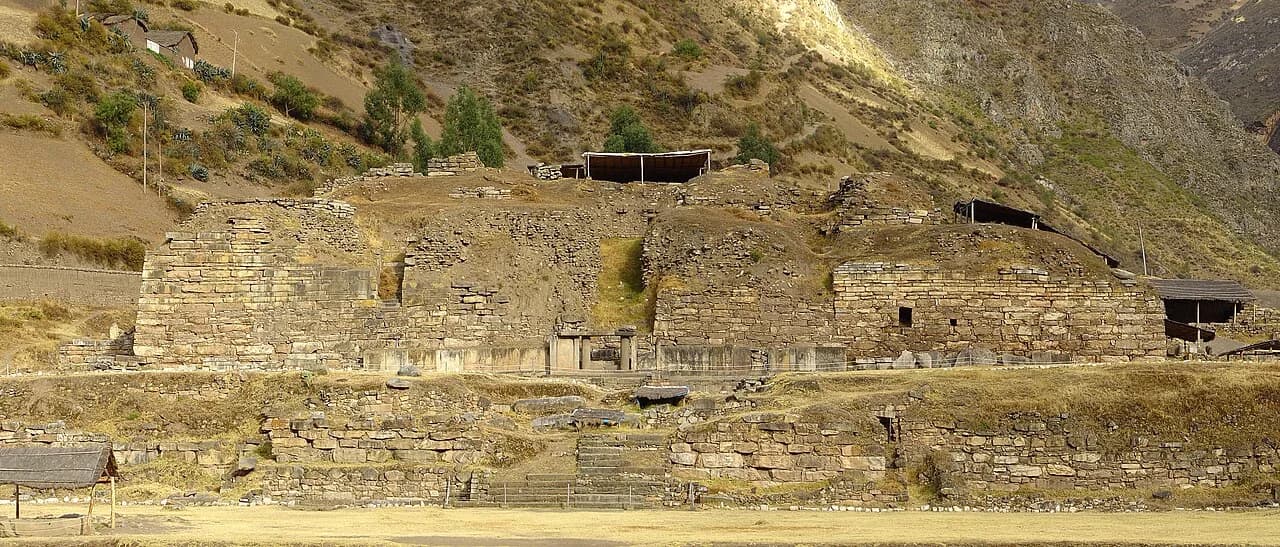
A granite figure about 4.5 meters tall stands in a cross-shaped room inside a temple in the Peruvian Andes. It has upturned eyes, fangs and snakes for hair.
A narrow duct leads from the level of its carved mouth to the stairs of a sunken plaza outside. Researchers have measured what that duct does to sound.
The traditional view
UNESCO says the culture that takes its name from Chavín developed between the 15th and the 5th century BC in a high valley of the Peruvian Andes. It calls the site a ceremonial and pilgrimage center that hosted people from different latitudes, distances and languages.
UNESCO describes an internal gallery system with a network of vents and drains that it calls unprecedented in South America. Miriam Kolar has led acoustics research at the site since 2008. She and her coauthors describe an architectural nucleus of organized stone-and-earth fill that encloses kilometers of passageways.
Jeffrey Quilter writes in his textbook on the ancient central Andes that the fill was carefully laid stone. It was then covered with fine masonry, so the fill was never seen once the construction was complete.
John Rick of Stanford has directed research at Chavín since the mid-1990s. His 2005 chapter argues that an "apparent highly planned ritual context" shows very intentional strategies in the making of early politico-religious organization. Stanford Magazine quotes him as saying that the evidence of sensory manipulation "could hardly be coincidence."
The same magazine report quotes Rick calling the galleries "complex and costly construction with no obvious function." UNESCO adds that the 1945 flood partially buried the site and that a major earthquake struck in 1970. It says landslides have affected the galleries, drains and vents.
What the Galleries Leave Open
In Earthly Enigmas I write that history books treat the ancient world as a series of isolated experiments. I argue that precision stonework, astronomical alignments and sacred proportions recur in cultures with no documented contact, and I call that a network.
In Chapter 5 I list acoustics among the shared features that have nothing to do with structural necessity. I give no example of the acoustics in those pages.
The acoustics at Chavín have been measured with instruments. The measurements come from a team based at Stanford.
What Has Not Been Settled
Both views lean on questions the evidence cannot yet answer. Three of them stand out.
Were the galleries built to carry sound?
Kolar writes that Luis G. Lumbreras first presented the possibility of acoustic intention in the architecture, in his 1974 excavation report. In a 1976 test his team poured two 200-liter cylinders of water through a canal under the stairs of the Circular Plaza. Observers described the sound as "a crowd applauding," in Kolar's translation.
Kolar measured the three ducts that run from the Lanzón Gallery to the Circular Plaza. The central duct is about 4.5 meters long. It narrows from an opening about 33 by 40 centimeters inside to one about 12 by 8.5 centimeters at the plaza. She writes that its tapering is "exceptional" among the site's ventilation shafts.
All three ducts emphasized frequencies between 100 and 400 hertz by more than 10 to 20 decibels above the rest of the audible spectrum. The measured tones of the conch shell horns found at the site run from about 272 to 340 hertz. Kolar and her coauthors write that "these ducts could have been amplifiers for the Chavín pututus." They also write that the ducts may have been built for horn sound, "not excluding the likelihood of their simultaneous functionality as air and light conduits."
Rick's later project report says Chavín specialized in the "manipulation of sound in acoustically designed situations." Kolar writes in a magazine essay that the link between ducts and horns is "difficult to dismiss as coincidence." In the same essay she writes that "it is difficult to prove that Chavín's ancient architects designed their buildings with sensory effects in mind."
The 2012 paper says the architecture of the Lanzón Gallery changed several times during construction. It says an upper level and additional ducts existed in prior construction. It also says the ancient acoustics of the Circular Plaza cannot be accurately understood from tests today and need computational modeling. It adds that site iconography does not specifically link gallery spaces with horn performance.
Dates add a second layer. Kembel and Haas report that the overwhelming majority of Chavín's characteristic elements developed between about 1200 and 800 BC. They say this includes the physical design of the ritual systems in its galleries and plazas. Kolar's 2021 abstract places the excavated horns in contexts associated with the mid-millennium BCE and the Circular Plaza. Her 2012 paper reports handling wear that suggests the horns were used over generations. I have not seen a paper that sets the horn dates beside the duct dates.
Were the galleries built to carry sound? A model tied to one dated building phase would test the claim.
When did Chavín begin?
The published ranges differ. UNESCO places the culture between the 15th and the 5th century BC. Rick's 2005 chapter covers the later Initial Period and the Early Horizon, which it puts at approximately 1300 to 600 BC. A 2005 Stanford Magazine report said his team believed construction ended shortly after 800 BC.
Kembel and Haas report 32 new radiocarbon dates from charcoal in the architectural mortar. They find that building largely happened between about 1200 and 800 calibrated years BC, with massive construction from about 1000 to 800. Thirteen of the 15 known architectural phases fall in that span. They put the whole sequence at about 1200 to 500 calBC and call it notably different than previously proposed ranges.
Richard Burger dated animal bone from his 1975 excavations in the settlement. He gives 950 to 800 calBC for the Urabarriu phase, 800 to 700 for Chakinani and 700 to 400 for Janabarriu. He writes that the site was established around 950 calBC and abandoned by 400 calBC.
His abstract says the results "cast doubt on some current interpretations of the site's founding and cultural apogee." I have read only the abstract. Kembel and Haas dated charcoal in the temple mortar and Burger dated bone from the town.
When did Chavín begin, and how long did it take to build? More dates from sealed contexts in both the temple and the settlement would help.
Where did the ideas come from?
Kolar writes that Julio C. Tello introduced Chavín as the "Mother Culture" of Andean civilization. She adds that "such a tidy origin myth cannot account for the strong identities of other monumental sites" whose images appear on ritual objects found at Chavín. Quilter notes that Rafael Larco Hoyle was arguing at the same time for the key role of coastal cultures.
Burger's abstract says his new dates fit the earlier hypothesis that the major developments at Chavín largely postdate the Initial Period fluorescence of early coastal civilization. The Smarthistory essay by Sarahh Scher says the cultural expressions found at Chavín can be seen as coming into their full force there. It adds that they most likely did not originate in that place.
UNESCO calls Chavín one of the earliest pre-Columbian sites. It calls Caral, on the coast, the oldest center of civilization in the Americas. It says the platform mounds, sunken circular courts and urban plan of Caral influenced nearby settlements and then a large part of the Peruvian coast. Chavín has a sunken Circular Plaza of its own that Kolar gives as about 20 meters across.
Where did the ideas at Chavín come from? Dated precursors for the temple form, the horns and the art style would help.
The questions I can't put down
Some questions need more room than one article gives them. Two of them keep pulling me back.
Was the temple built to watch the sky? Rick's 2008 chapter has an aerial photograph captioned with a Southern Hemisphere summer solstice alignment to the nearby hill from the Circular Plaza area of the early axis. The caption says the later axis points to the same hill. Quilter repeats the alignment and adds that a 20-ton altar has circular depressions that may represent the Pleiades. He credits that point to Lumbreras and I have not checked it. In Chapter 5 I follow the same sky across distant sites. I follow the question through Earthly Enigmas.
Does Chavín belong to a larger pattern? James Q. Jacobs writes on his personal website that "Chavin's precise latitude placement alone implies Chavin was an astronomical observatory." He reports distances and angles between Chavín and sites as far apart as Giza and the Newark Earthworks. He reads them as the golden ratio, pi and lunar cycles. The page is not peer reviewed. I have not checked his arithmetic and I have not seen a published reply. In Chapter 5 I follow a different pattern, Jim Alison's great circle through 17 ancient sites. You can read a free sample before you decide. The Puma Punku article looks at Andean stonework at another site. The articles section has more subjects in the same format.
Sources
- UNESCO World Heritage Centre: Chavín (Archaeological Site)
- UNESCO World Heritage Centre: Sacred City of Caral-Supe
- Kolar with Rick, Cook and Abel, Ancient Pututus Contextualized: Integrative Archaeoacoustics at Chavín de Huántar, Perú (Flower World, Vol. 1, 2012)
- Miriam Kolar, The Code of the Conch (Nautilus)
- Chavín de Huántar Archaeological Acoustics Project: publications (Stanford CCRMA)
- Kembel and Haas, Radiocarbon Dates from the Monumental Architecture at Chavín de Huántar, Perú (Journal of Archaeological Method and Theory, 2015) (abstract only)
- Richard L. Burger, Understanding the Socioeconomic Trajectory of Chavín de Huántar (Latin American Antiquity, 2019) (abstract only)
- John Rick, The Evolution of Authority and Power at Chavín de Huántar, Peru (2005) (abstract and figure captions only)
- John Rick, Context, Construction, and Ritual in the Development of Authority at Chavín de Huántar (2008) (figure captions only)
- John Rick, Evidence for Innovation in Pre-State Religious Systems: Research at Ancient Chavín de Huántar (RIHA project report)
- Stanford Magazine: What Lies Beneath (2005)
- Smarthistory: Chavín de Huántar
- Jeffrey Quilter, The Ancient Central Andes (Routledge World Archaeology)
- James Q. Jacobs: Chavin de Huantar Archaeogeodesy (personal website)