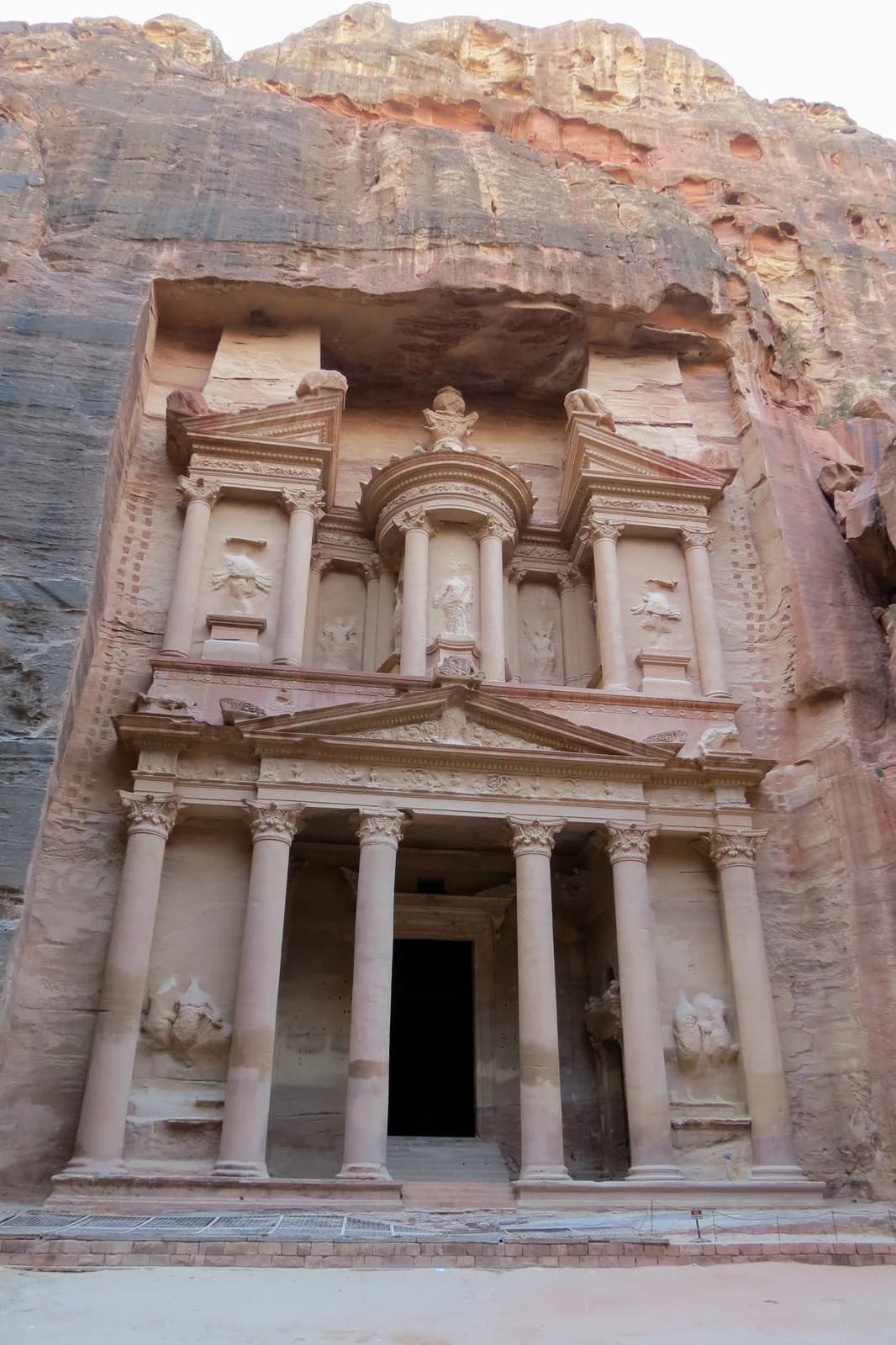
At the end of a narrow canyon called the Siq, a carved face opens in the cliff. Jordan's Petra Development and Tourism Region Authority gives its height as approximately 39.5 meters, carved directly into a massive block of pink sandstone.
The authority says the name comes from a legend. A king or pharaoh was said to have hidden treasure in the urn on top. Archaeologists have noted numerous bullet marks on that urn, left by people trying to break it open.
The traditional view
Jane Taylor, writing for the American Center of Research, puts it plainly. She says the Treasury "was never a treasury." She reads the carved figures on the façade as funerary symbols and writes "All are funerary symbols."
UNESCO lists the Treasury among what it calls the "so-called 'royal tombs' in Petra." It describes the rock-cut buildings as "temple/tombs." The same entry says an "ingenious water management system" allowed settlement in an arid area.
The authority gives the date as 60 BC to AD 50. It says the interior is "relatively simple," a single large chamber without the rich carving of the front. Taylor says the monument is now dated to the 1st century AD, "most likely in the reign of the great builder-king Aretas IV (9 BC–AD 40)."
The strongest recent evidence came from the courtyard. Taylor writes that the ground in front of the Treasury stands 4 to 6 meters above the Nabataean level. In 2003 the Jordanian Department of Antiquities uncovered earlier rock-cut tombs there. Taylor says some of the artifacts in them "provided an answer to the previously thorny problem of the Treasury's age."
Nabil Khairy gives the same reading in his abstract. He argues that the Khazneh is a tomb, carved during the reign of Aretas IV.
What Sits Beneath the Façade
In Earthly Enigmas I take up the question of what ancient monuments were for. In Chapter 5 I describe the structures on the global network as "not tombs" and as markers. That line is about the sites on the network.
The Treasury raises the same kind of question from a different side. The building has a funerary reading, a ritual reading and a practical reading, and the courtyard under it holds burials.
What the Treasury Leaves Open
Both views lean on questions the evidence cannot yet answer. Three of them stand out.
What was it for?
The authority itself lists several answers. It says "Some researchers suggest that Al-Khazneh served as a royal tomb for one of the Nabataean kings, possibly King Aretas IV, while others believe it functioned as a ritual building or a place for religious ceremonies or record keeping."
Other researchers add to the list. Juan Antonio Belmonte and colleagues call it "the most controversial" of the monuments in their study. They suggest that even if it was the tomb of a king, "it might have acted as a sort of sanctuary" where the protector of the city was venerated.
Daniele Manacorda wrote a 2024 chapter whose abstract reads "One of the most famous monuments of Petra is considered by questioning its nature as a sepulchral monument, generally accepted." He cites the historian Michael Rostovtzeff, who thought it was a temple and not a mausoleum. By my translation, Manacorda says the dilemma Rostovtzeff posed cannot be called definitively resolved.
Manacorda goes further and proposes that caravans paid customs duty in the front hall. He calls this a supposition and says he cannot use the word conviction. Taylor and Khairy read the same façade as a tomb.
Manacorda also notes that the Dioscuri on the façade can be read as guides for travelers and as guarantors of weights and measures. Taylor reads the same figures as guides of the dead. He adds that stone sarcophagi are largely absent from the burials of Petra, and he sets that beside an older view that the niches inside were meant to hold them. He takes both points from other authors and I have not read them.
Farajat and Nawafleh read the front as a place of offering. They write that "It is likely that they paused to make offerings or libations to the deceased notable Nabataean figure before proceeding into the city."
What was it for?
How old is it?
The sources give different dates. The authority says 60 BC to AD 50. Taylor says the 1st century AD and most likely Aretas IV, who ruled from 9 BC to AD 40. Khairy also gives Aretas IV.
Khaled Al-Bashaireh and Gregory Hodgins write about the neighboring temple Qasr el-Bint. They call the Khazneh "recently dated to the late years of Aretas IV or later." They also write that Petra monuments are hard to date because "typically they lack written inscriptions."
Manacorda says the dating has long oscillated. He says it is now mostly fixed between the end of the 1st century BC and the first decades of the next. The earlier tombs under the courtyard supply a date for their own burials only. The 2025 report on the 2005 season describes one grave in tomb 62C with pottery "dating to the second half of the first century BC until the first century AD." That pottery sits in a grave under the building, not in the façade itself.
In 2024 the American Center of Research and its Jordanian partners took samples from the tomb in front of the Treasury for optically stimulated luminescence dating, DNA and radiocarbon dating. The center says the results "will be published in the future." It says the luminescence dating is helping to establish "multiple periods of use and multiple instances of reuse of the site."
I do not know of a result that dates the façade directly. What would a direct date for the carving look like?
Why does it sit on top of earlier tombs?
The Treasury was carved into the cliff above a set of older tombs. Taylor writes that their "upper carvings had been hacked off and they had evidently been decommissioned when the grand scheme of carving a magnificent new funerary monument was begun."
Suleiman Farajat and Sami Nawafleh, who excavated the courtyard, write that the second floors of three of the tombs "were removed to highlight the feature of the Treasury." They add that the first floor and chamber of a fourth tomb "were completely eliminated." They report that "The site was used as a quarry" for the courtyard paving and the drainage works.
They also describe the façade of tomb 62C as not completed, "probably due to the carving of al-Khazna and changes to the plans." The chamber behind it held burials. The 2025 report records at least 11 individuals in tomb 62C, which had been looted.
The same report says the chamber "was originally either designed as a biclinum (a celebration hall or seating area), but it was later adapted for use as a tomb, or it was unfinished, left uncarved." The authors describe a stone bench in the west wall that was partly removed when the room became a burial space.
The remote sensing survey of 2024 found more. The American Center of Research team writes that "potentially a third row of ancient structures lies under the Treasury's façade and courtyard." I have not seen a published confirmation.
The Biblical Archaeology Society reports an open question from the 2024 work. Were the tombs an earlier phase of the mortuary complex, or was the Khazneh "built as a feasting hall to remember the dead buried in the tombs below?" It also reports that Megan Perry, who has excavated at Petra for more than twenty years, was disappointed that the 2024 excavation "did not follow best practices in the discipline of bioarchaeology." ACOR separately posted its sources and noted that television coverage may miss important details.
How do the tombs and the façade relate?
The questions I can't put down
Some questions need more room than one article gives them. Two of them keep pulling me back.
Does the Treasury face anything? Belmonte and colleagues measured the orientation of about fifty Nabataean sacred buildings. They found that the cliff leaves only a small section of sky at about 18 degrees of angular height from the inner sanctuary, "thus breaking any solar alignment." They add that "it is possible that lunar events could be compatible with the orientation and layout of the internal structure and the external decoration of the monument." They write that this, "provided it could be proven in the future, would reinforce the sanctuary nature of the building." In the book I take up whether the alignments at ancient sites were intentional or coincidental, under the heading The Same Sky, Everywhere. I follow that question through Earthly Enigmas.
How did a monument at the mouth of a flood channel survive the floods? Taylor says flash floods raised the ground in front of the Treasury by 4 to 6 meters. UNESCO says the flood diversion system must be continually monitored and repaired. Farajat and Nawafleh describe a hidden water system under the courtyard. In the book I follow builders who prepared for catastrophe, in a section called The Architects of Survival. The Hegra article looks at the unfinished Nabataean tomb at Qasr al-Farid, including the debate over how façades were carved. You can read a free sample before you decide. The articles section has more subjects in the same format.
Sources
- Petra Development and Tourism Region Authority: Al-Khazneh (The Treasury)
- UNESCO World Heritage Centre: Petra
- Jane Taylor, My Petra (ACOR Jordan, 2020) (a photo essay by a writer and photographer, not an excavation report)
- Farajat and Nawafleh, The Excavations of the Al-Khazna Courtyard in Petra, Jordan, Second Season 2005 (Jordan Journal for History and Archaeology 19, 2025)
- Farajat and Nawafleh, Report on the Al-Khazna Courtyard Excavation at Petra (2003 Season), Annual of the Department of Antiquities of Jordan 49 (2005) (scanned pages; I did not read it, and the 2003 findings above come from Taylor and later papers)
- Bala'awi and colleagues, Remote Sensing at the Treasury in Petra (ACOR Newsletter 36.1, 2024)
- Creasman, Shining New Light on Petra's Treasury (ACOR Newsletter 37.1, 2025)
- ACOR Jordan: Petra Expedition Unknown Episodes, Learn More
- Biblical Archaeology Society: New Tomb Found at Petra (2024) (journalism)
- Daniele Manacorda, A proposito del Khazneh al-Faroun (Florentia, Firenze University Press, 2024; in Italian, CC BY 4.0) (the English abstract is quoted; other passages are my translation)
- Belmonte, Gonzalez-Garcia and Polcaro, Light and Shadows over Petra (Nexus Network Journal, 2013)
- Al-Bashaireh and Hodgins, The Chronology of Qasr el-Bint, Petra (Palestine Exploration Quarterly, 2014) (abstract only, read through the OpenAlex record)
- Nabil Khairy, The Mada'in Saleh Monuments and the Function and Date of the Khazneh in Petra (Palestine Exploration Quarterly, 2011) (abstract only, read through the OpenAlex record)
- Wikipedia: Al-Khazneh (used only to locate the Khairy paper; no fact is taken from it)