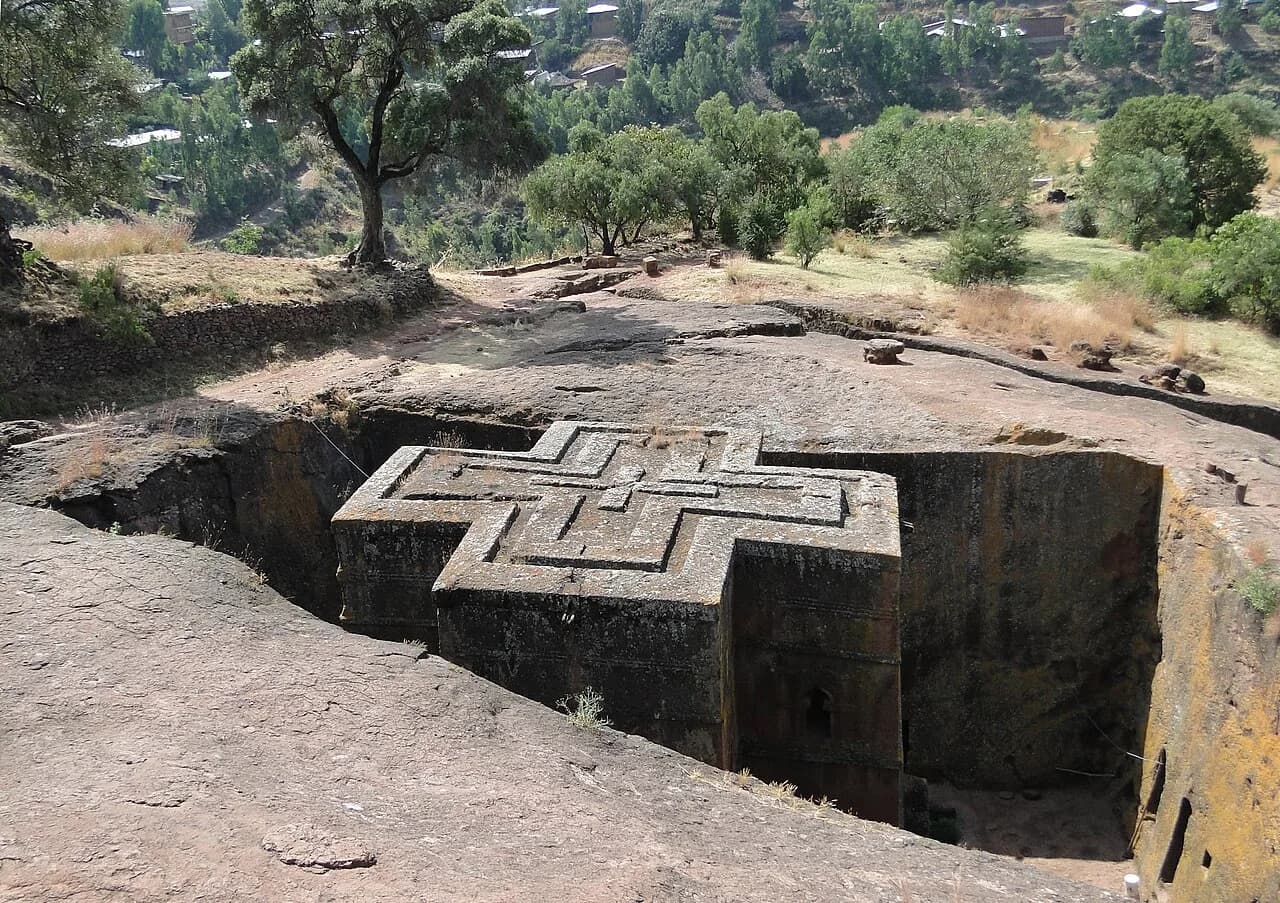
At Lalibela some of the churches have a door or a stairway that leads nowhere. A CNRS News report on the French and Ethiopian research team says some churches have "a door or stairway leading nowhere, showing that the original structure disappeared."
The churches were cut downward into one mass of red volcanic rock. Eleven of them are on the World Heritage list and every one is still a place of worship. Which cuts belong to which builders?
The traditional view
UNESCO inscribed the site in 1978. It describes eleven medieval monolithic churches and says their building is "attributed to King Lalibela who set out to construct in the 12th century a 'New Jerusalem', after Muslim conquests halted Christian pilgrimages to the holy Land."
UNESCO says the churches "were not constructed in a traditional way but rather were hewn from the living rock of monolithic blocks." It adds that the work was completed with "an extensive system of drainage ditches, trenches and ceremonial passages." It calls Biete Medhani Alem "believed to be the largest monolithic church in the world."
The tradition inside Ethiopia tells it differently. The ICOMOS evaluation for the 1978 nomination records that the king's legendary Life says he was taken up to heaven as a young man. In my translation from the French, "God showed him great houses made of a single stone." God then gave him the task of bringing forth similar ones from the earth. CBS News reported in a 60 Minutes segment that the faithful of the Ethiopian Orthodox Church say the churches were built by angels.
Claire Bosc-Tiessé and Marie-Laure Derat have led a French and Ethiopian research mission at the site. In a 2014 paper in the Journal of African Archaeology they and their colleagues describe "a group of rock-cut churches attributed to the sovereign of the same name, King Lalibela, who we know to have reigned in the late 12th century and in the first third of the 13th century." I have read only the abstract.
Rémy Chapoulie and colleagues describe the site as "a vast outcrop of basaltic slag from which churches were carved." They call the reddish rock "particularly suitable for carving."
The churches are also a working place of worship. UNESCO says Lalibela is "a living site which draws many pilgrims to celebrate the great feasts of the Ethiopian Christian calendar." A 2018 UNESCO, ICOMOS and ICCROM mission report says the Orthodox Church is the owner of the property.
The same report says four shelters were completed over five of the churches in 2008 as temporary protection. It says the local community "state unequivocally that they are not willing to accept these shelters 'any longer.'" It also says that under the covered churches "the completely dry environment has led to significant crumbling of the rock."
What the Evidence Does Not Settle
In Earthly Enigmas I do not discuss Lalibela. Two parts of the book bear on it.
In Chapter 4 I look at the Temple Mount foundation. I write that no inscription or construction record is known for the lower courses. I also write that the logistics of moving the 570-ton Western Stone "have not been demonstrated." In "The Dating Game" I explain that stone cannot be radiocarbon dated, so organic material found near it is dated instead. I write that the inference is "frequently wrong."
Bosc-Tiessé says the surviving archives at Lalibela "never discuss construction work." CNRS reports that the rock does not allow the buildings to be dated. The Aksum's Stelae article looks at another set of carved stones in the same country.
Where the Accounts Part Ways
Both views lean on questions the evidence has not settled. Three of them stand out.
Was it one plan or many?
François-Xavier Fauvelle-Aymar and colleagues open a 2010 paper in Antiquity with a question. They ask whether the churches "belong to one grand ceremonial monastic plan, or a long-lived ritual centre, continually refashioned over time." They write that in the cuts, the spoil heaps and the vanished sediments "the stratigraphic sequence is there to be read." I have read only the abstract because the paper is behind a paywall.
David Phillipson reads the same site from its joins. In a 2009 article for the British Academy he uses the word hypogean for churches hewn from solid rock. He writes that "Because the Lalibela hypogea form interconnecting complexes, it is possible to establish their chronological relationships."
He says two of them, "significantly older than the others, were not originally churches, but served a basically defensive function and were connected by an underground tunnel." He concludes that the creation of the hypogea "extended over a lengthy period, probably lasting several centuries." The last major phase, he writes, "may be attributed to the reign of King Lalibela."
Phillipson adds that the traditions are correct in attributing the complex "in its present form and symbolism" to the king. He says they "do not, when literally interpreted, take account of the fact that much of the complex had originated in earlier times."
The ICOMOS evaluation said something close in 1978. In my translation it states that "Not all of these churches are contemporary with the holy king Lalibela (13th century)." It names Biet Mercoreos and Biet Gabriel Rafael as "perhaps former royal residences" and says that "most were conceived from the outset as churches and date from the 13th century."
The French team traces occupation of the site to the tenth century. CNRS quotes Derat as saying "A powerful elite occupied the site around the 10th century, building substantial infrastructure." Excavated rubble held "traces that predate the 13th century," including "animal remains, as well as traces of hearths and ceramics, both signs of domestic occupation."
Derat adds that in the 13th century Lalibela began "transforming some buildings into churches and carving out new ones." The 2014 abstract describes "a long occupation sequence spanning at least eleven centuries (from the 10th to the 21st century)." A 2021 paper in Antiquity by Derat, Bosc-Tiessé and colleagues says that "the rock-cut churches were not created ex nihilo."
The sources also differ on the dynasty. Phillipson writes that "It is well established that Zagwe rule came to an end c. 1270, but evidence for its start is difficult to interpret." He adds that "Most historians have retained the view that it began early in the 12th century" but that his research leads him "to support the alternative of an inception in the 10th century and a 300-year duration."
Which cuts belong to which hands?
What were the trenches for?
UNESCO says the work includes "an extensive system of drainage ditches, trenches and ceremonial passages." It also says "The drainage ditches were filled up with earth for several centuries, before being cleared in the 20th century."
The 2018 mission report says of the ditch system that "its original purpose and function are still not comprehensively researched." It adds that "According to archaeological findings, there are indications that it has also served other purposes such as for defence or as a water reservoir."
A figure caption in the same report says "The function of this system is not fully investigated and understood. Its complete excavation has been suggested in previous reports, resulting in the creation of cavities that capture water in some areas instead of draining it."
Fasil Giorghis, an Ethiopian architect and historian, told CBS that Saint Mary's "was built starting from outside" and then dug downward. The trench that freed each church had to exist first. Chapoulie and colleagues write that digging let water into the rock mass and also protected the monuments from standing water. They call this "a very paradoxical situation in which water plays an alternately positive and negative role."
Were the trenches dug to free the churches, to drain them, to defend them or to hold water?
Was the New Jerusalem a replacement or a response?
UNESCO says that "The King of Lalibela set out to build a symbol of the holy land, when pilgrimages to it were rendered impossible by the historical situation." In Biet Golgotha, it says, "are replicas of the tomb of Christ, and of Adam, and the crib of the Nativity."
Phillipson agrees that the site's names point to Jerusalem. He writes that "Many features of the Lalibela landscape, including some of the hypogea, bear names linking them to places at and near Jerusalem that would have been visited by Ethiopian pilgrims." He also writes that Jerusalem was conquered by Salah ad-Din during Lalibela's reign. He calls this "an event which may have given rise to the fear – unjustified, as it actually transpired – that visits by Christian pilgrims would be curtailed, thus prompting the need for an Ethiopian alternative."
UNESCO says pilgrimages were halted. Phillipson says the fear proved unjustified. The legendary Life, as the ICOMOS evaluation reports it, gives a third reason in a divine commission.
An online essay on African History Extra argues that medieval Christian societies often built a small Jerusalem for reasons of local politics and that blocked pilgrimage is an unlikely cause. It cites other scholars and I have not checked them.
Was the New Jerusalem a replacement for a lost pilgrimage or a response to the fear of losing one?
The questions I can't put down
Some questions need more room than one article gives them. Two of them keep pulling me back.
Where does the twenty-four-year figure come from? An early European description is by Francisco Álvares, a chaplain with the Portuguese embassy of 1520 to 1527. He wrote "They told me that the works of these churches were done in twenty-four years, and that this is written." He also swore "that all that is written is the truth, and there is much more than what I have written."
Álvares records being told that the work was done by Gibetas, whom he glosses as white men. None of the modern sources I read repeats that and I have not checked who he meant. In Chapter 4 I ask how and by whom the Temple Mount foundation was built, because I find no construction record for it. I follow that question through Earthly Enigmas.
What does the date rest on? CNRS reports that "Since the rock does not allow for dating the buildings, research has concentrated on all other available traces, including an important body of manuscripts, paintings, and various objects found in churches." One of them is a small portable wooden altar with a dedication in Ge'ez from Lalibela himself.
The 2014 paper asks "How is it possible to write its history without excavation?" Phillipson notes that at churches still in use "Intrusive investigations or destructive analyses are very rarely permissible." In "The Dating Game" I set out how dating by nearby material works and where I say it goes wrong. It does lay out the method. You can read a free sample before you decide. The articles section has more subjects in the same format.
Sources
- UNESCO World Heritage Centre: Rock-Hewn Churches, Lalibela
- ICOMOS Advisory Body Evaluation, Lalibela (1978, in French)
- Report of the UNESCO/ICOMOS/ICCROM Advisory Mission to Rock-Hewn Churches, Lalibela, 20-25 May 2018
- David W. Phillipson, Ancient Ethiopian Churches in Historical Perspective (British Academy Review 14, 2009)
- Francis Lecompte, In Ethiopia, Lalibela's Mysteries (CNRS News, 2019)
- Fauvelle-Aymar et al., Rock-cut stratigraphy: sequencing the Lalibela churches (Antiquity 84, 2010) (abstract only)
- Bosc-Tiessé et al., The Lalibela Rock Hewn Site and its Landscape (Journal of African Archaeology 12, 2014) (abstract only)
- Derat et al., The rock-cut churches of Lalibela and the cave church of Washa Mika'el (Antiquity 95, 2021) (abstract only)
- Chapoulie et al., Le rôle paradoxal de l'eau à Lalibela (Restauro Archeologico, 2022) (English abstract only)
- Francisco Álvares, Narrative of the Portuguese Embassy to Abyssinia during the years 1520-1527 (Hakluyt Society, 1881)
- CBS News, 60 Minutes: Lalibela (transcript)
- African History Extra: Constructing a global Monument in Africa (secondary)