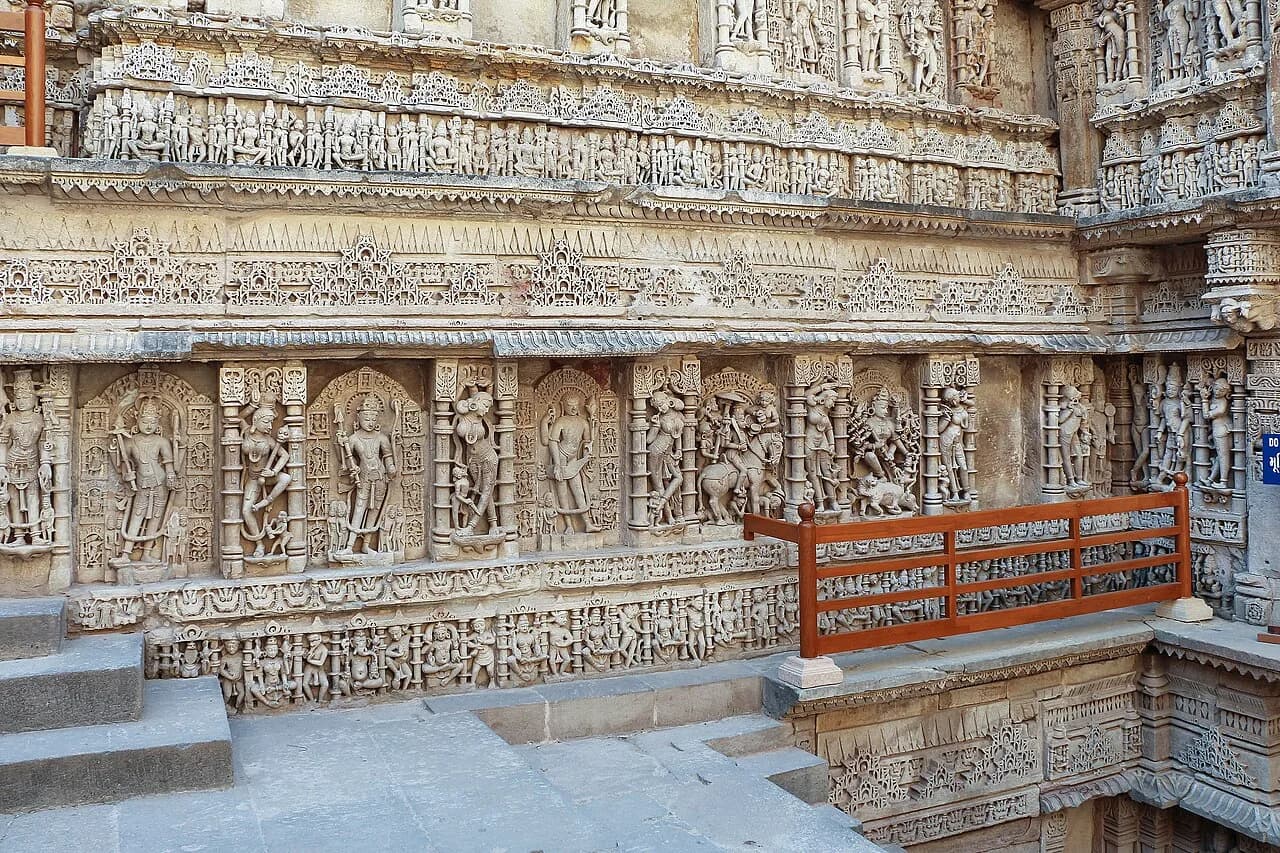
The ground at Patan is flat. The plain opens into a stairway that runs down seven levels to a tank 23 meters below the surface.
Two surveyors described the site in a report published in 1903. They wrote that nothing was left of the stepwell "except a huge pit." UNESCO now counts more than 500 principal sculptures there.
The traditional view
UNESCO added Rani-ki-Vav (the Queen's Stepwell) at Patan, Gujarat to the World Heritage List in 2014. It says the stepwell "was initially built as a memorial to a king in the 11th century AD." It calls the design "an inverted temple highlighting the sanctity of water."
The stepwell has seven levels of stairs with sculptural panels. UNESCO says the fourth level is the deepest and leads into a rectangular tank of 9.5 meters by 9.4 meters at a depth of 23 meters. The well itself is a shaft 10 meters across and 30 meters deep.
ICOMOS advised the World Heritage Committee on the nomination. It counts 292 carved pillars in the stepped corridor and says 226 remain. It says the stepwell "initially included more than 800 sculpted panels of which approximately 400 survive." Vishnu "by far outnumbers the other gods" among the figures in about 400 niches.
The builder comes from a chronicle. The Prabandhacintamani was compiled by the Jain monk Merutunga around 1304. In C.H. Tawney's 1901 translation it says king Bhima "began to reign in 1077 V.S. and reigned forty-two years, ten months, and nine days." The next sentence says "His queen, named Udayamati, caused to be made in Pattana a new reservoir, surpassing even the Sahasralinga lake."
Kirit Mankodi wrote the monograph on the monument. In an overview for Sahapedia he reads that sentence as this stepwell and writes that it was built "as a memorial to her husband, the Solanki king Bhīmadeva I."
ICOMOS says the stepwell was silted over after a change in the course of the Saraswati River in the 13th century. Repair began in 1937 and most of the silt was removed in the 1980s. Conservation work was completed in 2008.
What Stays Open
In Earthly Enigmas I do not write about Rani-ki-Vav. The book does look at the coast of the same state. In Chapters 3 and 10 I describe the sonar survey in the Gulf of Khambhat and write that without excavation we cannot know what is there. In Chapter 10 I also write that the builders of Göbekli Tepe buried it themselves. In Chapter 5 I place the Indus Valley planned cities inside the argument about a global network.
The Burial, the Builder and the Order
Both views lean on questions the evidence cannot yet answer. Three of them stand out.
What buried the well, and when?
UNESCO says the stepwell stopped working as a well after "geotectonic changes in the 13th century" moved the bed of the Saraswati. It adds that "the silting of the flood caused during this historic event" allowed the "exceptional preservation of Rani-ki-Vav for over seven centuries."
ICOMOS says the upper stories of the pavilions were lost "likely in an earlier massive earthquake." It says 19th-century travelers found the whole site "indiscernible due to the layers of silt" apart from the well shaft.
Mankodi gives a longer account. He writes of "repeated flooding of the Sarasvati River" that brought down the upper parts and left "heavy deposits of sand." He adds that in the early 19th century the owner of the land had pillars and parts of the fallen upper stories carted away. They went into a new stepwell in Patan.
Burgess and Cousens described the ruin in 1903. They write that every stone of the walls and pillars "has been dug out and carried off." They describe a pit 285 feet long with "a pool of stagnant water" at the well end. They compare it with a sketch made seventy or eighty years earlier and see "no great change" apart from further silting of the pool.
T. Lakshmi Priya writes in a 2010 paper that other floods "gradually silted up the entire well." I have read only the abstract.
ICOMOS itself says "little information has been provided to understand the historic geographic conditions" around the site.
The official account gives one event and more than seven centuries under silt. The other accounts give repeated floods, stone carried away and an open pit in the 1890s. They may all be true. The published material I found does not show how they fit together.
What buried Rani-ki-Vav, and when?
What do the sources record about why she built it?
UNESCO calls the stepwell a memorial. In Tawney's English the sentence about Udayamati has no date and no mention of a memorial. It calls the work a reservoir. I have not checked the Sanskrit. The same translation names "Karna's mother Udayamati" in a story set after Karna's coronation, so she outlived her husband.
Mankodi sets the building beside other memorial wells. An inscription from Mandasor records a well dug in 532 CE in memory of an uncle. An inscription from Vasantgarh records a widowed queen who renovated a stepwell in 1042 CE after her husband died. Mankodi is careful about the imagery. He writes "If the Ran-ki-Vav was indeed a commemorative structure" and then proposes that the many images of Parvati's penance "may have had symbolic significance."
A marble portrait of the queen carries the inscription "Mahārājñī Śrī Udayamati." Mankodi dates the sculpture and the writing to the 13th century. He says an unknown donor installed it sometime after the well was dug.
Burgess and Cousens say the stepwell "is said to have been constructed under the auspices of Udayamati." They compare the one pillar fragment they saw with the columns of the Vimala temple on Mount Abu, which they date to 1032. They see nothing to prevent the two being "coupled in date" and accept the traditional date "in the absence of conflicting evidence."
Mankodi writes that Merutunga places the building after Bhima's death in 1064. In one article he puts it in the third quarter of the 11th century. In another he says the style places it "squarely in the last years of the 11th century." Lakshmi Priya's abstract says construction began in 1063 and probably took ten to twenty years.
Wikipedia, which I used only to find sources, says it is disputed whether she was a dowager when she commissioned it. I have not checked that in an original.
What do the sources record about why she built it?
How much of the order of the sculptures is the builders' order?
Where a figure stands along the descent seems like it should matter, and in places it clearly did. Mankodi describes three images of Vishnu reclining on the serpent Shesha set one above another in the well. He writes that "one or more of the three sculptures would have been visible always" as the water rose and fell. He sees that as the idea behind stacking them.
He also describes a bracing structure built into the reservoir that was "quite likely an afterthought." The niches on the lowest level are "totally obscured by the pillared structure."
Other parts of the order are less clear. Mankodi writes that "the logic of the iconographic ordering" among Vishnu's 24 forms and the twelve Gauri goddesses on the reservoir walls "is not clear." He writes that the reason may be that the sculptures "were displaced when the walls had collapsed, and were then reset when the monument was conserved."
ICOMOS says several figures "found in the silt" could not be assigned to "a specific location on site" and were moved to a museum. It says the north wall was in poor condition, was reassembled in the 1970s and had its sculptures "put back into place."
After inscription the World Heritage Committee recommended joining the separate lists and inventories into "one single database" that links each record to photographs and maps of the sculptures. Excavation plans, photographs from before the resetting and the conservation records would help. I have not seen them.
How much of the order a visitor sees today is the builders' order?
The questions I can't put down
Some questions need more room than one article gives them. Two of them keep pulling me back.
How old is the idea of a stepwell? UNESCO says stepwells "have been constructed since the 3rd millennium BC" and that they "evolved over time from what was basically a pit in sandy soil." At Dholavira, a Harappan city in the same state, Frontline reports a "stepped well" carved out of the rock bed of the eastern reservoir. The lead excavator R.S. Bisht speaks of "the state of technology in the third millennium BCE." The sources I read do not say whether the two traditions are linked. I have not checked that. In the book I place the Indus Valley planned cities inside the argument that the ancient world was not a series of isolated experiments. I follow that argument through Earthly Enigmas. The Dholavira article has the Harappan side.
What can the masons' marks tell us? ICOMOS says "a large number of masons' marks and signatures remain visible on architectural elements and sculptures" and that only some "can be securely dated." Mankodi says the marks helped identify artisans or their guilds so that their dues could be settled. The sources I read report no study that reads the marks as a whole. Chapter 5 of the book is about shared construction signatures between distant sites. In that chapter the signatures are building methods, such as the interlocking stonework at Puma Punku and the stacked basalt at Nan Madol. These marks are signatures in the plainest sense. You can see how I treat the stonework at Puma Punku and read a free sample of the book before you decide. The articles section has more subjects in the same format.
Sources
- UNESCO World Heritage Centre: Rani-ki-Vav (the Queen's Stepwell) at Patan, Gujarat
- World Heritage Committee decision 38 COM 8B.25 (2014)
- ICOMOS evaluation of nomination 922
- Kirit Mankodi, The Rani ki Vav Stepwell at Patan, Gujarat (Sahapedia)
- Kirit Mankodi, Rani ki Vav as a Commemorative Monument (Sahapedia)
- C.H. Tawney, The Prabandhacintamani, or Wishing-Stone of Narratives (1901, Internet Archive OCR text)
- Burgess and Cousens, The Architectural Antiquities of Northern Gujarat (1903, Internet Archive)
- T. Lakshmi Priya, Protecting the Tangible and Intangible Heritage of Rani ki Vav (2010, abstract only)
- Frontline: The rise and fall of a Harappan city (T.S. Subramanian, 2010)
- Wikipedia: Rani ki Vav (used only to locate sources and for the dowager remark, not checked in an original)