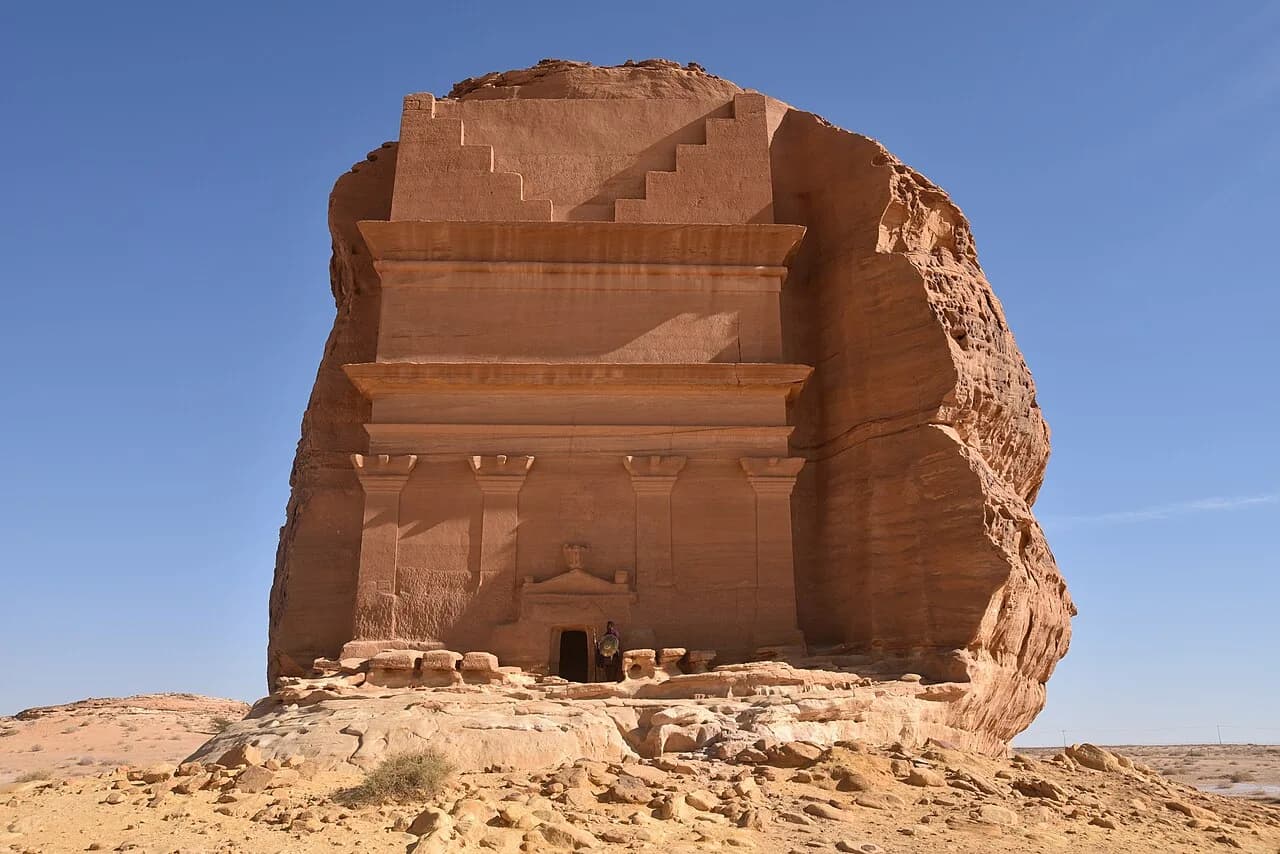
Qasr al-Farid stands alone on a sandstone outcrop in the desert of northwest Saudi Arabia. The Hegra Conservation Project gives the rock as about 23 meters high and 18 meters wide.
The upper façade shows the Hegra style, with a crown of half-crowsteps. The bases of the four pilasters and the decoration of the entrance were never defined. A short inscription above the door carries no date.
The traditional view
UNESCO describes Hegra as the largest conserved site of the Nabataeans south of Petra in Jordan. It lists 111 monumental tombs, 94 of them decorated, dating from the 1st century BC to the 1st century AD. Its statement of Outstanding Universal Value says the architecture and decoration are "directly cut into the sandstone."
The French Ministry of Culture reports that around one third of the decorated tombs carry a legal inscription in Nabataean. The text gives the owners, the stonecutter and a date counted in the years of the reigning king. It says all of the inscribed tombs date from the years 1 to 75 CE.
Qasr al-Farid is one of a few tombs cut into isolated outcrops. The 2007 nomination document calls it "the highest finished tomb on the site" at 21.50 meters. It adds that the façade is "the only one with four pilasters instead of the standard two."
The Hegra Conservation Project says the façade is decorated in Hegra style with Egyptian and Greco-Roman elements, "but many parts remain unfinished, such as the area near the entrance." It adds that the carving traces "allow visitors to observe the different stages of construction." The page lists the tools as the axe, the pick, the point chisel and the flat chisel.
The accepted account is that these façades were cut from the top down. Smithsonian Magazine writes that the abandoned work at Tomb 46 "shows most clearly how the Nabataeans built from top to bottom." At Petra, Shaher Rababeh writes in How Petra Was Built that he examined several unfinished monuments and suggests the masons cut their façades from top to bottom. He adds that similar examples can be seen at Mada'in Salih.
The nomination says the tool traces at Hegra are sometimes so clear that they allow the reconstruction of how the work was distributed among the workmen.
What the Unfinished Stone Shows
In Earthly Enigmas I follow unfinished stone elsewhere. I describe an unfinished stone at Baalbek of about 1,000 tons, with a second stone of about 1,650 tons beneath it. At Ollantaytambo I point to the unfinished wall and the abandoned monoliths as part of the transport and lifting problem. At Rapa Nui I note that about 400 statues were left unfinished.
Hegra offers a different kind of unfinished work. The façade was cut where it stands, so the chisel marks remain in place and the stages of the work can be read from the rock.
What the Tomb Leaves Open
Both views lean on questions the evidence cannot yet answer. Three of them stand out.
Why did the work stop?
The Hegra Conservation Project reports a hypothesis by the archaeologist Laïla Nehmé. She suggests that the tomb "changed ownership before the first owner had time to inscribe his name." The page labels it a hypothesis.
Other sources are plainer about what is unknown. The Royal Commission for AlUla sponsored a National Geographic piece that says "Mysteries remain, including why some of the tombs were never completed." It adds that the unfinished tomb of Lihyan son of Kuza opens "many questions about what happened within this family." Smithsonian writes that a few tombs "were abandoned mid-construction for unclear reasons."
Qasr al-Farid is not the only unfinished tomb. The nomination records another at Qasr al-Bint. It says the tomb would have reached more than 30 meters if it had been finished. An inscription written just below it names the owner as a local governor.
The Hegra Conservation Project also writes that tomb locations were chosen for visibility and rock quality. It says the quality of the stone dictated the size and complexity of the façades. The page does not link that point to this tomb.
Why did the work stop?
Whose name is on the door?
According to a Google Arts and Culture story linked from UNESCO's entry for Hegra, the inscription above the door "bears no date, and follows a different formula to other known legal inscriptions." I have only seen that story as an extracted passage.
The inscription reads two ways. The Hegra Conservation Project gives translation A as "For Hayyan son of Kuza (and) his descendants of him." It gives translation B as "Lihyan son of Kuza took possession of it." The story says the difference rests on the ambiguity of one letter. The tomb is usually called the Tomb of Lihyan son of Kuza.
The Conservation Project dates the tomb to 0 to 30 AD and does not say how it reached that range. I could not find the basis. About thirty other tombs carry dates between 1 BC or AD 1 and AD 75. The nomination also says the five façade types "do not seem to follow a precise chronological order."
The page does not say whether the name on the door belongs to the first owner or to a later one. Which reading is right, and how was the date range reached?
How general is carving from the top down?
Rababeh and Smithsonian describe the top-down method. Naif Haddad, writing in Mediterranean Archaeology and Archaeometry, says it is "generally agreed." He then writes that the assumption holds true for some façades, but "it cannot be taken as a general rule." He adds that unfinished tombs at Petra also show "cases where carving was simultaneously done at the top and the bottom of a façade."
Rababeh also reports a Petra quarry where scaffolding was needed. In the wadi esSiyyagh he says "the masons must have used scaffolding." Elsewhere he writes that carved terraces served as working platforms "in place of scaffolding." He also writes that "there was no scope for changes during construction" because the whole design had to be worked out in advance. I have seen those lines only as excerpts of his book.
Both Haddad and Rababeh write about Petra. At Qasr al-Farid the Conservation Project says the entrance sits 4 meters above the ground. Smithsonian describes the lower third as rough. What does the lower third of Qasr al-Farid show about the order of the work?
The questions I can't put down
Some questions need more room than one article gives them. Two of them keep pulling me back.
How long would a façade like this take? Rababeh estimates "approximately three years" for el-Khazneh at Petra. He bases it on talks with Bedouin craftsmen and his own experience as an architect. I could not find an estimate for Qasr al-Farid. In the book I follow the same question of labor and method through unfinished stone at Baalbek, Ollantaytambo and Rapa Nui. The Rapa Nui article looks at the statues left in the quarry. I follow the question through Earthly Enigmas.
What happened to the tradition of inscribed tombs? The nomination gives the dated inscriptions as running from 1 BC or AD 1 to AD 75. The French Ministry says Rome annexed the kingdom in 106. The nomination says the site stayed in use until the middle of the fourth century. It also records a tomb built for a man's mother in AD 267, with an inscription in Nabataean script but in the Arabic language. I could not find an account of why the dated inscriptions end where they do. In the book I follow what becomes of the builders' knowledge once the builders are gone, under the heading Oral Traditions Encoding Lost Knowledge. You can read a free sample before you decide. The articles section has more subjects in the same format.
Sources
- UNESCO World Heritage Centre: Hegra Archaeological Site (al-Hijr / Madâin Sâlih)
- Nomination document for the inscription of Al-Hijr Archaeological Site (January 2007), hosted copy (the UNESCO copy is on the documents page; I did not open it)
- French Ministry of Culture: Hegra
- Hegra Conservation Project: IGN110, Tomb of Lihyan son of Kuza (cites Nehmé 2015 and Healey 1993, neither of which I have read)
- Hegra Conservation Project: Architecture
- Google Arts and Culture: Hegra story (linked from UNESCO's entry; extracted passage only)
- Smithsonian Magazine: Hegra, an Ancient City in Saudi Arabia Untouched for Millennia, Makes Its Public Debut (2020) (journalism)
- National Geographic: Buried stories, the tombs of Hegra (paid content sponsored by the Royal Commission for AlUla)
- Shaher Rababeh, How Petra Was Built (BAR International Series 1460, 2005) (extracted passages from a hosted copy; page numbers not confirmed), with an excerpt of pp. 223-227
- Naif Haddad, Notes on Nabataean Construction Techniques: A Critical Review and Investigation of el-Khazneh Slots Function, Mediterranean Archaeology and Archaeometry (2015)