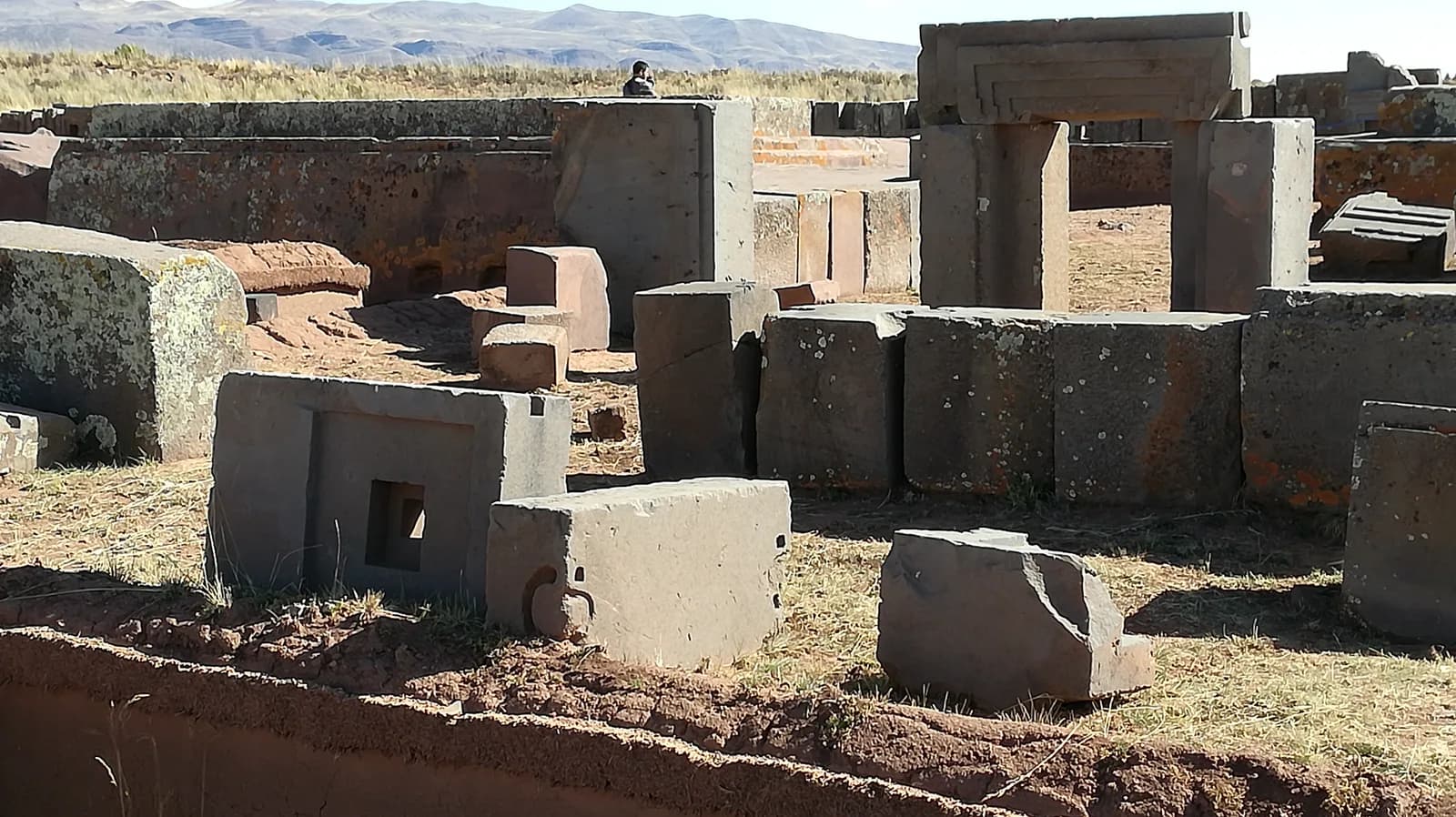
High on the Bolivian altiplano near the southern shore of Lake Titicaca lies a shattered stone platform called Puma Punku. Huge slabs of red sandstone sit in a row. Around them are blocks of gray andesite with sharp edges and perfect inside corners.
Many wild claims have been made about this place. The plain facts are strange enough.
The traditional view
The UNESCO listing describes Tiwanaku as a planned city that reached its height between 500 and 900 AD. UNESCO says its builders perfected the technology for carving and polishing stone. Puma Punku is one of the named structures.
A 2018 study by Alexei Vranich adds the numbers. The platform holds 17 sandstone slabs and the largest weighs an estimated 83 tons. About 150 cut andesite blocks lie around it. They range from small pieces a person can lift to one block of about 20 tons. The andesite quarry for that block sat on the other side of the lake. The joints between stones have no mortar, and the fit is precise enough that some scattered blocks could be matched with their neighbors.
Vranich also reports that the craftsmanship has long been considered the high point of Andean stone technology. The site itself was ruined by looters over about 500 years. Spanish chroniclers who saw it in the sixteenth and seventeenth centuries described it as unfinished.
Puma Punku: The Machine Question
In Earthly Enigmas I call Puma Punku the site most often raised in talk of impossible ancient building and also the site most often misrepresented. I think the facts are enough without embellishment.
The andesite blocks carry channels of uniform width and depth. Their inside corners are right angles. Their surfaces are flat to within fractions of a millimeter. The same cutouts repeat across separate blocks. I note that some materials scientists question whether those features can be reached with stone, bone and bronze tools. That debate has not been settled.
I do not think Puma Punku needs a supernatural explanation. I do think it calls for an honest acknowledgment. Our picture of what the Tiwanaku builders knew and could do has not been fully established by the published record.
What Has Not Been Established
The researchers and I agree on the stone. We part ways on how much the published record has settled. Three questions stand out.
What did they cut it with?
Jean-Pierre Protzen and Stella Nair studied the cuts at close range. They write that no matter how fine a hammerstone's point is, it could never produce the crisp right inside angles seen at Tiahuanaco.
They offer a reasonable guess. They suggest a chisel-like tool and a punch-like tool made the grooves at the corners and a saw-like or file-like tool made some of the edges. They also report copper cramps cast in place, which shows the builders could work metal. In the same passage they add that no such tools have been recovered or recorded. They call the builders' tools essentially unknown.
So the work looks possible and the tools are missing. If the tools have never been found, what do we really know about how the cuts were made?
Why was the finest masonry in the Andes left unfinished?
Vranich calls the craftsmanship unparalleled in the pre-Columbian New World. The same paper says Spanish chroniclers described the building as unfinished. Later architectural studies confirmed that both the andesite and the sandstone were unfinished.
The best work of its culture was never completed by a people who clearly could have completed it. I keep asking what stopped the work. I also wonder what an unfinished masterpiece says about the end of the people who built it.
Where is the blueprint?
About 150 andesite blocks and 17 slabs fit together without mortar. Vranich reports that the architect Jean-Pierre Protzen realized one famous carved block, the Escritorio del Inca, is an accurate reduced-scale model of a full-size form.
That model is the clearest hint of a plan. The andesite pieces came from across the lake and had to fit when they arrived. Who held the plan, and how did it reach the quarries?
The questions I can't put down
Some questions need more room than one article gives them. Two of them keep pulling me back.
How old is it? UNESCO places the planned city at Tiwanaku between 400 and 900 AD. In Earthly Enigmas I look at two published arguments for much older dates and I note that both methods have been disputed. I follow that debate in the book.
How do you carry a 20-ton block across a lake? The weights are documented. I have not found a record of the method. I take that up in the book and you can read a free sample before you decide. The articles section has more subjects in the same format.
You can decide how far each argument carries. What did they cut it with?