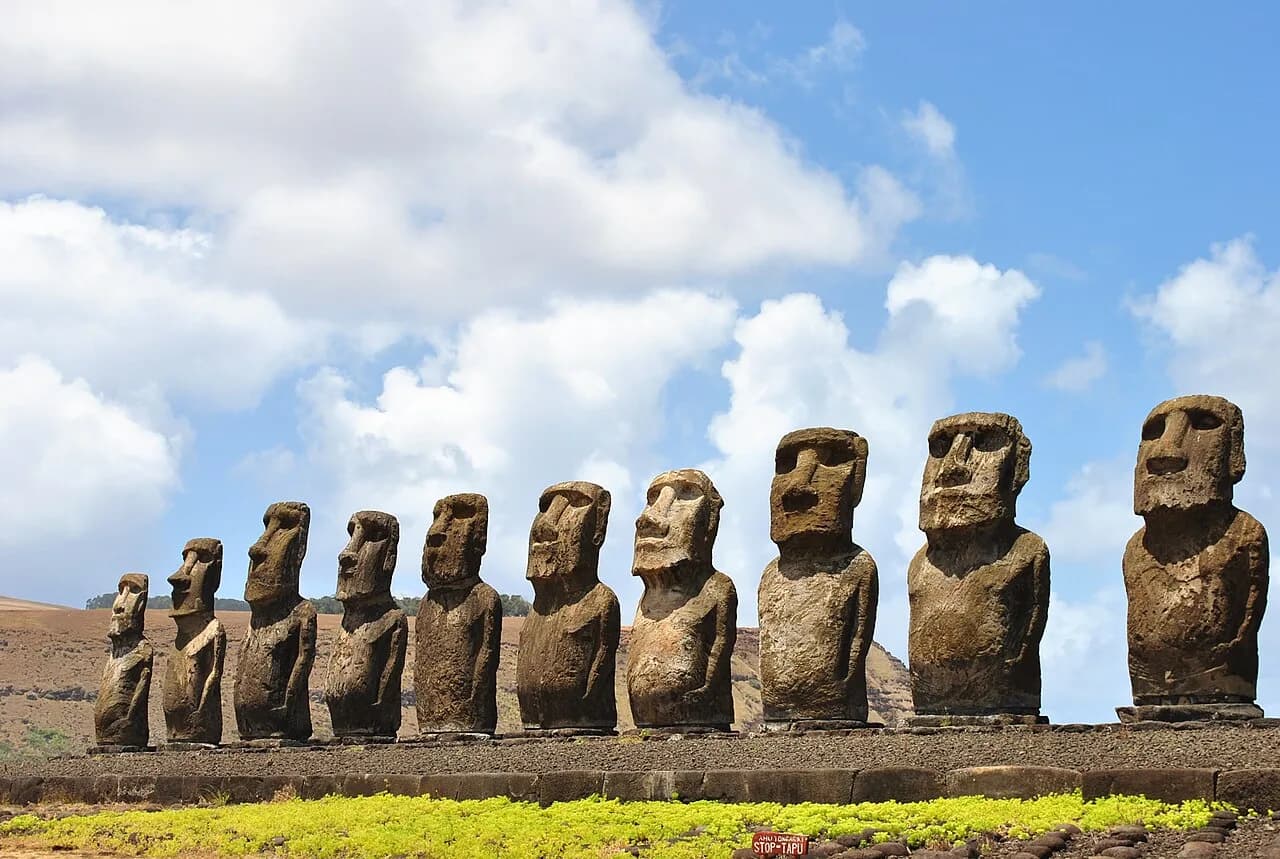
Rapa Nui sits about 3,700 kilometers off the coast of Chile. About 900 stone statues stand, lie or sit half buried across its slopes.
The oral tradition of the island says they walked.
The traditional view
UNESCO describes Rapa Nui as the home of a culture founded by settlers from Eastern Polynesia. That culture built more than 300 ceremonial platforms called ahu. It also carved the statues called moai, which represent ancestors. UNESCO places the building between the 10th and the 16th century.
The moai range from 2 to 20 meters in height. UNESCO says most were carved from volcanic tuff with simple basalt picks and then lowered down the slopes into holes dug for them.
The leading account of how they reached the platforms comes from Carl Lipo, Terry Hunt and Sergio Rapu Haoa. They studied the statues abandoned along the island's ancient roads. In the Journal of Archaeological Science they report that the statues were moved upright. Their 4.35 metric ton replica rocked from side to side and "walked."
Lipo and Hunt's 2025 follow-up reports that a team of 18 people moved the replica 100 meters in 40 minutes. They read the road statues as the ones that failed on the way.
The Stones That Walked
In Earthly Enigmas I count about 900 statues on the island. They run from 10 to 82 tons and I write that they were moved up to 20 kilometers from the quarry at Rano Raraku. I give Paro at 82 tons. About 400 statues were left unfinished.
I write that the Rapa Nui oral tradition says the moai walked. I also report that experiments have walked a moai upright with about 18 people and ropes. Whether that method scales to an 82-ton statue over 20 kilometers is not settled.
I note that Thor Heyerdahl argued for contact between South America and Easter Island. I name the 2020 Nature paper on Polynesian and South American admixture around 1200 CE. I describe the walls of the ahu as built in a polygonal style like the Andes. The direction of stoneworking influence has not been determined.
I place Easter Island inside a pattern that runs across cultures. I treat it as one mystery that happens to be global. I also give the mainstream view of adequate models its hearing, because I think it is a legitimate position that should be heard.
What Nobody Has Settled
Both views lean on questions the evidence cannot yet answer. Three of them stand out.
Could 18 People Move Paro?
Lipo and Hunt read the road statues as failed transports. They report that 51.6 percent of them lie within 2 kilometers of the quarry.
Critics read the same statues differently. A 2025 New York Times report, reprinted in The Star, gives the view of Nicolas Cauwe of the Royal Museums of Art and History in Brussels. He argues that many statues along the paths cracked while lying down. He also notes erosion patterns suggesting the statues stood upright along the trails for decades. The same report says abandoned or deliberately placed "remains a matter of debate."
Jo Anne Van Tilburg of UCLA supports moving the statues lying down on a sledge. In 1998 a NOVA dispatch reported that 60 Rapa Nui pullers dragged a replica of nearly 10 tons almost 100 meters. The Times report quotes her as saying "Just because something could be done, doesn't mean it was."
The walking idea has an older test. The Kon-Tiki Museum says Heyerdahl and Pavel Pavel walked a standing statue in 1986 with sixteen local residents. It says Heyerdahl concluded the mystery was solved. NOVA's account of the same trial says the swiveling damaged the base of the statue and forced the team to stop.
Could the same method move the biggest statues across the whole island?
Where Did the Builders Come From?
UNESCO describes a society of Polynesian origin that was "completely isolated from external cultural influences" for over a millennium.
The 2020 Nature paper by Alexander Ioannidis and colleagues says Heyerdahl "controversially suggested" that South Americans had an important role in settling Easter Island. It says the question remains "hotly contested." The authors report "conclusive evidence" of contact between Polynesians and Native Americans around AD 1200. They place a single contact event in eastern Polynesia before the settlement of Rapa Nui.
A 2024 study in Nature by Víctor Moreno-Mayar and colleagues sequenced 15 ancient Rapanui genomes. They report that the individuals are Polynesian in origin. They also find about 10 percent Native American admixture dated to about 1250 to 1430 CE, closest to Pacific Coast South Americans. They say contact "could have occurred more than once."
How many times, and where, did the two shores meet?
How Many People Lived There?
In the book I count about 400 unfinished statues at the quarry. The story of what stopped the work has two versions.
UNESCO writes that according to some studies, "depletion of natural resources had brought about an ecological crisis." It adds that this led to the decline of the ancient society by the 16th century.
Hunt and Lipo disagree in Pacific Science. They write that deforestation and contact-induced demographic collapse "were separated in time and causation." The 2024 genome study rejects a severe population bottleneck during the 1600s. It adds that it remains unclear whether or how the environmental changes led to a population collapse.
The same study notes that some authors put the population at as many as 15,000. European records suggest about 3,000. I have not checked either figure.
How many people lived on the island at its height?
The questions I can't put down
Some questions need more room than one article gives them. Two of them keep pulling me back.
Which way did the stonework travel? In the book I write that the ahu walls use a polygonal style like the Andes and that the direction of influence has not been determined. UNESCO describes an ahu as a platform of large worked stones filled with rubble. A guest essay on the Easter Island Statue Project site reports a remark by Jo Anne Van Tilburg. She said the fine wall at Ahu Vinapu is centuries older than the best Inca stonework and holds back rubble. Inca walls are cut all the way through. I have not checked that against her own work. I follow the question through Earthly Enigmas.
Does Easter Island sit on a line with Giza and Nazca? In the book I mention a second and a third great circle, and one of them connects Giza, Nazca, Easter Island and the Indus. Michael Rosola fitted a circle through 17 sites and puts Easter Island 9.62 kilometers from the line. He notes a selection bias, because he left out sites such as Stonehenge, Göbekli Tepe and those in North and Central America. You can read a free sample before you decide. The articles section has more subjects in the same format.
Sources
- UNESCO World Heritage Centre: Rapa Nui National Park
- Lipo, Hunt and Rapu Haoa, The "walking" megalithic statues (moai) of Easter Island, Journal of Archaeological Science (2013)
- Lipo and Hunt, The walking moai hypothesis, Journal of Archaeological Science (2025)
- Franz Lidz, New York Times report reprinted by The Star (2025) (secondary, for Cauwe and Van Tilburg)
- NOVA Online: The Moai is Moved (1998)
- NOVA Online: Past Attempts
- Kon-Tiki Museum: Easter Island, 1986 to 1988
- Ioannidis et al., Native American gene flow into Polynesia predating Easter Island settlement, Nature (2020) (abstract only)
- Moreno-Mayar et al., Ancient Rapanui genomes reveal resilience and pre-European contact with the Americas, Nature (2024)
- Hunt and Lipo, Revisiting Rapa Nui (Easter Island) "Ecocide," Pacific Science (2009)
- Francis B. Randall, Easter Island, the Loneliest World Ever Settled by Man (Easter Island Statue Project) (a guest essay, secondhand)
- Michael Rosola, Great Circle Alignment of Ancient Sites (2025) (a personal blog, not peer reviewed)