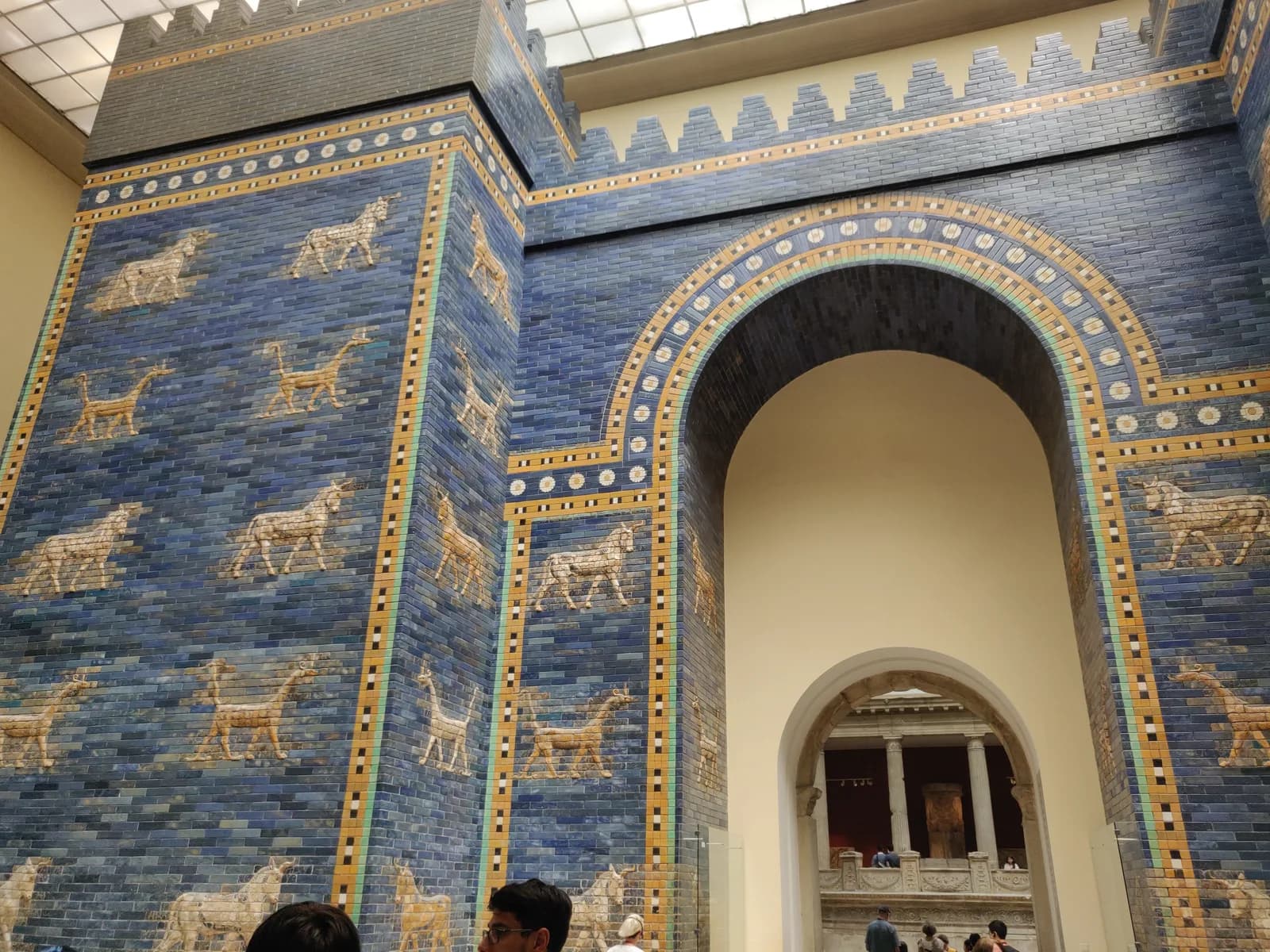
The blue gate in Berlin is 14.75 meters high and 26.41 meters wide, according to the museum's own record. Olof Pedersén of Uppsala University writes that about 80% of its surface is modern brick made in the 1920s. The ancient parts are 26 bulls and 16 dragons assembled from fragments dug up at Babylon.
Two structures carry the name Ishtar Gate today. One stands in Berlin and the other stands at Babylon in Iraq.
The traditional view
The Berlin museum gives the reign of Nebuchadnezzar II as 604 to 562 BCE. Helen Gries, a curator at its Vorderasiatisches Museum, writes that the Ishtar Gate was one of five city gates giving access to Babylon's inner city. It was the entrance to the ritual and political center. During the New Year festival the procession flowed through the Processional Way and the gate to the temple of Marduk.
Gries reads the animals as gods. The lion symbolizes Ishtar, the wild bull embodies the weather god Adad and the dragon embodies Marduk.
The king explains the rebuilding in his own inscription. Robert Koldewey, the excavator, printed it in his 1914 account in Delitzsch's translation. It says that "both entrances of the town gates had become too low owing to the filling up of the street (sulû) of Babil." The king says he rebuilt the gate with "baked bricks of blue enamel, on which wild oxen and dragons (sir-ruš) were pictured."
Pedersén describes a double structure. The front gate measured 13 by 28 meters and the main gate 33 by 22 meters, with 4 meters between them and a total depth of 50 meters.
Koldewey began excavating Babylon on March 26, 1899. He lists the gate as excavated from February to November 1902. Gries writes that no part of the gate reconstructed in Berlin was still standing at that time, because large parts had been removed to reuse the bricks. She says only the earliest phase, built of unglazed relief bricks, was preserved, and that visitors "can still see this phase in Babylon today." The excavators also found thousands of small glazed brick fragments in the rubble.
The museum says the fragments came to Berlin as its share of two divisions of finds, one with Istanbul in 1903 and one with Baghdad in 1926. In Berlin they were desalinated and sorted. Work groups assembled 72 animal reliefs in two years, and the reconstruction opened to the public with the Pergamonmuseum in 1930.
Gries writes that the original fragments were not enough to rebuild the gate. The department director Walter Andrae decided to fill the gaps with new bricks and commissioned three ceramic firms near Berlin to make them. She gives the original share as "Less than 20 per cent of the Ishtar Gate."
The museum describes the history in its own words. It says "Archaeological research interests, the German Empire's imperial ambitions and the creative ingenuity of the excavators and museum staff of the time converged in the reconstruction of the Ishtar Gate."
Iraq has asked for the return of material from Babylon. In 2002 the Guardian quoted Mohammed Aziz Selman al-Ibrahim, an official of Iraq's antiquities and heritage department, standing at the gate's original site. He said "I appeal to the German government to give back our antiquities to Iraq." The paper reported that a museum spokesman refused to comment. Gries writes that since its excavation and reconstruction the gate "has become an identity marker for the modern Iraqi state founded in 1921." I have not looked for later statements from either side.
The museum's refurbishment page says the South Wing, which holds the Vorderasiatisches Museum collection, has been closed since October 23, 2023. It expects the wing to reopen in 2037.
What The Newer Research Adds
Gries calls the Berlin gate a "visionary reconstruction." She writes that it is "less a representation of Nebuchadnezzar II's original gate than a modern impression." The impression is of how "we can imagine that the entire gate structure looked in Babylon in the 6th century BCE." She adds that it "primarily reflects the ideas of the excavators and the team at the museum."
Pedersén built a digital model of Babylon. He uses it to list six street levels for the gate. Level 1 is the gate of blue glazed bricks with reliefs at +15.5 meters. The lowest possible level, taken from the king's text, is -5.0 meters.
A 2024 paper in PLOS ONE measured the magnetic field recorded in bricks from all three phases of the gate. The authors include Anita Di Chiara, Lisa Tauxe and Helen Gries. I come back to their result below.
Where They Don't Meet
The sources agree on most of the history. Three questions sit between what was found and what is shown.
What do we mean by the Ishtar Gate?
The museum's object record says the Berlin display had to fit the museum's rooms. Only the smaller front gate could be rebuilt. The record says visitors must picture the far larger main gate with the help of imagination and a model. That is my translation of the German.
The museum's measurements for the display are 14.75 meters high, 26.41 meters wide and 4.38 meters deep. Pedersén gives the front gate at Babylon as 13 by 28 meters.
The museum's record names the Berlin display the third construction phase. Pedersén lists the gate of blue glazed bricks with reliefs as level 1, at +15.5 meters. He lists level 3, at +11.0 meters, as "Today best preserved" at Babylon. Gries says the phase that survived at Babylon is the earliest, built of unglazed bricks.
The World Monuments Fund says important remains of the gate stay at Babylon. It says modern bricks were used to repair the original facade, which had been taken away just above the modern level. It says the lowest levels cannot be shown because groundwater is too high.
Pedersén adds that a half-size copy of the front gate, in modern materials, was built at Babylon in 1958 and 1959. UNESCO says the Revival of Babylon reconstructions of the 1980s "negatively affected the integrity of the property."
The Guardian wrote in 2002 that "An entire tower, the Ishtar Gate, was lifted and taken to a museum in Berlin." The museum and Gries describe fragments from rubble, put back together. I have not found the basis for the newspaper's wording.
What do we mean when we say the Ishtar Gate?
Where is the line between what was found and what was decided?
The museum's record says only the animal reliefs and some ornament bands were put together from original fragments. It says the rest is modern additions "die man leicht unterscheiden kann," meaning that one can easily tell them apart. It also says the comparison of the fragments found with the wall measurements and the lower phases justifies the reconstruction. Both lines are my translation.
Pedersén sets out how the glazed gate was worked out. He writes that "no glazed relief bricks were found in situ and all were fragmented." The still standing lower part of the gate, with its unglazed reliefs, "stood model for the reconstruction process." He says the process "assumed that the animals were identical, of equal size, and that they were arranged in regular intervals."
He calls one detail a guess. The gap of 11 brick courses between the animal rows matches the unglazed levels. "Although this distance seems quite plausible, it naturally remains conjectured."
He also compares the door. Five rows of animals were counted between two street levels. That adds up to about 10 meters for the side wall. "The reconstruction in Berlin, however, reveals only three lines of animals in the gate opening."
The inscription on the Berlin gate is made of ancient fragments. Pedersén writes that its wording is taken from three passages of the East India House inscription. "As it stands, it cannot be an inscription for the construction of the Ishtar Gate." The museum's record says an extract of the king's founding inscription, also in glazed brick, is fixed beside the left tower. The sources do not say whether these two descriptions refer to the same panel. I have not checked that.
Pedersén ends with the proportions. He writes that the Berlin facade "consists to some 80% of modern materials, whilst 20% of ancient fragments according to type." The core inside "consists exclusively of modern German bricks."
Where is the line between what was found and what was decided?
Who was each row of animals made for?
Koldewey counted nine rows of animals in relief on the wall. He wrote that "The whole of this collection of creatures was certainly at no period visible at the same time and from the same point of view." He gave a minimum of 575 animals for the whole gate and said 152 pieces were still in position after the excavation.
The street rose again and again. Koldewey wrote that "with the successive heightenings of the road the lower part of the building gradually disappeared below the surface." He saw "great foresight, and of most scrupulous care expended on the work." The reliefs "were carefully smeared over with mud," and those of the eighth row "were actually covered with a fine clean white stucco."
Below the eighth row he found the bricks laid carelessly. He wrote that the lower rows "were not intended to stand out free and meet the eye, at any rate not for any considerable length of time." He noted that even the lowest courses carry a brick stamp "characteristic of the latter half of Nebuchadnezzar's reign." He also wrote that "No traces have been found of an earlier building, though Nebuchadnezzar speaks of one."
Pedersén writes that each street level "evidently" had its own gate structure. When the street was raised, the upper parts were taken down and served as the foundation for the next one.
The dating is not settled. Di Chiara and colleagues found the bricks of all three phases statistically indistinguishable. They suggest the phases "were built with no significant chronological gaps between them," most probably one right after another. Their best fit with the Levantine reference curve is 569 BCE. They suggest the gate was built after the conquest of Jerusalem "although probably not immediately after."
The same paper describes the problem it set out to test. Its authors write that "dating the individual construction phases of the Ishtar Gate is very difficult." They add that "It is even possible that the latest phase may not have been constructed under Nebuchadnezzar II, but later." Their own result supports construction within his reign.
Reviewer #2, whose report is published with the paper, writes that the date "is reasonable, but provisional until a local archaeomagnetic curve has been established." The reviewer also writes that the three phases in the paper are "the three types of wall decoration as presented in the museum." Those are not all the levels the excavations attest. Pedersén dates the three main steps to the early, late middle and late reign of Nebuchadnezzar, "or even that of his successor Nabonidus."
Who was each row of animals made for, and for how long?
The questions I can't put down
Some questions need more room than one article gives them. Two of them keep pulling me back.
What did the top of the tower look like? Pedersén writes that inscriptions of Nebuchadnezzar II say the top of the Etemenanki ziggurat was covered with baked bricks the color of lapis lazuli. He writes that "Nothing of the latter has survived within the ziggurat area." A few glazed fragments reported from the Homera mound might have belonged to it, but he says "this remains conjectural." In the book I follow the ziggurat in Chapter 7 under the heading "Landing Pads for Gods." I follow that thread through Earthly Enigmas.
Was the gate copied in antiquity? Pedersén writes that the first copy of the gate, "at least regarding its main gate building," "may have been relocated to the Persepolis area (Tol-e Ajori) as early as shortly after Cyrus' conquest of Babylon in 539 BC." I have not read the excavation report he cites. In the book I use the words "the attempt to rebuild" for Carnac in Chapter 11. The Carnac article sets out that question. The Babylonian Map of the World article looks at a tablet from the same city. You can read a free sample of the book before you decide. The articles section has more subjects in the same format.
Sources
- Staatliche Museen zu Berlin: From Fragment to Monument, The Ishtar Gate in Berlin
- Staatliche Museen zu Berlin: object record, Ischtar-Tor (III. Baustufe), text by Joachim Marzahn (German; translations are mine)
- Staatliche Museen zu Berlin: refurbishment of the Pergamonmuseum
- Helen Gries, The Ishtar Gate of Babylon: One Monument, Multiple Narratives, The Ancient Near East Today 11.4 (2023)
- Olof Pedersén, The Glazed Bricks that Ornamented Babylon: A Short Overview, in Glazed Brick Decoration in the Ancient Near East (Archaeopress, 2020), chapter 6
- Robert Koldewey, The Excavations at Babylon, translated by Agnes S. Johns (Macmillan, 1914), Project Gutenberg
- Di Chiara et al., An archaeomagnetic study of the Ishtar Gate, Babylon, PLOS ONE 19(1) (2024), with the peer review history
- World Monuments Fund: Ishtar Gate of Babylon
- UNESCO World Heritage Centre: Babylon, Outstanding Universal Value
- The Guardian, Iraq appeals to Berlin for return of Babylon gate (May 4, 2002)