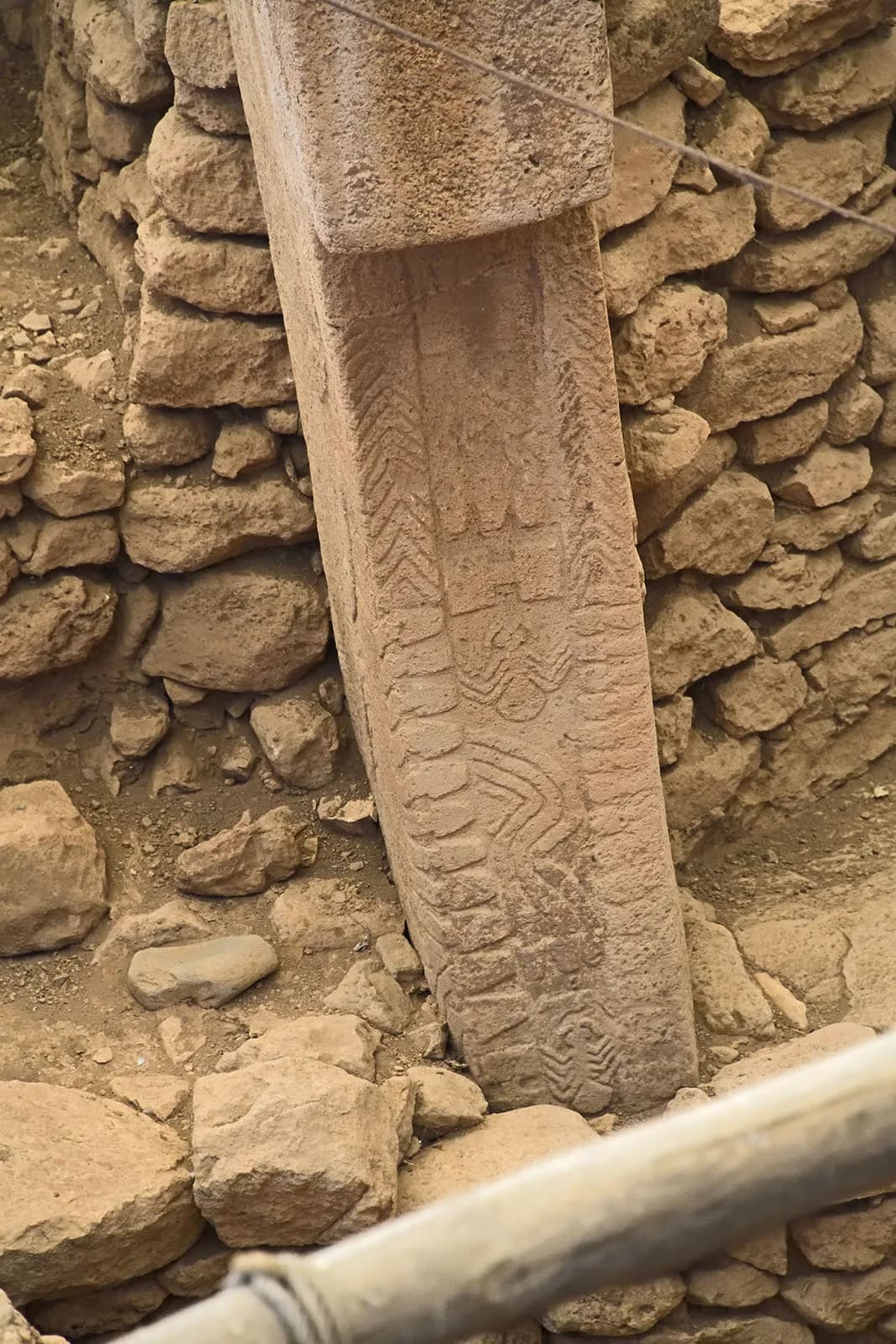
Go back about 11,500 years to a limestone ridge in southeastern Turkey. Nobody has invented pottery and nobody is farming. People are cutting stone pillars more than five meters tall and setting them in circles. They carve foxes, birds and insects into the stone. Some of the pillars even have arms and hands.
Klaus Schmidt began digging there in 1995. What his team found has made archaeologists rethink how early people organized themselves.
The traditional view
The UNESCO listing describes monumental round and rectangular structures built by hunter-gatherers in the Pre-Pottery Neolithic. It dates them between 9,600 and 8,200 BCE and says they were probably used for social events and rituals. The excavation team places the oldest layers at about 9,600 to 8,000 BCE.
The old model of history runs in a straight line. People farm first and farming makes a surplus. A surplus supports crowds. Crowds organize and eventually they build monuments. Göbekli Tepe sits awkwardly in that story. The team has found no domesticated plants or animals there. It says it would never have expected hunter-gatherers to organize something on this scale. It ties the building to the shift from hunting to food production.
The team also cautions against the popular word temple. It prefers "special buildings with a ritual component."
The burial is where the mainstream view has moved the most. The first reading was that the builders buried each building on purpose. The team now describes several filling events at different times. Some of the fill came from dumped building debris and some from natural slope slides. The whole mound is man-made and the filling ended around 8,000 BCE.
Göbekli Tepe: The Deliberate Burial
Most ancient sites are buried by time. Sediment builds up and structures collapse. In Earthly Enigmas I argue that Göbekli Tepe is different. I think its builders buried it on purpose.
I place the start of construction at the end of the Younger Dryas. The people who raised these pillars lived in the aftermath of a catastrophe and some of them may still have remembered it.
I find the usual explanations thin. Ritual closure and a change of religion are possible. Both leave the timing unexplained and both leave the effort unexplained. Someone retiring a sacred place can simply walk away. Burying it takes work.
The pillars and carvings came through in extraordinary condition. I read the burial as a message sent forward to someone living in a different world. The carvings have not been fully decoded. I think the builders trusted that someone would one day read them. I think they were saving it for us.
The Burial Date Nobody Can Pin Down
Both views lean on questions the excavators cannot yet answer. Three of them stand out.
How long did it stand before it was buried?
The plaster in Enclosure D dates to about 9,745 to 9,314 BCE. That date tells us when the building went up and says little about when it was buried.
The team says there is still no consensus on when the enclosure was abandoned and buried. Fill samples can be older or younger than the building, which produces upside-down layers. Some dates allow several hundred years of use. A short life span remains possible too.
So the gap between building and burial is unknown. Whether the builders closed a temple or sealed a time capsule may depend on that gap. I would like to know what that number says. Nobody can give it to me yet.
Why did they stop rebuilding and start filling?
The team says the buildings were repaired and rebuilt again and again. Then the rebuilding stopped. The team writes that the reason is unclear.
The enclosures were cleaned and parts of their fittings were taken out. Objects of great importance were placed in the fill. In the older layer the filling looks fast with no layers of wind or water between. I read that as people doing the work in one effort.
What made people who kept a place standing decide to fill it?
Where did they learn to build like this?
The oldest layer holds the large circular enclosures with the tall pillars. The younger layer holds smaller rectangular buildings with much smaller pillars. The builders started at the top and later built less. UNESCO credits the site with new levels of architectural and engineering technology.
I keep asking where the earlier and smaller attempts are. The excavators point to Nevalı Çori, a Neolithic site a few kilometers north where T-shaped pillars stood in a single building. The dating will have to say whether that came first.
The questions I can't put down
Some questions need more room than one article gives them. Two of them keep pulling me back.
Who were the builders? The excavators have changed their own answer. They first described a gathering place used for seasonal festivals. They now report fire installations, food remains, cisterns and burials and they describe a settlement with a strong ritual side. What that does to the label hunter-gatherer is one of the questions I follow in Earthly Enigmas.
How old is the oldest layer? The team says only a small part of the site has been excavated and says older remains cannot be ruled out. Ground radar suggests that many more buildings lie buried. I follow that thread through the book, and you can read a free sample before you decide. The articles section has more subjects in the same format.
Was it a retired temple or a time capsule?