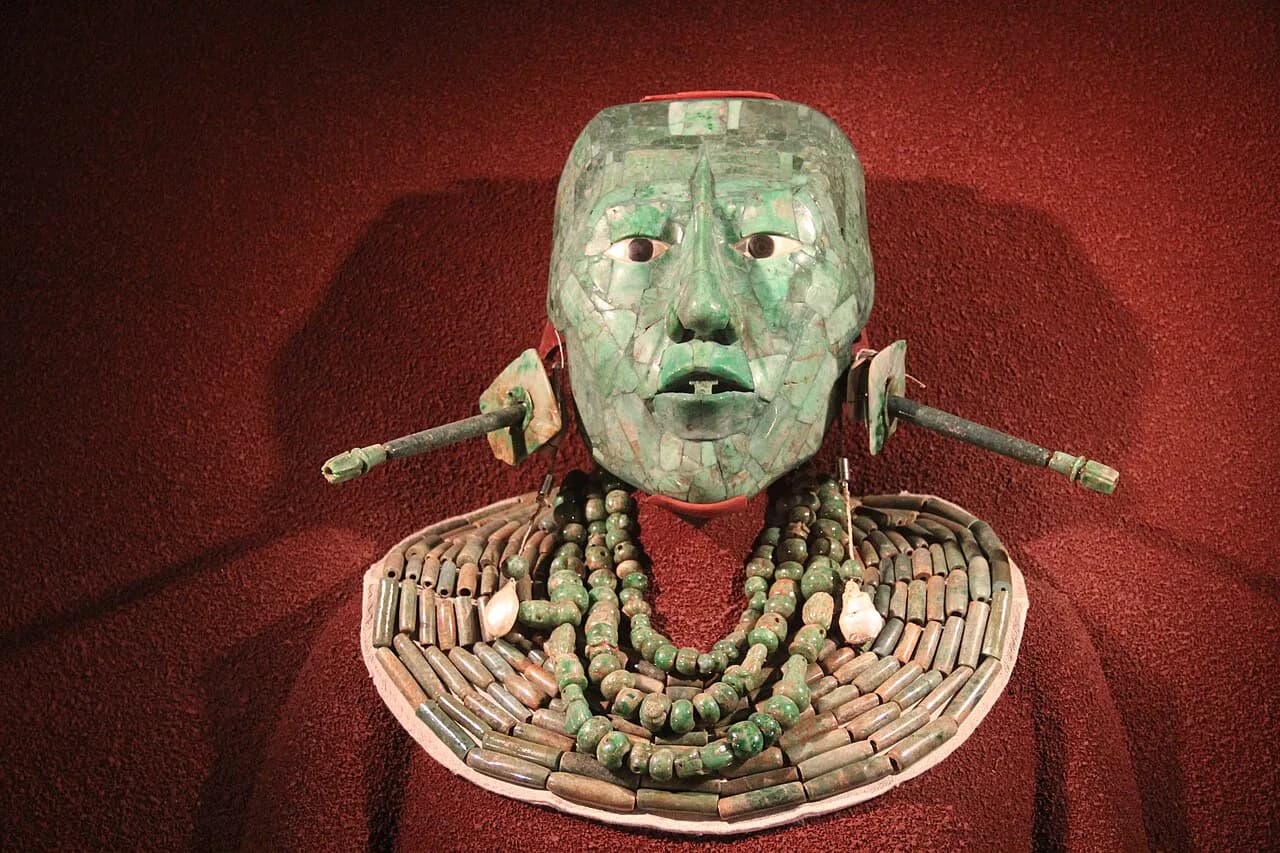
In 1952 Alberto Ruz Lhuillier found the tomb of K'inich Janaab' Pakal beneath the Temple of the Inscriptions at Palenque. A mask of green stone was inside the sarcophagus.
The mask on display in Mexico City today stands on a mount made in the early 2000s. A conservator who wrote about the older mount says it showed a swollen and deformed face. She says that look shaped how people saw the mask for almost 50 years.
The traditional view
The Mexican institute that runs the site, INAH, says on its Palenque page that Ruz found the tomb of the great lord Pakal in 1952. It calls the find the most notable and sensational in Mexican archaeology in many years. The same page describes an interior stair of 73 steps that leads to the funerary chamber.
The conservator Laura Filloy Nadal took part in restoring the mask. In an INAH bulletin she says the inscriptions give Pakal's birth as 23 March 603. They place the start of his long reign around 615 and his death in 683 at a great age.
She says the mask rarely left the Maya Room of the Museo Nacional de Antropología. Early in the 2000s a plan to show it in an exhibition led to an inspection. She writes in Arqueología Mexicana that the museum decided the mask could not leave the room "sin antes ser restaurada de manera integral." That means without first being restored in full.
The team found layers of polyurethane foam and plasticine under the jade tiles. They also found pastes in ochre, red and yellow that had been used to fix the pieces. The bulletin quotes Filloy Nadal on what her team learned from Ruz's 1952 slides. There had originally been stucco, which was used "quizá" (perhaps) to glue the tiles.
A provisional ceramic mount went on show in November 2001 at the Antiguo Colegio de San Ildefonso. When the mask returned to the museum the team made a mount in acrylic resin. The bulletin says it "permanece hasta hoy," so it remains today.
Popular writing about the tomb often turns to the sarcophagus lid. Stephen Epstein of the Penn Museum wrote in Expedition magazine that Erich von Däniken sees a figure reclining at the controls of a spacecraft. Epstein writes that Maya scholars read the same carving as Pakal falling into the underworld with the World Tree growing from his body. I have not read von Däniken's book. Epstein's article does not mention the mask.
A Face Put Back Together
In Chapter 5 of Earthly Enigmas I name the Temple of the Inscriptions at Palenque among the structures that contain the golden ratio. In the chapter on the archaeological awakening I write that the new Maya population estimates "are now mainstream."
What The Records Leave Open
The records leave several questions open. Three of them stand out.
How much of the face comes from the tomb?
Filloy Nadal says the team saw that the mask "tuvo modificaciones a lo largo del tiempo" and had been restored "en diversas ocasiones." It had been changed over time and restored on several occasions. She says the work led INAH to review how its Maya masks were mounted.
The sources date that work differently. INAH's bulletin puts the ceramic mount in November 2001. The Arqueología Mexicana caption names a 1954 mount before and a restoration in 2001 and 2002. The conservator Carolusa González Tirado, writing in the journal Intervención, says the studies began in 2000 and the restored mask dates to 2003.
González Tirado says the 1950s restoration showed "un personaje hinchado y deformado." That is a swollen and deformed figure. She says the main error was one of interpretation. Even the best adhesives by today's standards would not have saved the result.
She also writes that restoration decisions "no son científicamente objetivas." That means they are not scientifically objective. The same question comes up at Calakmul, where a jade belt was assembled at least twice (see Calakmul's Royal Belt).
Which features of today's face come from Ruz's 1952 record, and which come from the judgment of the team that reset the pieces?
How old was the man in the tomb?
The inscriptions give Pakal's birth in 603 and his death in 683. According to a Mesoweb report, Ruz's team read the bones as those of a man in his forties or fifties. Elaine Schele's history of the dispute says Ruz defended that estimate for 28 years.
Linda Schele and Peter Mathews called the calendar arithmetic of the inscriptions "incontrovertible." Mesoweb adds that someone had proposed a younger man was buried in Pakal's place. It does not say who.
Others offered reasons why the bones might look young. The same report says the dentist Allen Christenson told Schele and Mathews that diet kept tooth wear low in elite people. It adds that Schele and Mathews cited Norman Hammond and Theya Molleson, who wrote that people who reach old age tend to have "young bones."
A team from the Autonomous University of Yucatán restudied the remains starting in 1999. Vera Tiesler told an interviewer that his age "could well correspond to the age of eighty." She said he did not appear very old at first sight and that his tooth wear was low. She linked that to a soft and refined diet.
The Archaeological Conservancy's review of the team's book asks whether the controversy is resolved. It answers "Probably." The book's publisher page says it presents a new aging method called Transition Analysis. I have only seen a search excerpt of a later paper titled "Janaab' Pakal: The Age-at-Death Controversy Revisited." I have not read it.
Why did the bones read as young to one team and old to the next?
Is the mask a portrait?
González Tirado calls the mask "el retrato de un glorioso gobernante maya," the portrait of a glorious Maya ruler. Filloy Nadal has published a chapter titled "Imágenes convencionales o retratos. Los rostros de Pakal II," which means conventional images or portraits. In 2018 she published a chapter on visage, facial treatment and individual traits in Maya royal portraiture under Pakal.
I have not read either chapter and I do not know how she answers the question her first title asks. The Mesoweb report adds that Tiesler Blos found Pakal's skull had been shaped with boards in his first years and that his teeth were decorated with Ik' symbols.
Does the mask show one man's face or the face a Maya king was meant to have?
The questions I can't put down
Some questions need more room than one article gives them. Two of them keep pulling me back.
How exact is a Maya date? Trafficking Culture gives the day of Pakal's death as August 23, 683. The Archaeological Conservancy gives August 29 and Epstein gives August 31. I have not checked why they differ. Schele and Mathews, quoted on Mesoweb, say the scribes tied Pakal's birth, accession and death to the Long Count. In the book I write that the Maya calendar tracks Venus to within seconds of arc over centuries. I follow that question through Earthly Enigmas.
Is the golden ratio in the Temple of the Inscriptions? INAH describes the 73 steps of the interior stair and the stucco figures known as the Nine Lords of the Night in the crypt. In Chapter 5 I name the temple among the structures that contain the golden ratio. I have not found a published survey that gives the ratio and I have not checked it myself. You can read a free sample before you decide. The articles section has more subjects in the same format.
Sources
- INAH, Palenque archaeological zone (Lugares INAH)
- INAH bulletin 91, La ciencia y paciencia detrás de la restauración de la máscara de Pakal (2024)
- Filloy Nadal, La máscara mortuoria de K'inich Jannab' Pakal, Arqueología Mexicana special issue 111 (2023) (opening text only; the full article is sold separately)
- González Tirado, El restaurador como artista-intérprete, Intervención (INAH)
- Skidmore, Advanced Age Confirmed for Pakal of Palenque (Mesoweb)
- Schele, The Bones of K'inich Janaab Pakal: A History of the Controversy Over His Age At Death (Academia) (abstract only)
- Tiesler and Cucina, Janaab' Pakal of Palenque (publisher page, University of Arizona Press via UBC Press)
- The Archaeological Conservancy, review of Janaab' Pakal of Palenque
- Epstein, "Scholars Will Call it Nonsense," Expedition 29:2 (Penn Museum)
- Trafficking Culture, Museo Nacional de Antropología Theft
- Filloy Nadal and Martínez del Campo Lanz, El rostro eterno de K'inich Janaab Pakal (2010 chapter, title only) (login wall; not read)
- Filloy Nadal, Imágenes convencionales o retratos. Los rostros de Pakal II, soberano de Palenque, Chiapas (2011 chapter, title only) (not read)
- Filloy Nadal, The Importance of Visage, Facial Treatment, and Idiosyncratic Traits in Maya Royal Portraiture (Social Skins of the Head, 2018, title only) (not read)
- Wikipedia: Jade mask of Pakal (used only to locate the Arqueología Mexicana source; its piece count was not checked)