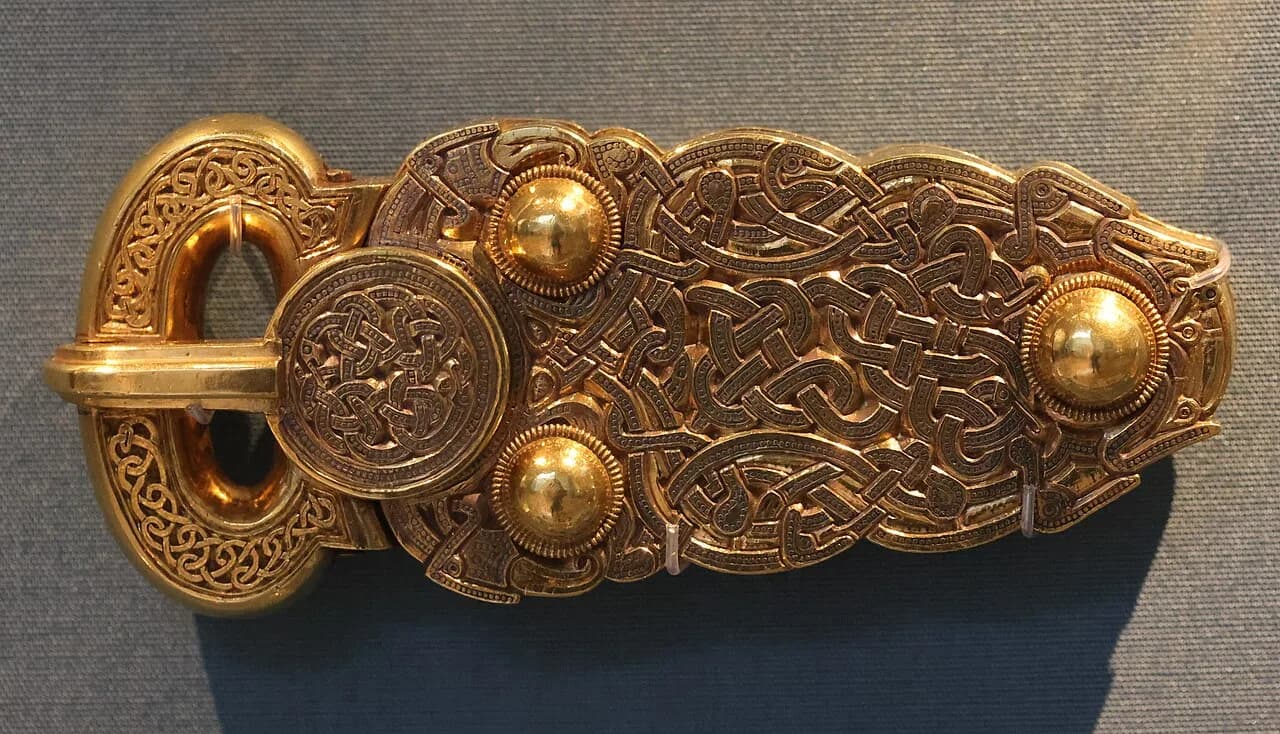
The buckle is 13.2 centimeters long and 5.6 centimeters wide. It weighs 412.7 grams, a little under a pound.
It is solid-looking gold covered in tangled animals. It is also a hollow box with a hinge, a swivel and a lock.
The traditional view
The buckle came out of Mound 1 at Sutton Hoo in Suffolk, a ship burial excavated in the summer of 1939. T. D. Kendrick wrote soon after that the finds were "presented to the British Museum by Mrs. E. M. Pretty just before the outbreak of war."
The British Museum catalogs it as object 1939,1010.1. Its wording describes a "gold belt-buckle, hollow with cast ornament." The upper surface "is covered entirely with zoomorphic interlace, the design picked out in tiny punched circles and inlaid (except on the loop) in niello." Niello is a black metal alloy that makes the lines stand out against the gold.
The same wording says three large bosses "connect with sliding catches on the back-plate, which opens on a hinge." The loop is hinged on its own and the tongue plate moves on a separate swivel. The museum page was blocked to my software, so I quote this text as it appears on a 3D scan record that credits the museum's catalog text.
A Google Arts & Culture page from the museum gives the date as 600 to 650 CE. A museum image caption says early seventh century. The burial itself is usually placed in the 620s. I have only seen that in Wikipedia, which cites other work, and I have not checked it.
Kendrick called the buckle "the most amazing product of the Sutton Hoo goldsmith's skill." He also admitted that a photograph misleads. In his words the photograph "suggests that the piece is ugly and stupidly ornate; but the reality is a flashing golden thing of undeniable splendour."
The burial is most often linked to Rædwald, a king of East Anglia who died around 624. Burger and colleagues write that the grave is "commonly attributed" to him. No body was found. The National Trust says chemical analysis of the sand below the chamber showed high phosphate levels, which points to a body that dissolved in acidic soil.
A person was laid to rest with this object. I have tried to write about it with that in mind.
What the Evidence Does Not Settle
The accepted account is clear about what the buckle is. It is a high-status gold fastening of the early seventh century, made in the animal style that Germanic-speaking peoples shared. The accepted account is less clear about where it was made, what its hollow body was for and who it belonged to.
In Earthly Enigmas I ask where the standard timeline and the physical evidence stop agreeing.
Where They Don't Meet
Three questions stand out. I do not answer any of them.
Who made the buckle, and where?
Kendrick looked at the animal ornament and saw Sweden. He wrote that it is "less Anglo-Saxon or Frankish than definitely Swedish in character." He added that "if we did not know where it came from, we might quite reasonably attribute it to one of the boat-graves in the Vendel cemetery in Uppland."
The museum's wording frames the buckle as part of the ship burial and names no workshop. Near Sutton Hoo lies Rendlesham, a large settlement that flourished at the same time. Jason Urbanus reports in Archaeology magazine that its finds include "scrap metal, casting molds, and slag." I have not found a published link between that metalworking and this buckle.
Is the buckle a Suffolk piece with a northern look or a northern piece that came to Suffolk? I have not read Bruce-Mitford's full volumes on the question.
What was the hollow for?
The buckle is a box. Kendrick noticed it from the start and wrote of "a removable back-plate." The museum wording describes catches that slide and a back that opens on a hinge.
Wikipedia calls the hollow "a secret chamber, possibly for a relic." A search excerpt of the British Museum's own account says that similar buckles from Frankish and Burgundian lands appear to have held Christian relics. It adds that nobody knows whether this one did, and that the sliders and rods leave little space. I have not read the museum page itself.
Wikipedia says the buckle is made in three parts. The museum wording lists a hinged back-plate, a hinged loop and a swiveling tongue plate. The counts may differ only in how the parts are counted.
If something was kept inside, what was it? If nothing was, why build a box?
Was it ever worn?
A buckle of this weight would have hung from a belt. Google Arts says belt buckles of the period signaled wealth and status through their metal and their fine decoration.
The sources I read say nothing either way about wear on the hinge, the swivel or the catches. I have not checked the 1978 volume of Bruce-Mitford's report or the museum's conservation records. The question matters because a buried object can be a possession of a living person, or it can be something made or chosen for the funeral.
Does the gold show use? What would the answer change about the person it was buried with?
The questions I can't put down
Some questions need more room than one article gives them. Two of them keep pulling me back.
Who lay in the grave? Burger and colleagues write that "no human body was found." Valerie Fenwick's 2023 paper in The Antiquaries Journal reads phosphate, bitumen and tar residues as possible signs of embalming. The leading candidate is still Rædwald, though one writer quoted on Wikipedia says the case has been argued "more strongly than convincingly." I have only seen that last quotation secondhand. In the book I follow a different deliberate burial, at Göbekli Tepe, and what it may have been meant to tell the future. The Göbekli Tepe article sets that out. The full story is in Earthly Enigmas.
How old was the buckle when it was buried? The museum's date runs from 600 to 650 CE, a wider span than the burial window. The burial date rests on coins and not on the gold. Dating is a thread that runs through the book, and you can read a free sample before you decide. The Sutton Hoo helmet has its own questions, and the articles section has more subjects in the same format.
Sources
- British Museum catalog wording for 1939,1010.1, as reproduced on a Zenodo 3D scan record (the museum's own page was blocked by a bot check)
- Google Arts & Culture, Gold belt buckle from Sutton Hoo (British Museum)
- T. D. Kendrick, Saxon Art at Sutton Hoo, The Burlington Magazine (about 1940)
- Burger et al., Bitumen among the grave goods of the Sutton Hoo Mound 1 ship burial, PLoS ONE 11(12) (2016)
- National Trust, Archaeology history: Sutton Hoo
- Valerie Fenwick, Sutton Hoo: Re-imaging the Ship and Chamber, The Antiquaries Journal 103 (2023) (abstract only)
- Jason Urbanus, The Ongoing Saga of Sutton Hoo, Archaeology (2014)
- Wikipedia, Sutton Hoo (used to locate leads and for the burial window and the relic remark, both unchecked in the originals)