The mound over the First Emperor's tomb still stands 51.3 meters high. Nobody has opened it.
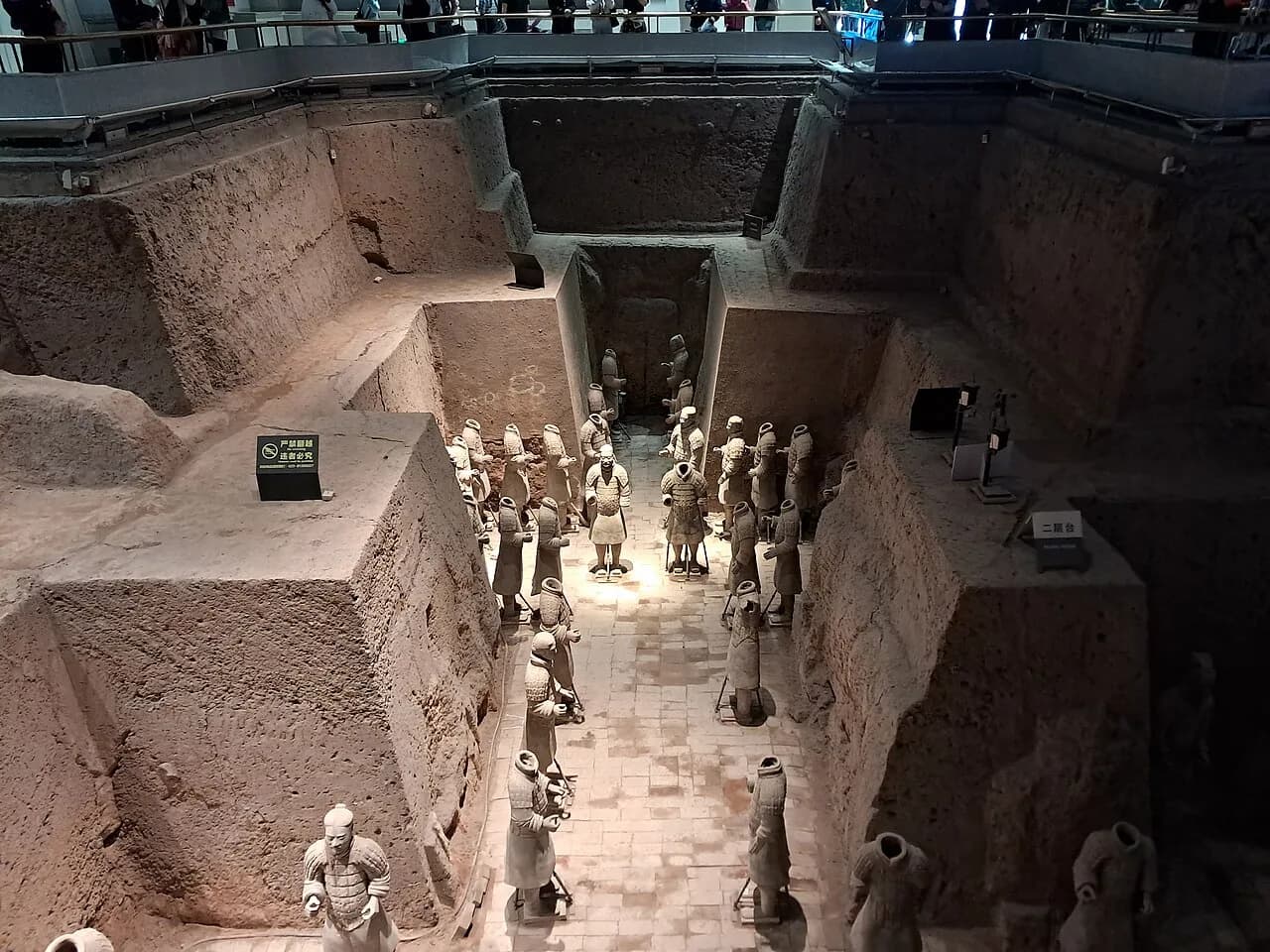
The famous clay soldiers are not inside. They stand in pits outside the tomb's boundary wall, and the burial chamber itself remains sealed.
The traditional view
The mausoleum lies 35 kilometers northeast of Xi'an. UNESCO says it was begun in 246 BCE. Nearly 200 accompanying pits hold "thousands of life-size terra cotta soldiers, terra cotta horses and bronze chariots and weapons." The property covers 56.25 square kilometers.
Farmers digging a well found the first chamber in March 1974, according to Britannica. It reports about 8,000 soldiers. The Technical University of Munich puts the figure at "some 7300". Martinón-Torres and colleagues write that over two thousand warriors have been excavated and that several thousand more remain buried.
The figures were made near the site. Quinn and colleagues write in Antiquity that the clay "was processed centrally before being distributed to different local workshops in a highly organised system of labour and craft specialisation." A later study in Archaeometry found a clay difference between figures marked "Gong" and figures marked "Xianyang." The authors read these as the products of two workshops.
The soldiers were painted. The Munich conservators report that "the lacquered undercoat flakes off, stripping the warriors of their color" once the figures leave the damp earth. The grey-brown figures a visitor sees in the pit are the result.
UNESCO says the army "faces outward from the tomb." Britannica adds that three nearby pits hold a smaller force, a command unit and a pit that is empty. Britannica also says the roof timbers "may have collapsed because of a fire shortly after the emperor's death."
What the Evidence Does Not Settle
In Earthly Enigmas I describe the proposal that three pyramid complexes follow the stars of Orion's Belt. I write that the Teotihuacan alignment is documented and not disputed. The same pattern is proposed at Giza and, less firmly, at Xi'an in China. I allow that coincidence, or the plain prominence of Orion's Belt, are legitimate explanations. You can read more about the other two sites in the articles on the pyramids of Giza and Teotihuacan.
The mound lies about 30 to 35 kilometers from Xi'an, according to UNESCO and to Zhu and colleagues. I have not checked whether the mounds in the Orion proposal include this one.
The Questions They Cannot Settle
Three questions stand out. I set out the evidence for each and I do not answer any of them.
What is in the chamber?
Sima Qian wrote that mercury was used to fashion the hundred rivers, the Yellow River and the Yangtze, and the seas in such a way that they flowed. Philip Ball quotes the line in that form and does not name a translator. The record counts 700,000 workers. Zhu and colleagues give the same figure.
Soil surveys have found mercury above the chamber. Ball reports an average of 30 parts per billion outside the central region and 250 above it, with places that reach 1500. In Scientific Reports Zhu and colleagues report airborne mercury above the mound at up to 27 nanograms per cubic meter. The area around it runs 5 to 10. They say the result adds "to the credibility" of Sima Qian's record.
The researchers split over what the pattern means. Duan Qingbo led the excavations from 1998 to 2008. He says "the distribution of mercury level corresponds to the location of waterways in the Qin empire." Zhang Yinglan was deputy director of the excavations. He says that "the mercury will have volatilized into nearby soils during this long time." Zhu and colleagues call the map reading "unwarranted," because mercury vapor in a chamber would spread evenly.
On opening the chamber Duan says, "We have no current plan to open the chambers." His reason is that "we have no mature technologies and effective measures to protect the relics." The South China Morning Post reports that online claims about a source for the mercury have revived interest in cinnabar sites in Shaanxi. I have only seen the opening of that article and I have not seen the excavation report.
What would it take to know what the chamber holds, and how much can be learned without opening it?
Where did life-size sculpture come from?
Lukas Nickel writes in the Bulletin of the School of Oriental and African Studies about sculpture. It "played only a minor role in ancient East Asia" until the First Emperor. He says the change was sudden and short-lived. His paper asks whether the interest "may have been the result of contacts with the contemporary Hellenistic world." I have read only the abstract. I have not read the paper or any reply to it.
UNESCO calls the figures "major works in the history of Chinese sculpture prior to the reign of the Han dynasty." The production studies point to a local system. Quinn and colleagues show local clay, central preparation and named workshops. They write that "many questions remain about how, where and by whom the figures were made."
The scale and the organization trace to the site. The idea of life-size figures in thousands is the part Nickel asks about.
Where did the idea come from, and what would a precursor look like in the ground?
Why does the best account of the tomb leave out the army?
Sima Qian describes the workforce, the mercury, the sealing of the chamber and a tomb with the heavens set out above. I searched the Chinese text of the chapter on the First Emperor, as transcribed on Wikisource, for the characters for figurines and for soldiers and horses. Neither term appears in it. I searched that chapter only. Other chapters may mention the figures.
Ball notes that Sima Qian wrote to justify the Han ascendancy. He suggests the First Emperor "gets something of a raw deal." I have also seen it suggested that a Han historian avoided praising the dynasty the Han replaced. I have not checked who first made that argument.
UNESCO itself cites Sima Qian for the labor. The army was found in 1974.
What did the historian know, and why would a record this detailed leave the army out?
The questions I can't put down
Some questions need more room than one article gives them. Two of them keep pulling me back.
Does the Qin mound belong to the Xi'an pyramid pattern? In the book I write that the Orion pattern is proposed at Xi'an with less firmness than at Giza or Teotihuacan. Sima Qian says the chamber had the heavens set out above, which is my reading of the Chinese. UNESCO says the enclosure is oriented north-south. I follow the Orion proposal through Earthly Enigmas.
How much of the army that visitors see is the army that was buried? The color is gone and the figures were reassembled from fragments. For forty years many people also believed the Qin had coated their bronze weapons with chromium to stop rust. Martinón-Torres and colleagues tested the idea. They wrote that "the chromium anti-rust treatment theory should therefore be abandoned." Chapter 3 of the book gives precision figures for the Great Pyramid and for sites in the Andes. You can read a free sample of the book before you decide. The articles section has more subjects in the same format.
Sources
- UNESCO World Heritage Centre: Mausoleum of the First Qin Emperor
- Britannica: terra-cotta army
- Technical University of Munich: Conservators preserve the paint layers of the Terracotta Army
- Zhu, Svanberg and colleagues, Mercury as a Geophysical Tracer Gas (Scientific Reports 10, 2020)
- Martinón-Torres, Li and colleagues, Surface chromium on Terracotta Army bronze weapons (Scientific Reports, 2019)
- Quinn, Zhang, Xia and Li, Building the Terracotta Army (Antiquity 91, 2017) (abstract only)
- Quinn and colleagues, Geochemical evidence for the manufacture, logistics and supply-chain management of the Terracotta Army (Archaeometry) (abstract only)
- Nickel, The First Emperor and sculpture in China (Bulletin of SOAS, 2013) (abstract only)
- Philip Ball, The First Emperor's rivers of mercury
- Sima Qian, Shiji chapter 6, Chinese text on Wikisource (transcription, Wikipedia-family site)
- South China Morning Post, Online claims revive mercury mystery around tomb of first Chinese emperor (opening paragraphs only)