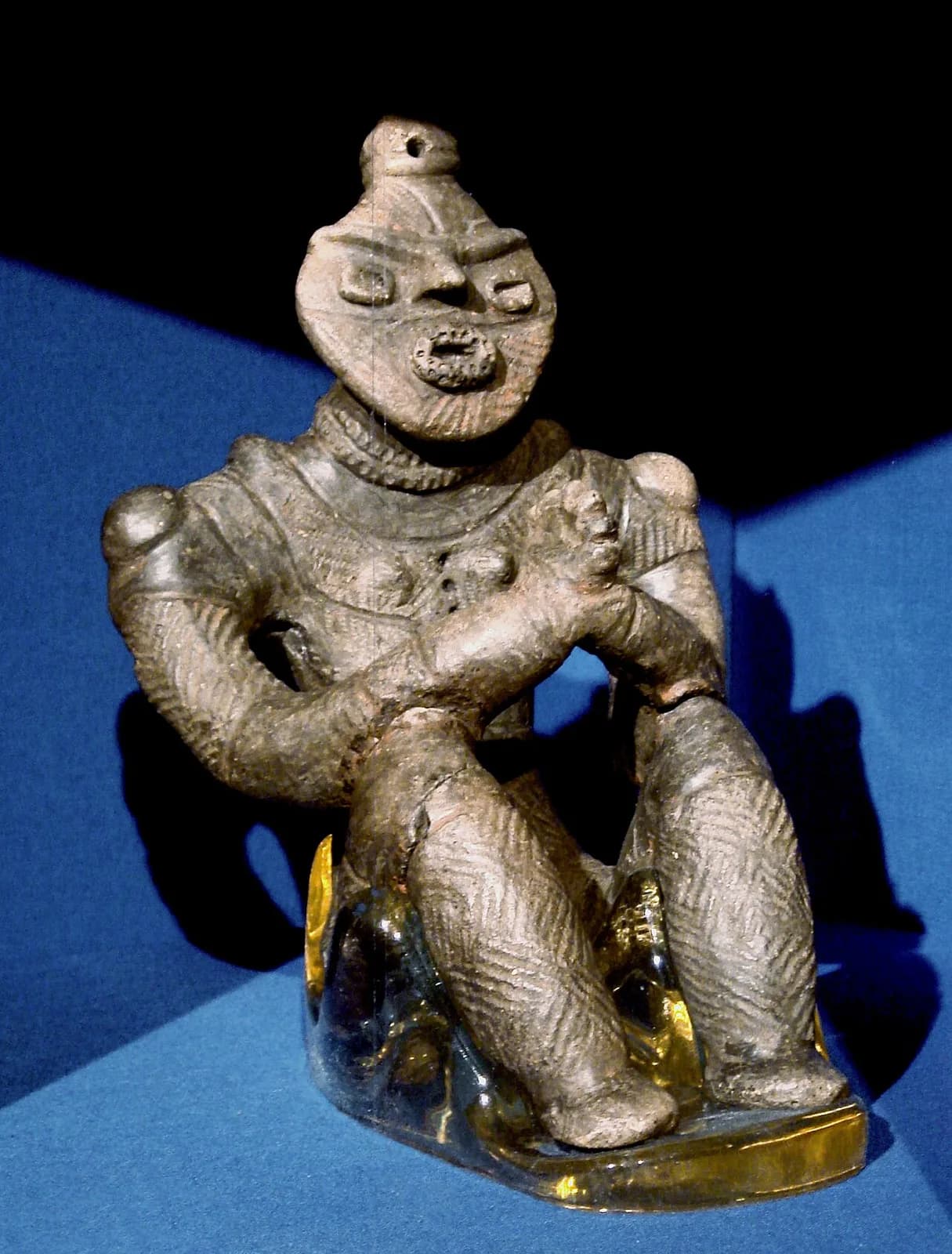
A clay figure about 20 centimeters tall sits with its knees up and its hands pressed together. Someone glued its cracks with natural asphalt in prehistory.
Archaeologists found it inside a house, leaning against a wall. One foot lay 2.5 meters away on the floor.
The traditional view
The Korekawa Archaeological Institution in Hachinohe, Aomori Prefecture, calls it the clay figurine with clasping hands. It stands 19.8 centimeters high. Hachinohe City dug it up in July 1989 during a rescue excavation at the Kazahari 1 site.
Kazahari 1 was a large circular settlement. The institution says pits, dwellings and storage pits stand around two cemeteries. It reads the site as a probable hub of settlements in the Late Jōmon period.
The figure lay in pit dwelling 15 near the back wall. It rested on its right side and faced the center of the room. The institution says dogū usually turn up in middens and outside any structure. It calls this find rare and important.
About 70 dogū came from Kazahari 1. The institution says this is the only intact one. Its Japanese page says the figure was broken at the roots of both thighs and at the knees and arms. It says the breaks carry traces of asphalt repair and that red pigment survives on the face and body. The institution reads these traces as signs of a figure used with care. (That page is in Japanese and the translations are mine.)
Aomori Prefecture describes the figure in its National Treasure summary. It says the figure had already broken into four parts before the dwelling was abandoned. It says natural asphalt had bonded the breaks.
The institution dates the figure to about 3,500 years ago, in the second half of the Late Jōmon period. It bases that on the style of the pottery and the dogū. The Tokyo National Museum lists it as Late Jōmon, 2000 to 1000 BC.
The Agency for Cultural Affairs database records that Japan named the dogū a National Treasure on July 10, 2009. It lists Hachinohe City as the owner and the Korekawa Jōmon Kan as the place where it is kept.
The spot where it was found is now a nursing home on private land. The Korekawa institution says visitors cannot enter it.
Where the Evidence Stops
The one Japanese site in Earthly Enigmas is the Yonaguni Monument, which I discuss in Chapter 10.
Two ideas from the book touch this figure. In Chapter 4 I describe three dating habits and say each can be misused, and one of them is dating by style. In Chapter 5 I write about networks that link distant cultures.
What the Record Cannot Settle
The record leaves several questions open. Three of them stand out.
Was it broken to be mended?
Aomori Prefecture says the figure was already broken into four parts before the dwelling was abandoned. Harada Masayuki is a former chief cultural properties specialist at the Agency for Cultural Affairs. In a December 2024 booklet from the Aomori Prefectural Buried Cultural Properties Research Center he says the figure came out of the dwelling in four pieces. He names them as the upper body, the left leg, the upper right leg and the lower right leg. (The booklet is in Japanese and the translations are mine.)
Harada says thick brown-black asphalt clings to the break faces. He reads this as an effort to rejoin a figure that had broken once or been broken on purpose. He notes a theory that dogū were broken after ritual use and sent back to the earth or scattered. He calls this case very interesting as an apparent attempt at a figure's rebirth.
Korekawa reads the mend as a sign of long use and care. The Sainsbury Institute's teaching page says almost all of more than 20,000 dogū were deliberately broken by their makers. In its second part the same page says archaeologists cannot agree whether dogū were broken intentionally.
Was the break an accident, a ritual act or both, and what was the mend for?
Why was it in the house?
Korekawa says dogū usually come from middens. Its Japanese page says this one lay as if set down in a corner of the dwelling. Historia8 is a Hachinohe guide to local cultural properties. It says only two posed dogū among the roughly 70 at Kazahari 1 came from pit buildings. They are this figure and a second one that seems to rest its cheek on a hand.
The Sainsbury page says the figure "may have fallen from an altar-like perch" when the building was abandoned. Aomori says it broke before the house was left. Harada lists four pieces. Korekawa says one foot was missing and lay 2.5 meters away on the west floor.
I have not seen the excavation report or a plan of the dwelling. I have not checked how the pieces lay relative to each other.
What happened in dwelling 15 when the house was left, and what moved the foot?
Was it a prayer or a birth?
Korekawa says the figure holds its hands together as if to pray. Aomori says the name Gasshō Dogū was given at the time of discovery. In 2014 the Tokyo National Museum showed the figure in an exhibition built on the theme of the form of prayers. Its caption asks what the figure sees before it.
Other voices offer a different reading. A 2025 post from the Tohoku History Museum's official account says the figure looks like prayer. The post adds that it is also thought to show a woman facing childbirth in a seated position. The Sainsbury page says one interpretation is that it shows birth.
Harada lists both readings. One treats the pose as the embodiment of prayer in the Jōmon world. The other reads it as a prayer to ease labor pains in the custom of seated birth. He writes that he does not think an answer is needed in a hurry.
What was the pose meant to show?
The questions I can't put down
Some questions need more room than one article gives them. Two of them keep pulling me back.
How do you date a figure by its style? Korekawa gives about 3,500 years ago and says the date rests on the style of the pottery and the dogū. A Hachinohe sign near the site dates the village of that period to between 3,500 and 3,000 years ago. The Tokyo National Museum gives 2000 to 1000 BC. I have not found a radiocarbon date for dwelling 15. In Chapter 4 I describe three dating habits and say each can be misused. I follow that question through Earthly Enigmas. The Bactrian Princess article asks a similar question about a small figure with no findspot.
Where did the asphalt come from? Tanaka Kousaku wrote a 2000 paper on the use of asphalt in ancient periods. He says Jōmon people collected it only from oil fields on the Japan Sea side of the Tōhoku region. He names Akita and Yamagata Prefectures and says it traveled across Tōhoku along trading routes. I have only seen the abstract. I have not found a chemical source for the mend on this figure. In Chapter 5 I follow the question of how far ancient networks reached. You can read a free sample of the book before you decide. The articles section has more subjects in the same format.
Sources
- Korekawa Archaeological Institution: About the clay figurine with clasping hands
- Korekawa Archaeological Institution: permanent exhibition page (in Japanese)
- Korekawa Archaeological Institution: where the figure was found, with the Hachinohe roadside sign (PDF in Japanese)
- Agency for Cultural Affairs: National Cultural Properties database record (in Japanese)
- Aomori Prefecture: National Treasure summary (in Japanese)
- Aomori Prefectural Buried Cultural Properties Research Center: December 2024 event booklet, Harada Masayuki's text (PDF in Japanese)
- Historia8: Gasshō dogū and cheek-resting dogū (in Japanese)
- Tokyo National Museum: National Treasures of Japan (2014 exhibition)
- Sainsbury Institute: Mystery of Dogu Figurines
- Tohoku History Museum post on X (in Japanese)
- Tanaka Kousaku, Use of asphalt in ancient periods (2000), abstract on ResearchGate (abstract only)