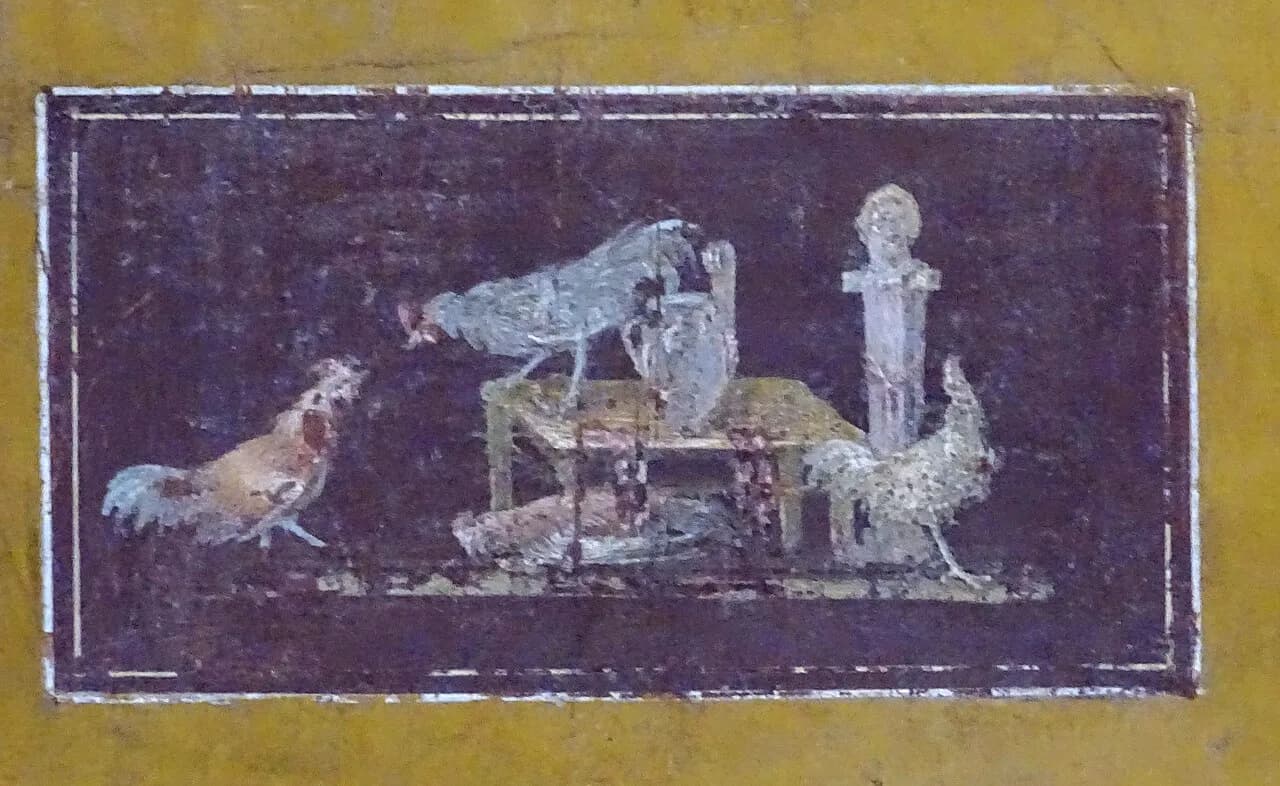
A close photograph of a Pompeii wall painting looks like a framed picture. The frame is an illusion. The painter built the picture into a wall, and the wall belonged to a room in a house where people lived and worked.
Pompeii is also a place where people died. This article stays with the walls and treats the town with that in mind.
The traditional view
Mount Vesuvius erupted in 79 AD. UNESCO's record says it "engulfed the two flourishing Roman towns of Pompeii and Herculaneum." Pompeii was buried "largely by a thick layer of volcanic ash and lapilli." UNESCO adds that the sites give "a vivid and comprehensive picture of Roman life at one precise moment: the eruption of Vesuvius in 79 AD."
The House of the Vettii is one of the best known homes in the town. The Archaeological Park's guide calls it "one of the richest and most famous in Pompeii." It names the owners as Aulus Vettius Restitutus and Aulus Vettius Conviva. It calls them brothers and freedmen who "became rich through trade."
The guide says Priapus, "the god of prosperity," is painted to the right of the door. It also describes a living room "with the frieze of Cupids which carry out the main productive activities of that time."
August Mau gave the house a full chapter in Pompeii, Its Life and Art. He wrote that it was excavated in 1894 and 1895. He wrote that "The wall paintings of this house are the most remarkable yet discovered at Pompeii." He placed the decoration "throughout of the fourth style," the last of the four styles he defined.
Mau also wrote that the paintings "have been left on the walls and are preserved with the greatest care." That choice is part of why the house is famous today.
The standard story includes an earthquake. The Park's guide says a violent earthquake in 62 AD "shook the entire area surrounding Mount Vesuvius." Rebuilding began at once but "took a long time to be completed." The guide says the eruption came on August 24, 79 AD and left "what seemed to be an open construction site."
What a Photograph Leaves Out
The sources point to four layers in any painted surface at Pompeii. The first is the painter's work. The second is any renovation that came before the eruption. The third is what the eruption did. The fourth is what excavation and restoration have done since.
A photograph shows all four layers at once and labels none of them. The three questions below come from that gap.
Where They Don't Meet
The traditional account and the surviving walls agree on a great deal. They separate on three questions.
Which wall did the photograph come from?
Mau lettered the rooms of the house on a plan. The Park's restoration notice says the work covers the "eccezionale ciclo di affreschi e degli apparati pavimentali dell'intera casa." In my translation that is the exceptional cycle of frescoes and floors of the whole house.
Beth Severy-Hoven writes about the house in Gender & History. She says "Many large houses in Pompeii offered rooms decorated with expensive panels of mythological scenes; the House of the Vettii has six." She cites Katharina Lorenz for the point that "images in houses tend to be juxtaposed within rooms in unique ways." I have not read Lorenz.
A panel seen alone loses that company. The Park's guide shows how far a painting can end up from its wall. For the neighboring House of Castor and Pollux it says "the most significant paintings can now be viewed at the National Archaeological Museum in Naples." It adds that copies "have been recently relocated in situ."
Mau argued against moving paintings at all. He wrote that removing one "can hardly be accomplished without some damage to the parts of the wall immediately in contact with it."
Can a given panel be placed on a room plan, and what hung on the walls beside it?
How long had the paint been dry?
UNESCO describes the town as a picture of Roman life "at one precise moment." The walls may hold more than one moment.
Mau split the paintings of the House of the Vettii into two groups. He wrote that the earlier paintings "must have been placed upon the walls before the year 63." He put the room of the Cupids and Psyches in that earlier group. He wrote that the contrast between the groups "seems impossible to explain except on the assumption of a change of owners."
Severy-Hoven gives a different picture. She writes of "wall paintings generally agreed to have been carried out by a single workshop" in the renovations after the earthquake of 62 CE. She names Willem Peters, Arnold de Vos and Mariette de Vos as scholars who agree the house was "extensively renovated" between the earthquake and the eruption. I have not checked those works.
The question of unfinished work has its own record. In 2018 the Park presented a charcoal inscription from the House of the Garden. It was dated "XVI K NOV," which is 17 October. The Park's 2024 journal article notes that it carries no year. The authors write that the wall may have been finished a year earlier and left waiting for its floor. In my translation they add that such a situation could last "a year or more."
How long had these walls been finished when the ash fell, and was every room complete?
What colors did a Roman visitor see?
Heat changed some of the paint. Iker Marcaida and colleagues write in 2019 that the eruption's "thermal impact" promoted "the partial transformation of some yellow-painted areas into red." Their heating tests on Pompeii fragments found the change complete at 275 degrees Celsius.
Not every dark patch is the eruption's work. In 2021 Silvia Pérez-Diez and colleagues reported that "not all the darkened areas on the Pompeian cinnabar paintings" come from changes in the pigment. The same paper names another cause. It says the site has suffered decay from "the (former) application of restoration products that are no longer used."
The Park's 2023 reopening release names one of those products. In my translation it says removing layers of wax applied to the frescoes in the past "to protect them and make them shine" was especially difficult. It calls that method "highly damaging" and says it hid many details of the paintings.
UNESCO still rates the site's authenticity as "very high" despite earlier restoration. Mau, writing soon after the excavation, called some of the later colors "sometimes crude." I have not checked whether either laboratory study sampled the House of the Vettii.
Which of the colors now on the wall did the painter put there?
The questions I can't put down
Some questions need more room than one article gives them. Two of them keep pulling me back.
What day did the eruption happen? UNESCO's text and the Park's 2015 guide give August 24. In 2018 the Park presented the charcoal inscription as support for an autumn date. In December 2024 the Park's own journal asked whether the archaeology gives enough reason to doubt Pliny. The authors write that archaeology "può solo o confermare la data pliniana o provarla falsa." In my translation it can only confirm the Plinian date or prove it false. Chapter 4 of Earthly Enigmas has a table called "The Dating Game" that sets official dates beside evidence-based dates for other sites. Pompeii is not in it.
Who were the images for? The Park describes the owners as former slaves who grew rich through trade. Severy-Hoven reads paired rooms of the house as pictures made to assert "the status of the owners as masters." The Park's 2023 release adds a detail about access. A room beside the kitchen with small erotic paintings once had an iron door that let in only adult men. The Park says the door came out days before the house reopened. In Chapter 6 of the book I ask a related question about cave art under the heading "Who Were They Drawing For?" You can read a free sample before you decide. The articles section has more subjects in the same format.
Sources
- UNESCO World Heritage Centre, Archaeological Areas of Pompei, Herculaneum and Torre Annunziata (list 829)
- Archaeological Park of Pompeii, A Guide to the Pompeii Excavations (2015)
- Archaeological Park of Pompeii, Casa dei Vettii: Restauro in corso (Italian)
- Archaeological Park of Pompeii, press release on the reopening of the House of the Vettii (Italian)
- Zuchtriegel et al., La data della distruzione di Pompei, E-Journal degli Scavi di Pompei 27 (12 December 2024) (Italian)
- August Mau, Pompeii, Its Life and Art, translated by Francis W. Kelsey (Project Gutenberg 42715)
- Beth Severy-Hoven, Master Narratives and the Wall Painting of the House of the Vettii, Gender & History 24 (2012) (text read through a scholarly index, not the publisher page)
- Marcaida et al., Raman imaging to quantify the thermal transformation degree of Pompeian yellow ochre, Analytical and Bioanalytical Chemistry (2019) (abstract only)
- Pérez-Diez et al., When Red Turns Black, Analytical Chemistry (2021)