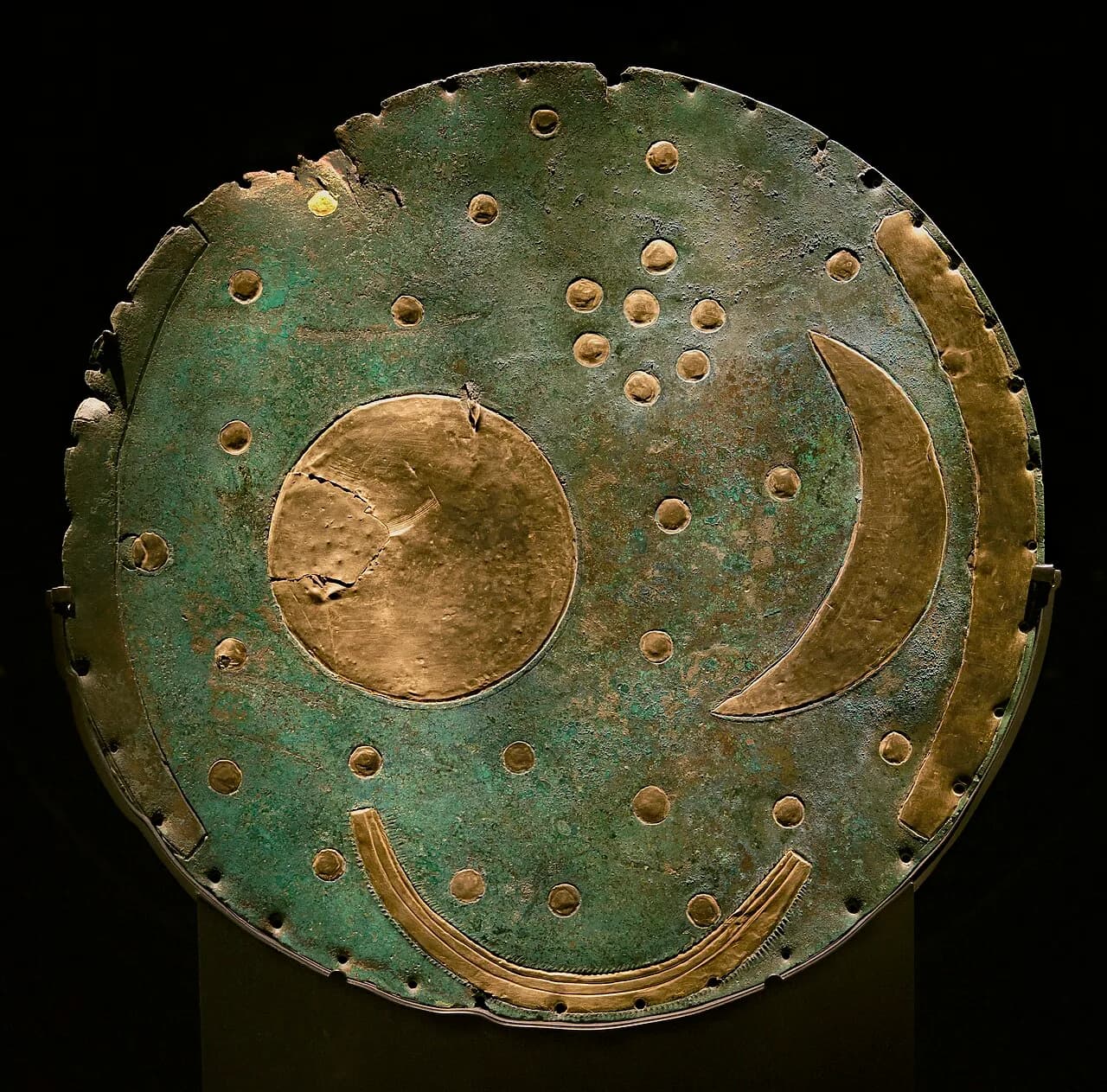
A bronze disc about 32 centimeters across carries gold shapes that look like a sun or full moon, a crescent and about thirty stars. Detectorists dug it up in 1999 on the Mittelberg, a hill near Nebra in Germany. Police took it back in 2002.
Specialists on both sides of the argument accept that it is a genuine prehistoric object. They disagree about almost everything else.
The traditional view
The State Museum of Prehistory in Halle calls the disc "the world's oldest concrete depiction of astronomical phenomena that we know." UNESCO added it to the Memory of the World register in 2013. Its entry says the disc was ritually buried about 3,600 years ago with two swords, two axes, two spiral arm-rings and a chisel.
The museum cannot date the disc by comparison, because nothing like it exists. It dates the hoard instead. It says axes of that type belong to the Early Bronze Age around 1600 BC in the region of the lower Elbe and Oder rivers. It adds that radiocarbon on birch bark from the sword hilts gives the 16th to 15th centuries BC.
The museum describes the disc as a layered object with five phases. First came the night sky with 32 stars, a full moon and a crescent. Later rim arcs covered two of the stars. A feathered arc was wedged in between the stars, the rim was perforated, and one horizon arc was removed before burial. The gold of the stars, the rim arcs and the feathered arc each has a different silver content.
The museum reads the picture as astronomy joined to myth. It says the stars are spread so that no constellations appear and one cluster stands out, the Pleiades. It reads the gold arcs as the sun's course between spring and autumn and the curved shape between them as a boat.
Sky Knowledge
I do not discuss the Nebra disc in Earthly Enigmas. I do write about sky knowledge at other sites. In Chapter 5 I say that Stonehenge, Carnac, Callanish and Newgrange share the same celestial events and the same long-cycle awareness. I place them in seven countries not in contact by any route mainstream archaeology accepts. I say the solar and lunar alignments take generations of observation.
Where the Accounts Part Ways
The museum, its critics and the astronomers lean on questions the evidence has not closed. Three of them stand out.
Was it found as we are told?
The museum says its reconstruction of the find context rests on its excavation of the Mittelberg and on "the statements of the finders." It adds that the excavation turned up no graves or settlement remains nearby.
Rupert Gebhard and Rüdiger Krause published a critique in 2020. Their abstract says the published results do not allow the conclusion that the re-excavated site is correct. It says they do not allow the conclusion that the objects form a closed find either. They write that the scientific tests on the objects contradict a shared origin rather than confirm one. They treat the disc as a single object and call a date in the first millennium BC most likely. Krause told The Art Newspaper that the iconography points to around 500 to 50 BC.
Ernst Pernicka and twelve colleagues answered the same year. They write that the critics' argument "is based on early published and unpublished material, which is used and cited selectively." They say it rests on "a distortion of the evidence." The Austrian Academy of Sciences summarizes their case. Soil samples, metal concentrations in the sediment, the looters' pick marks and court statements place the hoard on the Mittelberg. The copper of the disc and the companion finds comes from the same ore deposit in the Salzburg region.
Both sides agree that the disc cannot be dated on its own. Gebhard and Krause say no comparable disk exists. Pernicka and colleagues write that no scientific method can yet date a copper alloy exactly. The date of the disc therefore depends on the finds said to lie beside it. What evidence would show beyond argument that the disc and the swords lay in the ground together?
Which sky does it show?
The museum names the Pleiades. Other researchers read the same gold shapes differently. A 2024 preprint by Bernd Fiedler summarizes three earlier readings. I have not read the original papers by Wolfhard Schlosser or Rahlf Hansen.
Fiedler reports that Schlosser saw "a reminder of a method of determining the start and end dates for the farming year," using the settings of the Pleiades. He reports that Hansen saw "a rule for inserting a leap month," a rule he says is known from the much later Babylonian calendar. He reports that Emília Pásztor and C. Roslund see an object for cultic purposes "that has no astronomical background." The abstract of their 2007 paper calls it "the shamanistic device of a local warrior society."
Fiedler then offers a reading of his own, built on a line of stars from the constellations Auriga and Gemini. His paper is a preprint and I know of no peer review. A 2024 paper by Vogt and Crocco reads the seven-star group as a conjunction of planets in 2210 BC and the large circle as a supernova. I have seen only the abstract of that paper in a search excerpt. The date it proposes falls about six hundred years before the museum's burial date.
Even the largest curved shape is disputed. The museum reads a boat. Gebhard and Krause's press captions say it "turns out to be a rainbow." The Austrian Academy summary says a boat is a typical Bronze Age motif unknown in the Iron Age.
How would anyone test one of these readings against another?
Which version of the disc are we reading?
The museum says the disc was "repeatedly modified with different generations of craftspeople each leaving their own signature." It says it was "probably adapted again and again to the altered ritual needs and changing worldviews." It also says, "We do not know when the Sky Disc was made and how much time has passed between the changes."
The museum assigns the stars to the first phase and the rim arcs to the second. It says the arcs mark the solstice points and point to landmarks such as the Brocken mountain. A reading that uses the Pleiades and the solstice arcs together as one instrument therefore combines two phases. I draw that from the museum's own pages. I have not seen a published paper that makes the point.
Which phase does a given reading describe, and who was meant to read it?
The questions I can't put down
Some questions need more room than one article gives them. Two of them keep pulling me back.
Why would anyone bury it? The museum says the disc was equipped like a chieftain and that "the age of the Sky Disc and its message had passed." It says the treasure was deposited in an enclosed sacred precinct. In the book I read the deliberate burial of Göbekli Tepe as intent that it be found later, by someone else, in a different world. I make no claim about Nebra. You can follow that question through Earthly Enigmas and in the Göbekli Tepe article.
How did the metal travel? The museum says copper is found near Nebra but research points to a different source and "extensive long-distance trade," with trails to Austria and England. The Austrian Academy places the gold in Cornwall. In the book I write that shared sky awareness appears at sites not in contact by any route mainstream archaeology accepts. I follow that question through the book. You can read a free sample before you decide. The articles section has more subjects in the same format.
Sources
- State Museum of Prehistory Halle: Nebra Sky Disc
- State Museum: Dating
- State Museum: The Nebra hoard
- State Museum: The place of discovery
- State Museum: The phases of the Sky Disc
- State Museum: The universe of the Sky Disc
- State Museum: Scientific research
- UNESCO Memory of the World: Nebra Sky Disc
- Gebhard and Krause, Critical comments on the find complex of the so-called Nebra Sky Disk (Archäologische Informationen 43, 2020), abstract
- DGUF press release on Gebhard and Krause (3 September 2020)
- Pernicka et al., Why the Nebra Sky Disc Dates to the Early Bronze Age (Archaeologia Austriaca 104, 2020), abstract
- Austrian Academy of Sciences: The Nebra Sky Disc dates from the Early Bronze Age (13 November 2020)
- The Art Newspaper: Is the Nebra Sky Disc a millennium younger than we thought? (15 September 2020)
- Fiedler, An Astronomical Interpretation of the Nebra Sky Disc (arXiv preprint, 2024) (secondary source for Schlosser, Hansen, Pásztor and Roslund)
- Pásztor and Roslund, An Interpretation of the Nebra Disc (Antiquity 81, 2007), abstract on Academia.edu
- Vogt and Crocco, Does the Nebra Sky Disk encode an early Bronze Age report of a galactic supernova? (Astronomische Nachrichten, 2024), abstract seen only in a search excerpt