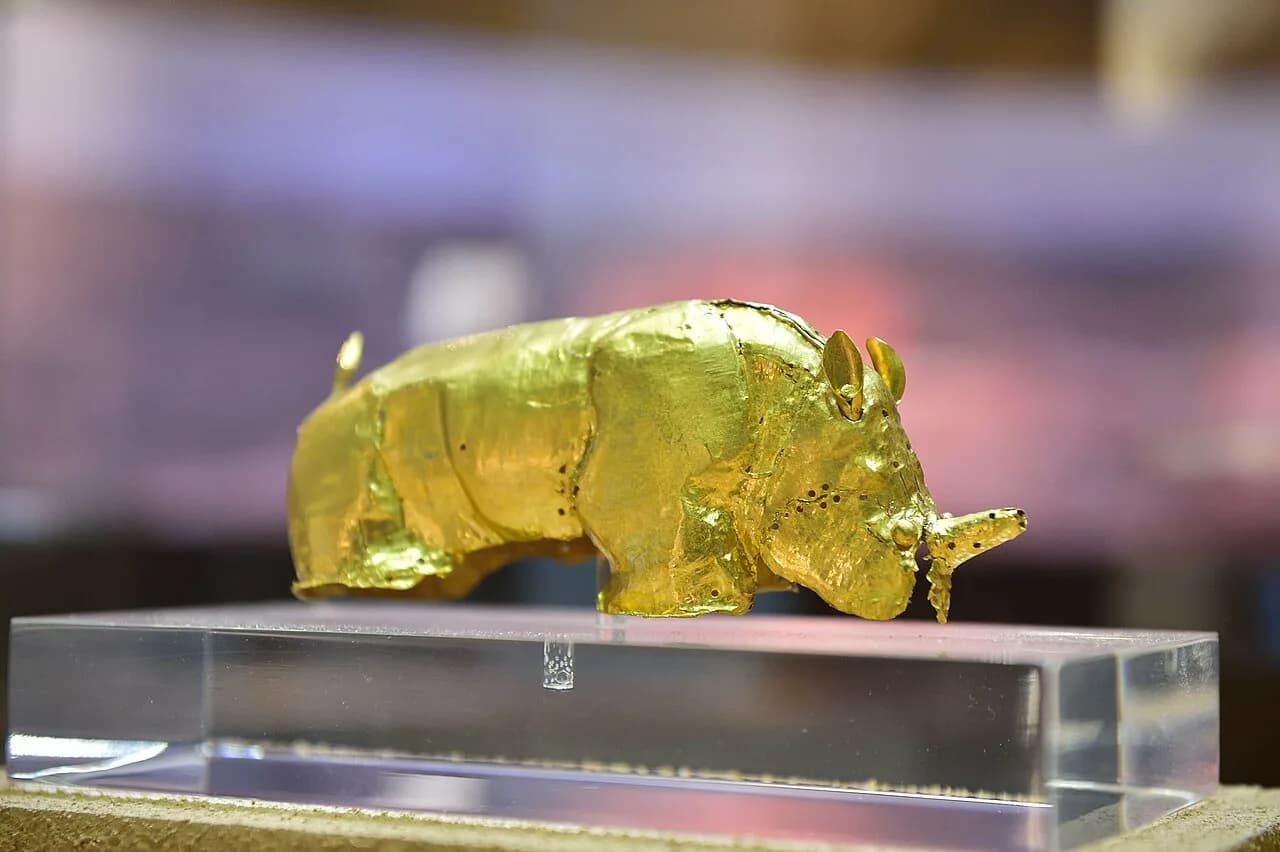
A small gold rhinoceros sits in a museum in Pretoria. It is about 14.5 centimeters long and 5.5 centimeters high. It weighs 37.4 grams.
The University of Pretoria Museums say it came from a grave on Mapungubwe Hill. They give it a date. A published paper on that grave says the grave has never been dated.
The traditional view
UNESCO lists the Mapungubwe Cultural Landscape and describes it as the rise and fall of the first indigenous kingdom in Southern Africa, between 900 and 1,300 AD. The landscape lies where the Limpopo and Shashe rivers meet. UNESCO says the kingdom harvested gold and ivory from its hinterland and traded through East African ports with India and China. Its wealth showed in Chinese porcelain and Persian glass beads.
The Metropolitan Museum's timeline essay says Mapungubwe is the earliest known site in southern Africa where leaders lived apart from their followers. The Met says the city flourished from 1220 to 1290 or 1300. UNESCO attributes the end to climate change and says power moved north to Great Zimbabwe.
Gold turned up in three of the 27 graves excavated on the hill. In 2009 Woodborne and colleagues dated plant fibers wound inside two gold anklets. They place the manufacture in the 13th century AD. They call the gold the product of a mature indigenous metalworking tradition. They also write that no gold has been found in southern African Iron Age sites that pre-date the hill.
The rhinoceros came from a grave known as the Original Gold Grave, labeled M1 A620. The University of Pretoria Museums describe it as hollow gold foil made of several thin pieces. They say it was nailed onto a wooden carving that has since decayed. They date it to about CE 1250 to 1290. The British Museum restored it in 1999.
The Pretoria curator adds that the figure resembles neither the white nor the black rhino and was made to be unique.
What the Evidence Does Not Settle
In Earthly Enigmas I write about gold in Chapter 7. I write that Earth holds far more accessible gold than planetary formation models predict. I also write about circular stone structures, roads and terracing across about 1,500 square kilometers in Mpumalanga, a gold-rich region of South Africa, with no official age assignment.
The published work on the rhinoceros leaves its own questions open. Three of them stand out.
Where the Accounts Don't Meet
How old is the rhinoceros?
The Pretoria museum gives about CE 1250 to 1290. Alex Duffey, in a 2012 paper in the Journal of African Archaeology, writes that the Original Gold Burial has never been properly dated. He explains that gold cannot be radiocarbon dated and the skeleton was too fragmentary. He concludes "we cannot put a date to iconic figures such as the gold rhino."
Woodborne and colleagues made the one direct measurement. Their two fiber samples gave calibrated ranges of AD 1157 to 1266 and AD 1210 to 1288. They say the rhinoceros itself could not be dated. They also say the samples cannot be tied to a particular grave and that the description points to a different burial, the Gold Skeleton grave M7.
Duffey goes the other way. He notes that the graves on the hill were shallow and that many beads from the hill look later than the 13th century. He writes that an 18th or 19th century date for the Original Gold Burial "seems feasible." He also says the beads from this grave were mixed with the rest during repacking in the 1990s and cannot be identified one by one.
The bead work he cites comes from Prinsloo, Tournié and Colomban. Their 2011 abstract reports pigments made after the 13th century in beads from the hill, some from the 19th century. They say the result raises questions about the revision of the hill's last occupation date to 1290 AD. Their paper is about the hill as a whole. I have read the abstract and introduction only.
What would date the grave that held the rhinoceros?
What was it attached to?
Everyone agrees on a wooden core. The Pretoria museum says the foil was nailed onto a wooden carving. The Met says the foil was molded over what was likely a soft core of sculpted wood. Duffey cites the British Museum conservator Andrew Oddy, who reasoned that the gold pins were too soft for anything harder than wood.
Duffey then looks at the feet. The legs flare outward and carry small nail holes. He says the bovine and the feline from the same grave show the same feature. He argues that all three stood on the rim of a lost wooden divining bowl. He compares the figures with divining bowls from Zimbabwe and from Venda collections.
He describes his own idea as one that began as a speculative hypothesis and became in his words a firmly established theory. His conclusion is milder. He writes that it seems sensible to argue for a divining bowl. He adds that many fragments are missing, so a full reconstruction cannot be made.
His oldest comparison bowl was found in a cave in the 1880s. He writes that it has not been dendrochronologically dated and most probably belonged to a diviner of the late 18th century. The rhinoceros may be centuries older. I have not found a published reply to Duffey's proposal.
Was the rhinoceros a figure that stood alone, or one piece of a larger object?
What did the first dig leave behind?
Duffey describes how the gold came out of the ground. A party of five men removed sheet gold, beads and small nails from the grave at the turn of 1932 to 1933 and divided the finds between them. Leo Fouché, a history lecturer at the University of Pretoria, recovered the pieces later. He found the head with one man, the tail and ears with another and the rump with a third. Duffey quotes Fouché saying reconstruction was almost impossible.
Duffey writes that no written record of the dig was ever made, so there is no record of where the fragments lay in the grave. Little else from the grave was saved. UNESCO says the standard of the 1930s excavations could be argued to have lost valuable evidence.
The human remains were repatriated to the site and reburied in November 2007, according to Woodborne and colleagues. They write that further research on the skeletons is no longer possible. The university's Mapungubwe Archive holds records from 1933 onward. It is open to registered researchers by appointment.
Even the year of the find changes with the source. Duffey and the Pretoria slide record point to 1932 and 1933. John Giblin writes 1934.
What can the surviving records still tell us about the grave?
The questions I can't put down
Some questions need more room than one article gives them. Two of them keep pulling me back.
Where did the gold tradition come from? Woodborne and colleagues write that no gold has been found in southern African Iron Age sites that pre-date the hill. They also say the technology matched the copper and iron work of the centuries before. I write about gold and about stone ruins in southern Africa in Chapter 7 of Earthly Enigmas.
Who told the story, and when? In a 2016 essay for The Conversation, John Giblin writes that the white South African government of the 20th century marginalized the finds in official narratives. That is one scholar's view and I have not checked it against the 1930s records. In Chapter 17 of the book I look at how institutions handle evidence. The section is called "The Archaeological Suppression Pattern." You can read a free sample before you decide. The articles section has more subjects in the same format, and the Mapungubwe Hill article looks at the settlement around the grave.
Sources
- UNESCO World Heritage Centre: Mapungubwe Cultural Landscape
- University of Pretoria Museums, Sian Tiley-Nel: The one and only gold rhino in the world (2020)
- University of Pretoria: Mapungubwe Archive
- Duffey, Mapungubwe: Interpretation of the Gold Content of the Original Gold Burial M1, A620 (Journal of African Archaeology 10, 2012)
- Woodborne, Pienaar and Tiley-Nel, Dating the Mapungubwe Hill Gold (Journal of African Archaeology 7, 2009)
- Prinsloo, Tournié and Colomban, A Raman spectroscopic study of glass trade beads from Mapungubwe hill and K2 (Journal of Archaeological Science 38, 2011) (abstract and introduction only)
- Metropolitan Museum of Art, Heilbrunn Timeline: Mapungubwe (ca. 1050-1270)
- John Giblin, The Conversation (2016)
- UP repository: pre-restoration slide of the rhinoceros
- Wikipedia, Golden Rhinoceros of Mapungubwe (used only to locate sources)