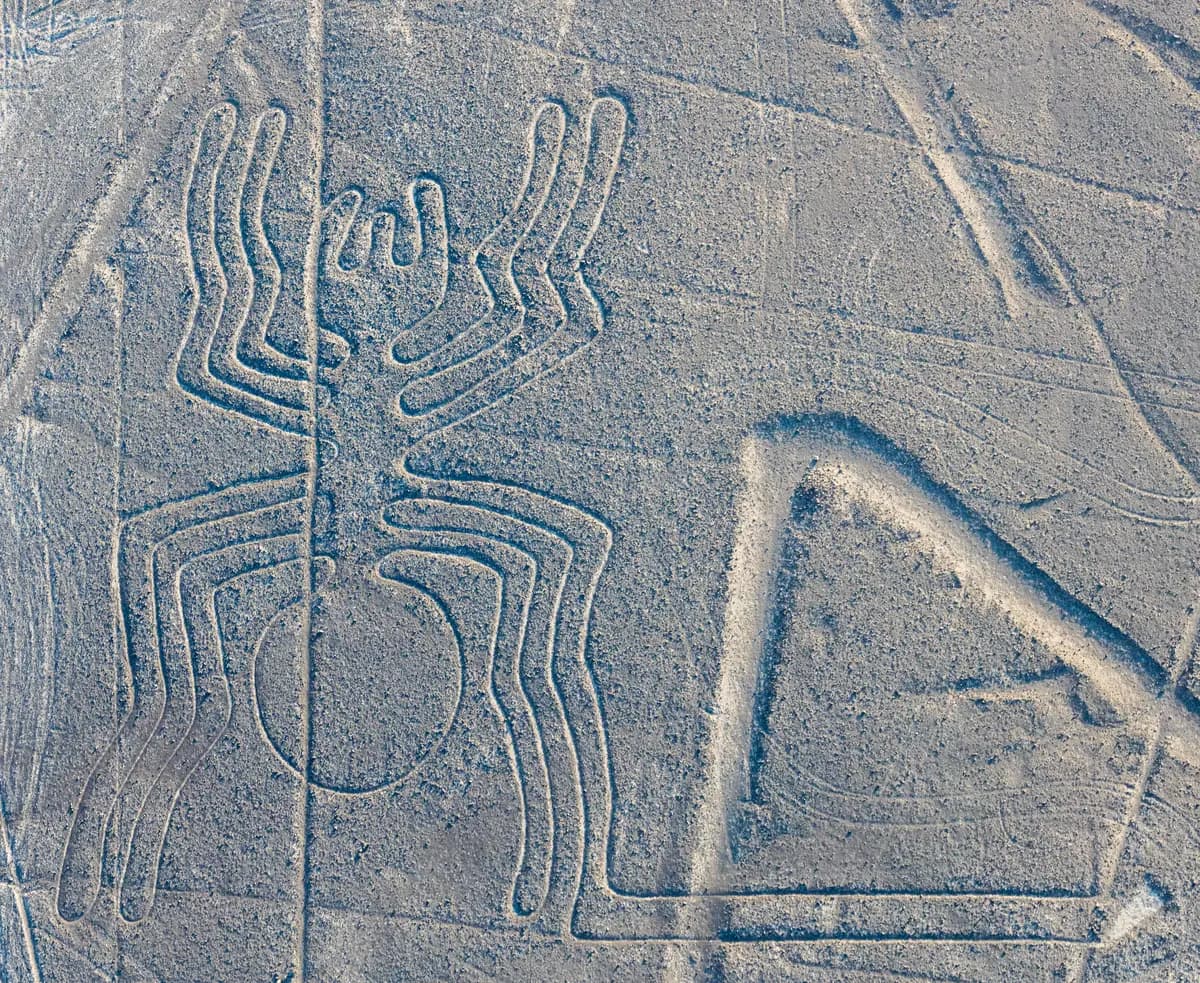
On a dry coastal plain in southern Peru someone scraped shapes into the ground. There are animals and plants and geometric figures. Some of the lines run for kilometers. The giant figures average about 90 meters in length.
Stand beside one of them and you see a shallow trench and a trail of cleared stones. Rise a few hundred feet and the outline comes together. That is the puzzle at Nazca.
The traditional view
The UNESCO listing describes thousands of figures and lines spread over about 450 square kilometers. The makers removed the dark gravel on the surface to expose the lighter ground beneath. UNESCO dates the work to roughly two thousand years ago and believes the lines had ritual astronomical functions. It also describes cleared "tracks" that appear to have been laid out for large numbers of people.
The researchers add detail. A 2024 survey counts 683 small figures that sit beside old walking trails. Their authors conclude that people viewed these while walking along the trails. The same survey counts 50 giant figures. It says the community built and used those for ceremonies, and it links the lines to pilgrimage routes toward the temple at Cahuachi.
The dry climate explains how all of it survived. UNESCO notes that the rainfall there is among the lowest in the world.
The Lines That Only God Can See
In Earthly Enigmas I start from a plain question. If the giant figures only come together from above, who was meant to see them from there?
I think archaeology tends to sidestep that question. The usual answer is that the figures were offerings to sky deities. That answer explains why they were made. It leaves out how the makers could check the result. If the goal was a visible offering, someone would need to see the offering. That means seeing it from above or being guided by someone who could.
I lay out a second idea in the book. It says the makers had seen or been shown the view from above. It is the less common idea and I present it as an idea. I say plainly that neither one can be settled by the evidence we have.
The Question Nobody Has Closed
The researchers and I agree on the geometry. We part ways on what it means. Three questions stand out.
Who were they drawing for?
The new survey sharpens this question. The small figures were made for walkers and can be read from the ground. The giants are the figures with no easy ground-level reading. As I describe them in the book, they look like a trench and a trail of cleared gravel until you gain height.
Walking a line is a ceremony. Drawing a recognizable animal at that scale is a picture. If the giants were made to be walked, why draw them as animals? If they were made to be seen, who could see them?
How do you date a line made by taking stones away?
UNESCO gives the work as made between 500 BCE and 500 CE. A few paragraphs later it says the drawing ran from the 8th century BC to the 8th century AD. It also says the work lasted nearly 2,000 uninterrupted years and approximately one thousand years in the same listing.
The survey explains where the dates come from. Pottery lying on and near the lines supplies them. A line made by removing stones has little of its own to test.
I would like to know what the date attaches to. Is it the line or the pottery beside it?
What are they actually for?
UNESCO says the lines are believed to have ritual astronomical functions. The survey authors count at least five distinct hypotheses about why people built them. Those are astronomy, geometry, water and farming, movement such as walking and dancing, and artistic expression. The authors add that the five are not all related.
They also report that the reading of the giant animals as constellations has been criticized as based on a Western view of the sky. So the public label says ritual and the specialists keep five answers open.
If five answers are competing and none has won, what is the confident label covering?
The questions I can't put down
Some questions need more room than one article gives them. Two of them keep pulling me back.
How much is still undiscovered? It took nearly a century to find 430 figures at Nazca. An AI-assisted survey added 303 more in six months. If the inventory was that far off, I wonder what else we have missed. I follow that thread in Earthly Enigmas.
How did they hold a straight line? The usual explanation uses stakes and cord. I keep coming back to a different problem. If you cannot see the whole line, how do you know it is right? I take that up in the book and you can read a free sample before you decide. The articles section has more subjects in the same format.
You can decide how far each argument carries. Who were they drawing for?