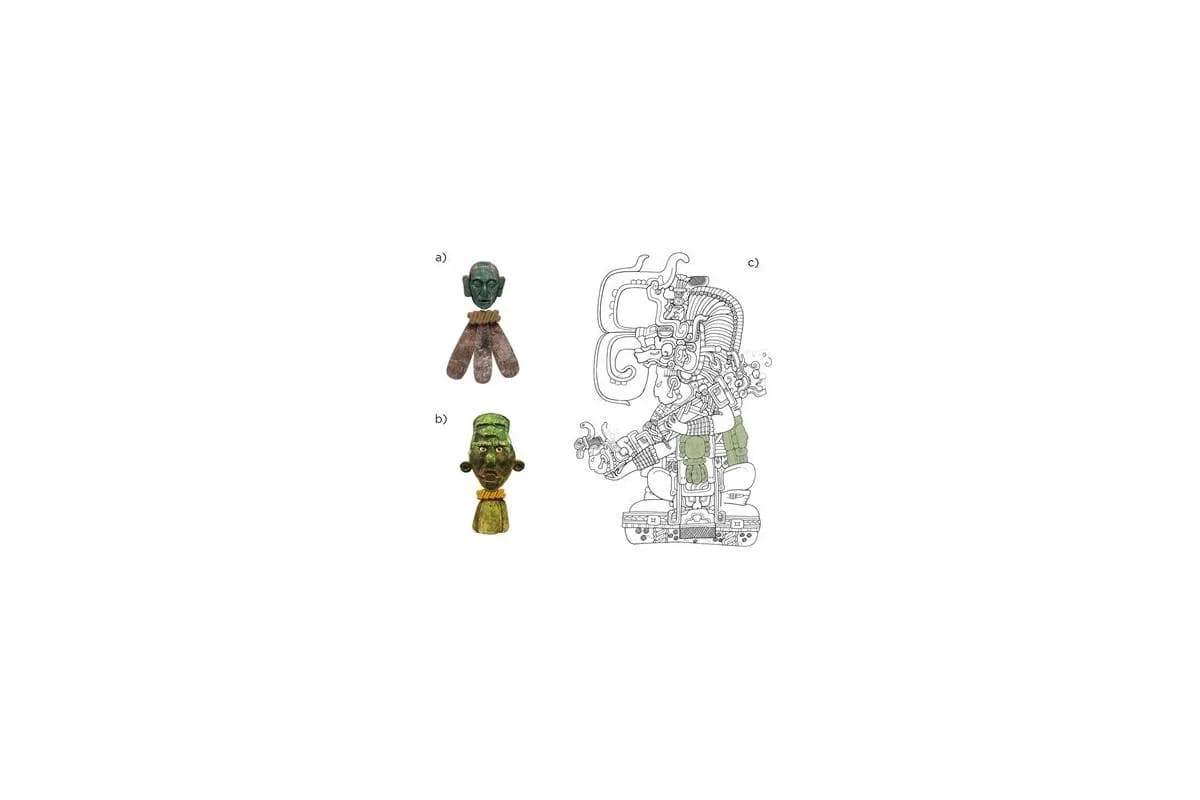
A man was laid in a vaulted tomb under Room 6 of Structure III at Calakmul. Three mosaic masks of jade and shell went into the tomb with him.
One was for his face, one went with his chest and one belonged to a belt. The belt now stands in a museum as a finished object. It has been assembled at least twice.
The traditional view
Calakmul is a Maya city in the Mexican state of Campeche. The Mesoamerican Photo Archives summary on Mesoweb describes Structure III as a palace of twelve rooms just outside the Central Plaza. It says the palace was built in the Early Classic and was "apparently built to surround an elaborate tomb."
The conservator Sofía Martínez del Campo Lanz writes in Arqueología Mexicana that the tomb was found in 1988. The Calakmul Archaeological Project made the find, and William J. Folan directed it at the time. She credits Sophia Pincemin with a "minucioso registro" of the offering, which means a meticulous record. The translations from Spanish in this article are mine.
Vera Tiesler and colleagues describe the burial in a 1999 symposium paper. They place it in a vaulted tomb in Room 6, 3.60 meters long, 1.50 wide and 4.60 high, and they date it to the Early Classic. The skeleton belongs to a robust, tall adult male.
They list the offering as three masks of jade and shell. In their words the masks are "una facial, otra que formaba parte del cinturón y una tercera que formaba parte del pectoral." That means one for the face, one that formed part of the belt and a third that formed part of the pectoral. They also list three plaques "incisas con glifos," incised with glyphs.
The date is a range. The Mesoweb summary says the tomb "is currently thought to date to the fifth century A.D." Kai Delvendahl discusses a late fourth century construction date for the palace and calls it approximate. I read his study as a copy on Scribd and did not check the edition. James Doyle of the Metropolitan Museum of Art gives about A.D. 250 to 550 for the Early Classic at Calakmul.
The same Mesoweb summary says Folan and Marcus concluded the tomb "must have belonged to one of the early rulers of Calakmul." Pincemin titled a 1993 book La tumba de uno de los primeros gobernantes de Calakmul. I have only seen the catalog record.
A mask at the waist fits a known royal pattern. Karl Taube's 2005 paper on jade carries a drawing caption that reads "Ruler wearing heavy belt in form of jaguar-pelt-cushion throne with jade-mask and belt-celt assemblages," and it names Dos Pilas Stela 17. A master's thesis summarizing Taube says jade belt celts typically hang as tinklers in sets of three. I have not checked Taube's own page for that line.
A Belt Put Back Together
In the chapter on the archaeological awakening I do write that the new Maya population estimates "are now mainstream." I also write that airborne laser mapping has shown pyramids, palaces and a ball court in Campeche.
What The Excavation Record Leaves Open
Both views lean on questions the evidence cannot yet answer. Three of them stand out.
How much of the belt rests on the record?
Martínez del Campo Lanz says the three mosaics were first rebuilt in 1989 and then worked on again almost two decades later. During the new assembly the restorers added the jade tesserae and shell appliqués "que no fueron utilizadas en las propuestas de 1989." Those are the pieces that were not used in the 1989 proposals.
She says those pieces sat in small boxes in the storeroom of the INAH Campeche center until 2003. They then went to Mexico City, to the restoration workshop of the Museo Nacional de Antropología.
She writes that placing the pieces correctly in the funerary mask and in the face of the belt "ha derivado en un cambio sustancial de su fisonomía." The change in appearance was substantial. The belt work finished in June 2007, and the pectoral was still being restored as she wrote.
I did not find a tessera count for the belt in what I read. The museum's own illustrated study of the belt might hold one. Its site asked me to confirm I am human before it would load, so I have not read the study.
How much of today's belt rests on the position record, and how much rests on judgment?
Was it worn, or laid beside him?
The Mesoweb summary says "He wore one mosaic jade mask on his face, one on his chest, and one on his belt." The excavation paper by Folan and colleagues is more specific. It says the belt mask was "also found on the tomb floor just to the deceased's right." The mask carries three plain stone pendants that were probably meant to give off sound as they clinked together.
A later paper by Pincemin and colleagues describes three jade mosaic masks. In the search excerpt I could read, the face mask was "found on the floor of the tomb near the deceased." A caption in the 1995 paper still speaks of "a mask worn by the male buried in Tomb 1."
I read the 1995 paper as an Academia copy and through JSTOR search excerpts. Tiesler's paper prints a Pincemin cross section of the tomb and a hypothetical reconstruction of it. I have not examined those drawings.
What does the record show about where each mask lay, and how was the belt arrangement drawn from it?
Do the inscribed plaques belong to the belt or the chest?
The 1995 paper says "The chest mask probably depicts a long-fanged jaguar with an inscribed disk in its mouth." It then says three jade plaques hang from that mask. Each plaque is about 10 by 6 centimeters and carries a couplet of incised glyphs.
The belt mask in the same paper carries three plain stone pendants. For the plaques the authors write that the text on Plaque I "seems to label the plaque itself" and that the text on Plaque III "seems to give the name and title of an individual, perhaps the tomb's occupant."
The Metropolitan Museum essay by James Doyle describes Early Classic Calakmul regalia as including "incised jade belt plaques." The link in that essay to the object page is dead, so I cannot say whether the plaques it means are this set. I have not checked that.
Which ornament carried the incised plaques, and whose name does the text give?
The questions I can't put down
Some questions need more room than one article gives them. Two of them keep pulling me back.
How big was the city? The Mesoweb summary says Calakmul is "estimated to cover 70 square kilometers, and to have had a population of 50,000 during the height of its power." Its sources date from 1993 to 1998. Doyle writes that at its height Calakmul "encompassed some twenty square kilometers." In the book I write that laser mapping raised the Maya lowland population estimate from 5 to 7 million to 10 to 15 million. I follow that question through Earthly Enigmas.
How much of the Maya written record can anyone read? The Folan paper hedges even on the plaque text, which "seems to" name a man. In the book I write that fewer than 20 of an estimated 400 Mesoamerican codices survive. You can read a free sample before you decide. The articles section has more subjects in the same format.
Sources
- Mesoamerican Photo Archives, Calakmul Background (Mesoweb)
- Martínez del Campo Lanz, Los mosaicos ceremoniales de la Estructura III de Calakmul, Arqueología Mexicana 88
- Tiesler, Domínguez and Folan, Los restos humanos de contextos funerarios y extrafunerarios de Calakmul (XII Simposio, 1998)
- Folan and others, Calakmul: New Data from an Ancient Maya Capital in Campeche, Mexico (Latin American Antiquity 6, 1995) (read as an Academia copy and JSTOR search excerpts)
- Pincemin and others, Extending the Calakmul Dynasty Back in Time (Latin American Antiquity 9, 1998) (search excerpt only)
- Taube, The Symbolism of Jade in Classic Maya Religion (Ancient Mesoamerica 16, 2005) (figure captions only)
- Azarova, Maya jade T-shape pendants within Mesoamerican wind-jewel tradition (UC San Diego thesis) (secondary, quoting Taube)
- Delvendahl, Calakmul in Sight (2008), Scribd copy (edition not checked)
- Doyle, A Maya Game of Thrones and Artistic Innovation in Golden Kingdoms (The Met)
- Pincemin, La tumba de uno de los primeros gobernantes de Calakmul (catalog record) (record only)
- Wikipedia was not used.