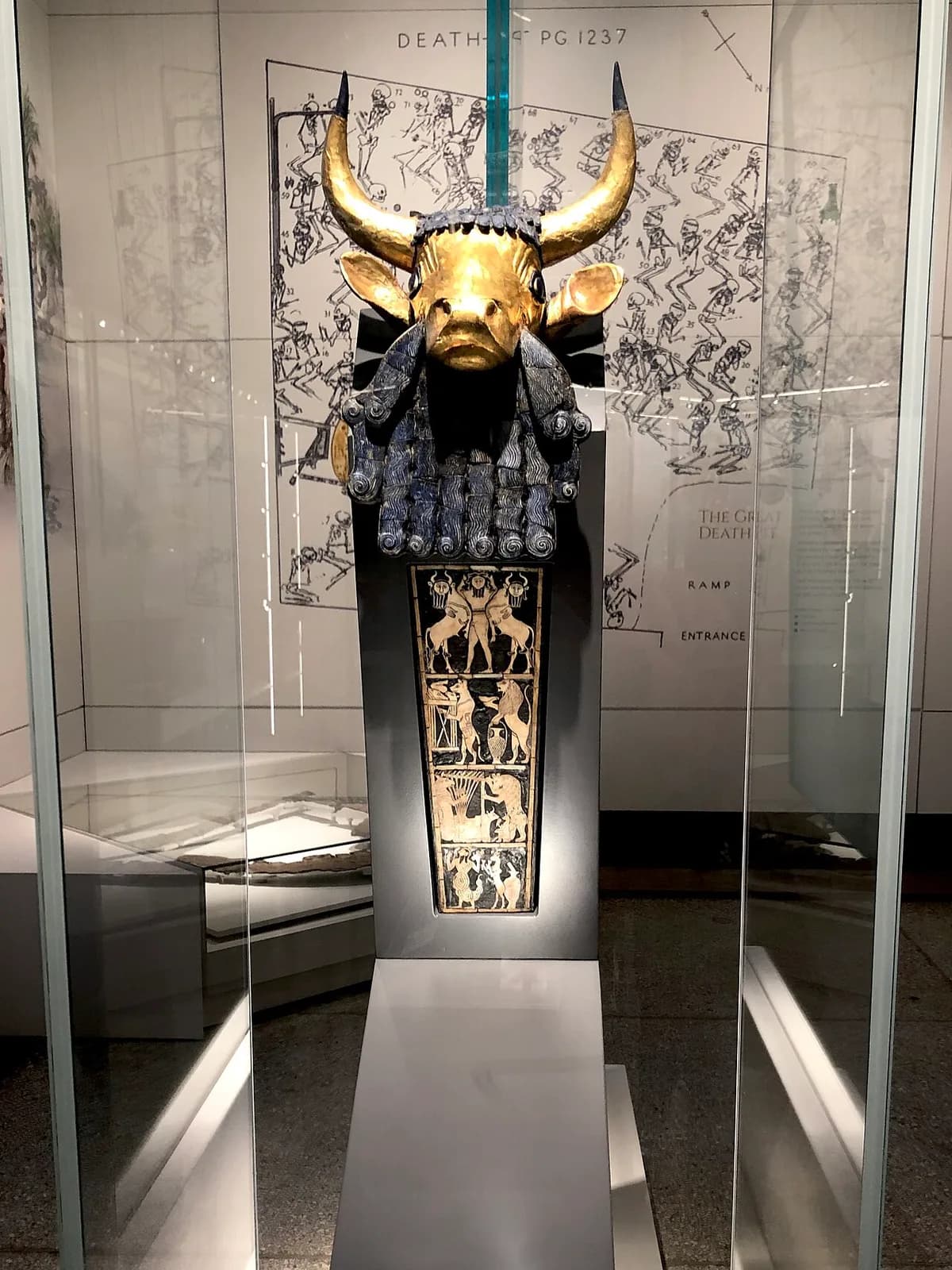
A gold bull's head about 40 centimeters long sits in a gallery in Philadelphia. Its beard is made of lapis lazuli. The wooden lyre it was fixed to decayed in the ground.
Leonard Woolley found an outline in the soil where the sound-box and back upright had been. Any complete lyre built around this head today is a modern assembly.
The traditional view
The Penn Museum record lists the head as object B17694B from grave PG 789 at Ur. It dates the piece to about 2450 BCE and names gold, shell, lapis lazuli, bitumen and silver. The record says the head was originally fixed to the front of a wooden lyre. It adds that the decayed remains of the lyre were somewhat apparent in the soil when it was excavated.
The museum catalogs the shell plaque found just beneath the head as a separate object, B17694A. Penn says its imagery appears to depict a descent into the underworld.
Woolley called PG 789 the King's Grave. In his 1934 report he places the lyre in the open pit beside the tomb chamber. It stood against the side of the pit, over the top of the bodies. He counts 63 people in that pit. He writes that "in front of the sounding-box was the magnificent head of a bearded bull in gold and lapis."
Moorey wrote in Penn's Expedition magazine in 1977 that the levels holding the royal tombs are now dated to roughly 2600 to 2500 B.C. He bases that on texts and on calibrated Carbon-14 dating. He also notes the remarkably small amount of textual evidence for calling the sixteen tombs the graves of kings and queens.
Anne Draffkorn Kilmer is an Assyriologist who wrote on the Ur instruments for Expedition in 1998. She says that without the eleven stringed instruments recovered at Ur we would have no actual stringed instrument from ancient Sumer and Babylonia. She calls the lapis-bearded lyre the largest of the lyres recovered.
Playable replicas of the lapis-bearded lyre exist. Kilmer says reconstructions in coniferous wood produce rich sounds. In her account the largest lyre, with the longest strings, has a register and resonance like that of a bass viol.
She adds that ten cuneiform tablets carry technical information on scales and tuning. They show standardized tuning procedures in a system of seven scales by at least about 1800 BC.
Sumer and the Starting Line
In Earthly Enigmas I read the Sumerian tablets as possible historical records and not only as myth. I say Sumer has no developmental trail. I call it a starting line and I date its emergence to about 4500 BCE.
I write that scholars have catalogued 39 distinct cultural firsts that appear together in the Sumerian record without a traceable ancestry. In Chapter 11 I describe oral tradition as a technology of redundancy and sacred duty that preserved coastlines and astronomy for thousands of years. The Sumerian King List article follows the same chapter.
What the Gold Cannot Tell Us
Both views lean on questions the evidence cannot yet answer. Three of them stand out.
What is original, and what did we add?
Woolley wrote that the impression in the soil gave "nothing to throw further light on the character of the instrument." The lyre had no mosaic or silver to define its frame.
The gold head came out crushed. One ear and both horns had broken away. Woolley pressed the gold back into shape and fitted the horns and ears as the holes and the edges of the metal dictated. He wrote that the reconstruction "involved no risk of any departure from the original." I have not seen an independent conservation report that confirms that.
Penn's register entry reads "Reconstructed." Kilmer reports a non-playable reconstruction in the 1970s and later playable replicas, several in coniferous wood. She notes that more recent research identified the original wood fragments as boxwood.
The strings are an open matter too. The plaque draws an eight-stringed bull lyre. I did not find a string count for this lyre in Woolley's report. Kilmer says several of the Ur instruments had eleven strings and one had thirteen.
Maude de Schauensee studied a different Ur lyre, the boat-shaped one, in the same issue of Expedition. She wrote that direct evidence of how the sound was produced or what type of sound was favored remains elusive.
Which dimensions of the Great Lyre are fixed by what Woolley saw in the soil, and which come from comparison?
How do you tune a lyre that is 850 years older than the manual?
Kilmer dates the standardized tuning procedures to "by at least ca. 1800 BC, or about 850 years after the period of the Royal Cemetery of Ur." Two of the tuning tablets came from Ur itself. She calls it highly probable that the tuning systems had earlier Sumerian antecedents, because many of the Akkadian technical terms have Sumerian equivalents.
De Schauensee writes that little is known about the tuning or sound of these instruments other than from descriptions in later texts. Kilmer adds a caution of her own. She writes that "we have no evidence on which to base an assertion that ancient Near Eastern music sounded like modern Near Eastern music."
Jay Rahn, in a 2022 paper in Music Theory Online, says the view that Mesopotamian tuning was diatonic rests on conclusions first advanced in 1968. The paper identifies flaws in that reasoning that "have remained uncontested." It quotes Sam Mirelman calling the consensus "uncomfortably familiar and Eurocentric." Rahn still concludes the tuning can be interpreted as diatonic without assuming scale degrees or octave identity.
I have read only the abstract of Mirelman's 2013 paper. It calls the tuning manual the earliest known example of music theory, about a thousand years ahead of anything comparable from other cultures.
Woolley went further than Kilmer. He saw three sizes of lyre. He wrote that if they were bass, tenor and alto harps, then Sumerian musicians may have had "a knowledge of harmony very surprising at so early a date." He asked whether the Greek modes have a parallel or a precedent in Sumer.
The symbolism leans on later writing as well. Woolley tied the bull head to a text of Gudea, centuries later, that compares the tone of a bull-headed instrument to a bull's roar. He added that "the late text may explain the early custom."
What would count as evidence that the tuning in the manual was the tuning at Ur?
Where is the lyre's ancestor?
Kilmer says the bovine lyre was the most common stringed instrument of the mid-third millennium BC. The Ur finds are the only actual stringed instruments we have from ancient Sumer and Babylonia.
The craft is advanced. De Schauensee reports CAT scans of the boat-shaped lyre showing a stag's head modeled in bitumen over an armature of copper rods. She calls that use of bitumen previously unknown. The silver sheathing on that lyre tested at 99 percent pure.
Woolley reasoned that a long tradition lay behind the form. He wrote that the way the animal body is conventionalized is "only a testimony to the strength and endurance of the tradition which prescribed this form." He also found seal impressions at Ur showing comic animals playing instruments in strata he says are considerably older than the royal cemetery.
Renate van Dijk, in a 2013 paper, reports that the Plaque of Lumma from Nippur shows a female musician with an eight-string bull lyre. The paper dates the plaque to a century before the lyres at Ur and cites Montagu for that date. I have not checked it.
Wood decays, which may be one reason no earlier lyre survives. Kilmer notes that at Ur the gold, silver and lapis outlasted the wood. That leaves the earlier tradition known mostly from pictures.
In the book I make the no-trail argument about Sumer as a whole. What would an earlier lyre look like, and could any part of it have survived?
The questions I can't put down
Some questions need more room than one article gives them. Two of them keep pulling me back.
What story is the plaque telling? Penn reads it as a descent into the underworld. Woolley called the four scenes a cycle of semi-mythological folk-lore and wrote that no legend or mythological allusion survives that such animal scenes could illustrate. He also reports Gadd's view that the animals are men in disguise at a rite to expel demons, and he doubts it. Zettler and Horne, quoted by van Dijk, say no literary evidence of such a fable survives. In the book I ask what happens when we read Sumerian texts as records and not only as myth. I follow that question through Earthly Enigmas.
How did blue stone from a remote mountain range reach a bull's beard? A team from Turin reports in Current World Archaeology that some third millennium BC beads from the Royal Cemetery definitely came from the Afghan lapis source at Badakhshan. The article says that source was long assumed "despite its remoteness." The team tested beads. I have not checked whether anyone has tested the beard. In Chapter 5 I write about sites in seven countries that share the same long-cycle awareness of the sky. I say they were not in contact by any route mainstream archaeology accepts. Lapis is a case where an accepted route exists. You can read a free sample of the book before you decide. The articles section has more subjects in the same format.
Sources
- Penn Museum: Lyre Fragment, Bull Head, B17694B
- Penn Museum: Lyre Fragment, Plaque, B17694A
- Woolley, Ur Excavations II: The Royal Cemetery (1934), full text at the Internet Archive
- Kilmer, The Musical Instruments from Ur and Ancient Mesopotamian Music (Expedition 40:2, 1998)
- de Schauensee, The Boat-Shaped Lyre (Expedition 40:2, 1998)
- Moorey, What Do We Know About the People Buried in the Royal Cemetery? (Expedition 20:1, 1977)
- van Dijk, Mesopotamian Early Dynastic Bull-Lyres (2013)
- Rahn, Was Mesopotamian Tuning Diatonic? (Music Theory Online 28:1, 2022)
- Mirelman, Tuning Procedures in Ancient Iraq (2013), abstract only
- Lapis Lazuli, The Blue Road (Current World Archaeology 131, 2025)
- British Museum: Queen's Lyre, 1928,1010.1.a (a sister piece, for comparison)