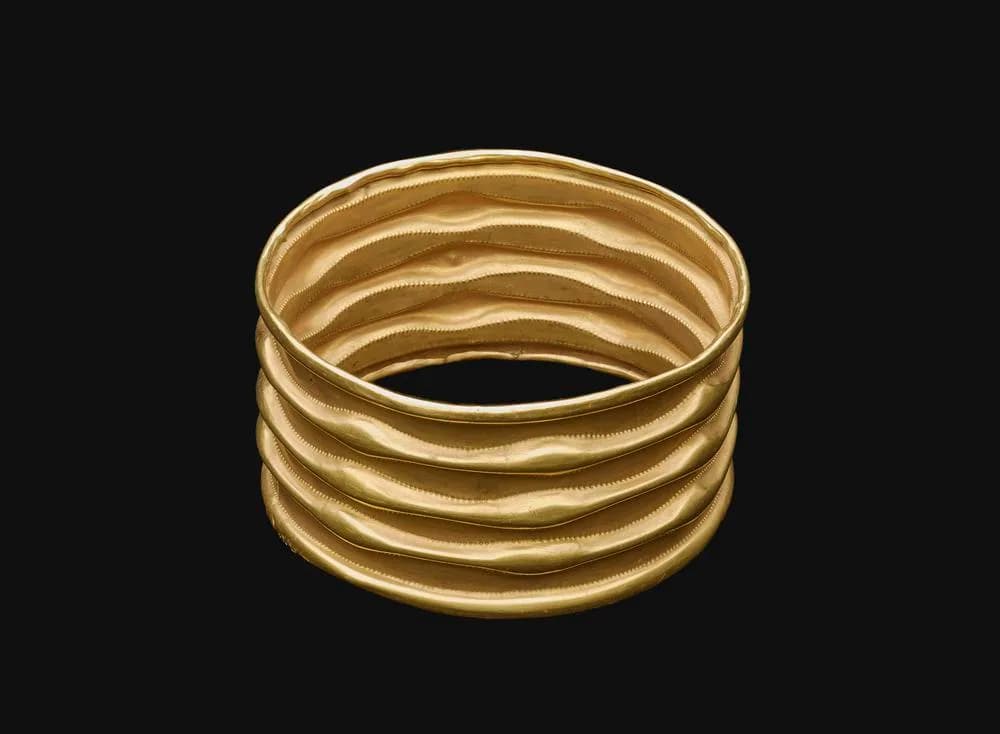
In September 1994 an excavator uncovered a small pit in a Bronze Age barrow cemetery in Leicestershire. It held two gold armlets, a long dagger and two broken pots turned upside down.
The pit held no body.
The traditional view
The British Museum holds the two armlets as 1996,0901.1 and 1996,0901.2. It dates both to the Early Bronze Age and gives a production date of about 2100 to 1900 BC. It credits the excavation to Birmingham University Field Unit.
The museum describes each armlet as a cylindrical band of beaten sheet gold with no evident join. The first has five embossed ribs that swell into evenly spaced lozenges. A neat row of dots runs along each rib. The second has seven evenly spaced ribs.
The first armlet weighs 34.82 grams and is 0.30 millimeters thick. The second weighs 28.16 grams and is between 0.45 and 0.60 millimeters thick. The museum reports that surface analysis by X-ray fluorescence found a gold content of 87 percent in the first and 85 percent in the second.
The Leicestershire and Rutland Historic Environment Record says the barrow was threatened by the Derby Southern Bypass. It calls the pit group "a very unusual, high status artefact group." It adds that "No evidence of a burial was found."
Gwilym Hughes published the excavation in 2000 under the title The Lockington Gold Hoard. Anwen Cooper, Duncan Garrow and Catriona Gibson summarize the pit in a 2020 paper. A copper dagger and two gold armlets lay at the base. The lower parts of two nesting beaker pots were inverted over them.
They report that no human remains were found in the pit. Soil phosphate levels were similar inside and outside it, which supports the idea that no body was deposited.
They set out three readings. Hughes preferred a protracted funerary ceremony in which burying a body was not central. Needham saw a hoard that referred in its position and content to burial rites. Jones saw a deposit like a burial, designed to make people present in the landscape.
What the Evidence Does Not Settle
The three readings all link the pit to burial rites. Cooper and her coauthors still put the word "hoard" in quotation marks when they name it.
The publisher's description of Hughes's report poses two questions. It asks "why was there no body with the deposit?" It also asks why grazing animals were in the palisaded enclosure immediately before the mound was built. The same description says the authors offer answers. I have not read them beyond the summary above.
Cooper, Garrow and Gibson turn the missing body into a question about categories. Their paper asks whether the absence of human bone "could be a positive attribute rather than simply a negative outcome of taphonomic processes." They also ask whether it might help to move beyond terms such as "grave," "hoard" and "cenotaph." Here they write about body-less object deposits at funerary sites in general. I have not read their wider survey beyond the abstract and the Lockington passage.
The Pit Nobody Can Label
Both views lean on questions the evidence cannot yet answer. Three of them stand out.
What was the pit for if no one lay in it?
The record says no burial was found. Cooper and her coauthors say the only hint of funerary activity at Lockington was a layer of charcoal across the center of the barrow. It held flecks of unidentifiable burnt bone and was interpreted as potentially redeposited pyre material.
The record adds that "A very few fragments of burnt bone and ash" lay on the old ground surface under the mound.
Needham, quoted by Cooper and her coauthors, says every object in the pit is "very familiar in graves." Their paper calls the combination unique.
The objects belong to graves and the pit has none. What was the pit for?
How was it laid out, and where exactly did it lie?
The sources do not agree on the layout. The British Museum says the pit lay "inside a ring-ditch and beside a palisade gully." The Historic Environment Record says a team member uncovered the group "immediately outside the ditch of a large barrow." Cooper and her coauthors place it at the northern edge of a multi-phased barrow.
They also differ on the pots. The museum's summary says the inverted vessels partially covered one armlet. The record says they were inverted over one of the bracelets. Cooper and her coauthors say the pots entirely covered one armlet.
The cemetery record summarizes a 1996 report in Current Archaeology. It says both pots had been broken before they were placed. The museum calls them incomplete.
Cooper and her coauthors say the objects were clustered and in some ways carefully placed. The two armlets lay along one side of the dagger. They see no clear sense that the objects were arranged as if worn on a body.
The metal of the dagger is also described two ways. The museum says copper. The record says bronze and calls it the largest dagger from Britain. The museum adds that a black corrosion product of tin was found under the lip of the first armlet. I have not checked what that means for the dagger.
Was the pit filled in one act or over a longer ceremony?
Who made the armlets, and where is the rest of their story?
The first armlet is 0.30 millimeters thick. It was beaten from one sheet with no evident join. Embossed ribs and rows of dots run around it.
Needham's 2000 paper in The Antiquaries Journal says the Lockington armlets "add substance to a tradition of embossed goldworking in Early Bronze Age Britain." The record, quoting a British Museum highlight page that I have not read, says the armlets "demonstrate great skill."
Needham's abstract ends with "the problem of interpreting continuity of craft skills against a very sparse record of relevant finds through time and space." I have not read the paper beyond the abstract.
A skilled tradition sits behind two armlets and the surviving record is thin. Where was the rest of that tradition?
The questions I can't put down
Some questions need more room than one article gives them. Two of them keep pulling me back.
Who was the pit for? Jones, as summarized by Cooper and her coauthors, sees the deposit as a way to make people present in the landscape. In the book I write that the enclosures at Göbekli Tepe were buried on purpose, "as if they wanted it found later." Lockington is another place and another age. I follow the idea of a deliberate burial through Earthly Enigmas. The Göbekli Tepe article looks at that burial in detail.
How old were the objects when they went into the ground? Cooper and her coauthors say the objects had "complex temporal and spatial histories." The museum dates the armlets to about 2100 to 1900 BC and shows them in its Stonehenge exhibition. In the book I put the start of Stonehenge at about 3000 BCE and I follow the idea of knowledge carried forward across the stone sites. You can read a free sample before you decide. The articles section has more subjects in the same format.
Sources
- British Museum: armlet 1996,0901.1
- British Museum: armlet 1996,0901.2
- Leicestershire and Rutland HER via Heritage Gateway: Early Bronze Age Lockington Hoard (MLE6034)
- Leicestershire and Rutland HER via Heritage Gateway: Lockington barrow cemetery (MLE4687)
- Cooper, Garrow and Gibson, Spectrums of depositional practice in later prehistoric Britain and beyond (Archaeological Dialogues 27-2, 2020)
- Needham, The Development of Embossed Goldwork in Bronze Age Europe (The Antiquaries Journal 80, 2000) (abstract only)
- Hughes, The Lockington Gold Hoard (2000) (publisher description only; I have not read the report)