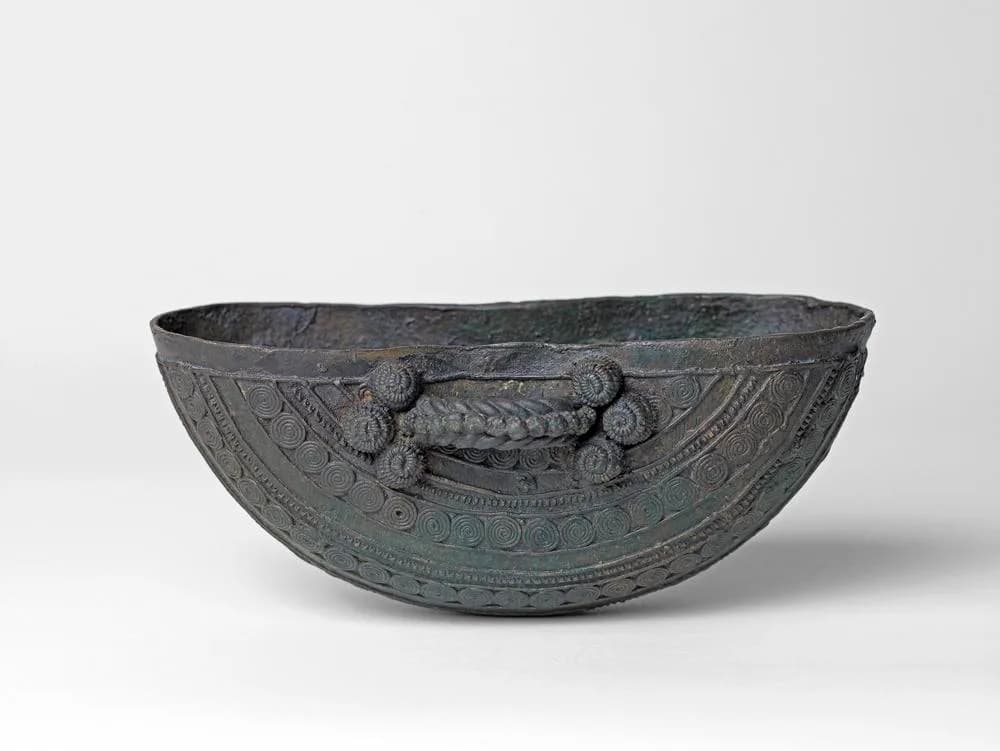
A bowl of leaded bronze stands in a case in Room 25 of the British Museum. It is 15 centimeters wide, 7 centimeters high and weighs 373 grams.
Seven rows of raised spirals run along its outer surface. A single twisted handle sits at one side, and the museum number is Af1956,15.3.
The workshop that made it has not been found. Neither has a crucible, a mold or an earlier version of the craft.
The traditional view
The British Museum record describes a deep crescent-shaped bowl, lost-wax cast in leaded bronze. It gives the production date as the ninth to tenth century CE and the place as Nigeria. The findspot field reads "Presumed to be from Isaiah Anozie's compound (Igbo Isaiah)."
The story of the find starts with a water cistern. Susan Keech McIntosh writes that Isaiah Anozie recovered a number of bronze vessels and ornaments in 1938 while digging a cistern at his compound. Some of them were dispersed among neighbors.
The museum's acquisition note says District Officer Frank Carpenter visited in 1939 and collected most of the pieces the neighbors held. Five came to the museum in 1956. The remainder was acquired by the Department of Antiquities, Nigeria, in 1958 and now forms part of the National Museum Lagos collections.
Quanyu Wang, Paul Craddock and Julie Hudson write that the fragmentary objects they studied, thought to come from the 1939 collection, have no primary archaeological context. The record for this bowl says presumed. I have only read their abstract.
Thurstan Shaw then excavated three sites in the Anozie family compounds in 1959, 1960 and 1964. McIntosh describes the corpus as 75 kilograms of copper and bronze plus over 165,000 glass and carnelian beads. She writes that the quantity from a single site remains unique in West African archaeology.
The British Museum's own research review traces historic copper and lead mining to Abakaliki, 100 kilometers from Igbo-Ukwu. It says this work strengthened "an emerging model of independent, indigenous development of non-ferrous metallurgy in southern Nigeria." It adds that "The raw materials were locally sourced."
McIntosh writes that there can be no doubt the symbolism and iconography of the bronzes is entirely local in inspiration and idiom. She quotes the scholar Sutton calling the work "without parallel in any other part of the world… local or distant, ancient or modern." She adds that the technical mastery of Renaissance Italian casters might challenge that.
Shaw's radiocarbon dates pointed to the ninth century. The Igbo historian A. E. Afigbo, as McIntosh quotes him, wrote that this made Igbo-Ukwu about three or four centuries earlier than the date accepted for Ife and Benin.
The Craft and the Gap
The sources agree on a good deal. The bronzes are leaded bronze or unalloyed copper. McIntosh writes that the leaded bronze was always lost-wax cast and the copper was smithed. She adds that a significant amount of the copper and lead came from the Benue Rift, in places as close as 100 kilometers away.
McIntosh also notes that the smiths used lost-wax casting for sheet-metal forms such as bowls, which elsewhere would have been hammered. Wang, Craddock and Hudson conclude that the smiths were fully aware of the properties of their metals and made careful choices about technique.
What the sources cannot supply is the record of how the craft arose. McIntosh writes that "there is currently no evidence relevant to the question of technical and artistic development and production locations."
The Questions the Ground Has Not Answered
Each of these three questions rests on what the specialists themselves describe as open.
Where was the workshop?
McIntosh calls the technology a long-acknowledged enigma. She writes that "No crucibles or casting molds have yet been recovered from Igbo-Ukwu or anywhere in southern Nigeria before the thirteenth-century evidence at Benin City."
She asks how we understand "the emergence of such technical virtuosity without the evidence for an antecedent period of technical and artistic experimentation." She adds that subsequent investigations have not revealed any evidence of artisanal production areas or domestic activities at the site or in the immediate vicinity. In her words, "Convincing precursors to Igbo-Ukwu's distinctive material culture in bronze and pottery have yet to be identified."
She also gives the counterpoint. The shortage of first-millennium dates in southeastern Nigeria "may be a sampling artifact of the small number of excavated and dated sites." She notes bronze from the seventh to tenth century at Jenné-jeno and Akumbu in Mali, and bronze evidence at Marandet in Niger. What that means for the movement of ideas, she writes, cannot be determined without more evidence.
Where did the smiths who made this bowl learn the work, and where did they do it?
How old is this bowl?
The museum record gives the ninth to tenth century. I did not find the basis for that range in the record.
McIntosh explains that Shaw's four clustered dates read as the ninth century, with a calibrated range from the seventh to the twelfth. She writes that the ninth century date "is still commonly cited as the date of Igbo-Ukwu."
A newer date comes from a textile fragment from Igbo Isaiah. According to the Springer page for McIntosh and Cartwright, it calibrates to 1027 to 1180 CE. It "likely dates the final use of the shrine," and "the bronze and other objects in the shrine may have been in use for some time before being wrapped or covered with cloth for the last time." I have only seen an excerpt of that paper.
Keith Ray places the final wrapping between the mid-eleventh and late twelfth century. He adds that the earlier wood dates from Igbo Richard "can no longer be regarded as unproblematic."
McIntosh concludes that the creation and use-life of the Igbo Isaiah bronzes "have not been resolved."
How old is this bowl, and how long was it in use before it went into the ground?
How did the metal and the glass get there?
The metal has two readings side by side. McIntosh summarizes lead isotope work on 30 artifacts. Ores at Abakaliki proved a close match for Group 1, which holds 17 of them. The ten artifacts in Group 2 were "closely matched by Tunisian ores." Three more were thought to be a mix.
McIntosh writes that "the possibility of sources beyond the Sahara cannot be excluded." She also reports that the large-scale workings at Abakaliki left slags from smelting iron, "not copper or lead." The British Museum review says the raw materials were locally sourced. I have not checked the original papers, and I do not know which group this bowl belongs to.
The beads add a second line of evidence. McIntosh writes of the commonest glass type that "Most of these were made from glass produced in Mesopotamia and more easterly areas in Iran, as well as the eastern Mediterranean." She says Shaw acknowledged that the lack of evidence for long-distance trade as early as the ninth century did not match the large number of glass beads.
Whether such goods arrived directly through trade or indirectly as gifts or offerings, she writes, "is not known and perhaps is not knowable in the absence of historical documents."
What route linked a forest shrine in southeastern Nigeria to glassmakers in Mesopotamia and, for some of its metal, to lead ores that match Tunisia?
The questions I can't put down
Some questions need more room than one article gives them. Two of them keep pulling me back.
Why cast what you could hammer? McIntosh writes that the smiths used lost-wax casting for leaded bronze items of sheet metal, such as bowls. Wang, Craddock and Hudson find that the hammered pieces tended to be unalloyed copper and the cast ones alloyed. They list twisted handles among the hammered components of composite objects. The museum calls this bowl lost-wax cast and I have not seen whether its handle was cast or hammered. McIntosh offers a reading tied to ritual practice and calls it "admittedly speculative." In Chapter 11 I write about Göbekli Tepe that one explanation "explains the act without explaining the method." I follow that line of thought through Earthly Enigmas.
Why was it buried? Shaw read Igbo Isaiah as a storehouse or shrine for ritual objects and regalia. McIntosh reports that a pit at Igbo Jonah may have been dug expressly to deposit ritual material. Ray writes that the principal items may represent "a unique situation and a key juncture in early Igbo history." I ask a version of the question about a different site in the Göbekli Tepe article and in the book, where the section is called "Built to Last: The Deliberate Burial." You can read a free sample before you decide. The articles section has more subjects in the same format.
Sources
- British Museum: bowl Af1956,15.3
- British Museum: Researching Lower Niger Bronzes (Babalola and Coulson)
- McIntosh, Igbo-Ukwu at 50: A Symposium on Recent Archaeological Research and Analysis, African Archaeological Review 39 (2022)
- Ray, A Contextual Reintegration of Shaw's 1959-1964 Igbo-Ukwu Excavation Sites and Their Material Culture, African Archaeological Review (2022)
- Wang, Craddock and Hudson, A Metallographic Study of Objects and Fragments from the Site of Igbo Isaiah, African Archaeological Review 39 (2022) (abstract only)
- McIntosh and Cartwright, Igbo-Ukwu Textiles: AMS Dating and Fiber Analysis (2022) (search excerpt only)