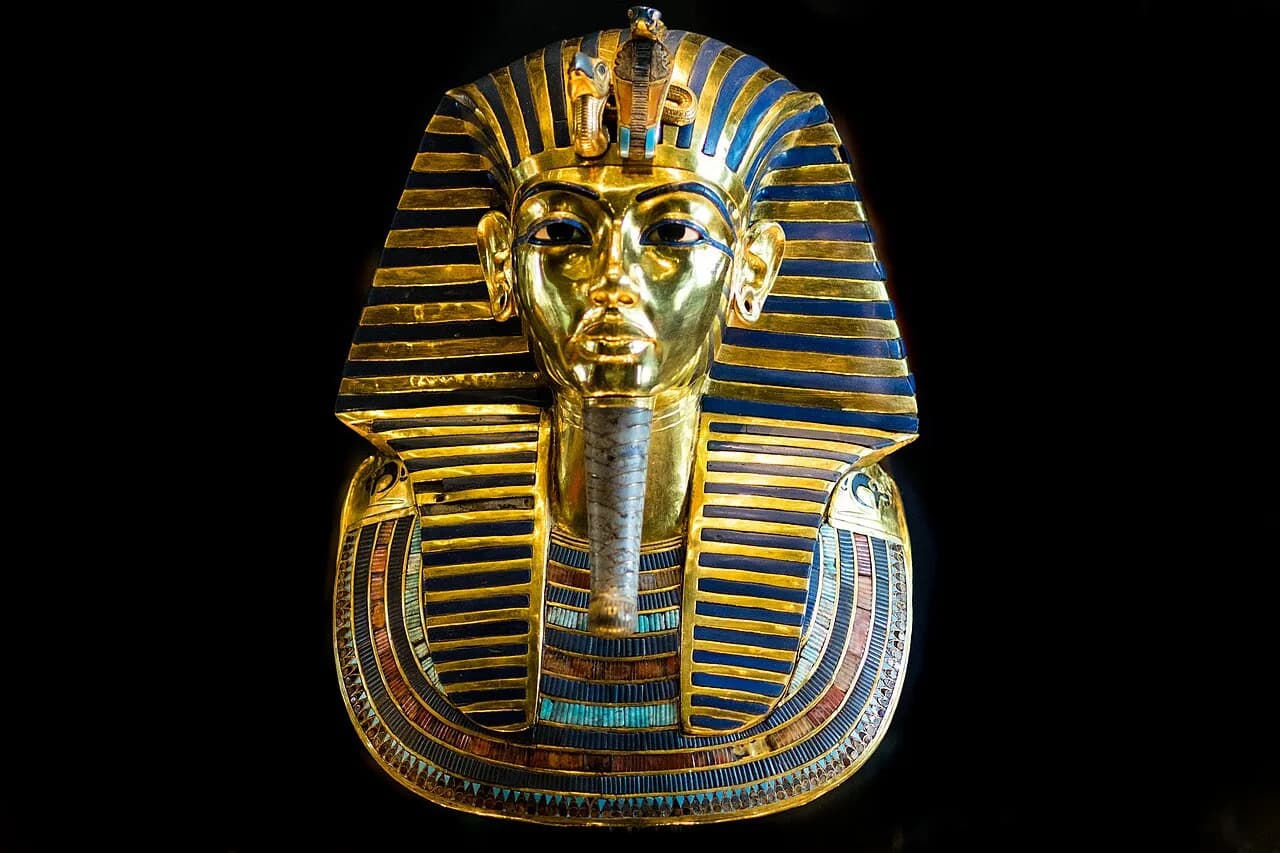
The mask measures 39.3 centimeters across. It was found lying over the head and shoulders of a mummy.
Howard Carter's team could not lift it. Resin had stuck the mask to the coffin.
The traditional view
The Grand Egyptian Museum catalogs the mask as number 8. It says the mask of solid gold "was found placed over the head and shoulders of Tutankhamun's mummified remains." The museum lists gold, glass, lapis lazuli, obsidian, carnelian, faience and quartzite among its materials.
The Griffith Institute records it as Carter's object 256.a. It came from the burial chamber in the fourth season of 1925 to 1926. The same record gives its later numbers as Cairo JE 60672 and GEM 8.
Carter described it in his own words. He called it "a brilliant, one might say magnificent, burnished gold mask" and a "similitude of the king, covering his head and shoulders." He also wrote that it "bears a sad but calm expression suggestive of youth overtaken prematurely by death."
Getting it off took heat. Carter wrote that the mask and the mummy "were stuck fast to the bottom of the coffin by the consolidated residue of the unguents, and no amount of legitimate force could move them." A trial in the midday sun failed. His team then lined the gold coffin with zinc, wrapped the outer coffin in wet blankets and burned paraffin lamps beneath it. The mask "was freed and lifted away with comparative ease."
The museum prints a line from the inscription. It reads "Your forehead is Anubis, your right eye is the night boat (of Re), your left eye is the day boat, your eyebrows are in the company of nine gods." The text is translated and printed on a museum page because scholars can read hieroglyphs. The Rosetta Stone article tells how that came about.
The tomb itself was not divided. Tom Hardwick, writing in Apollo, says Lady Carnarvon "was simultaneously denied any right to the finds" and that the Egyptian government voted her a little over 35,000 pounds. I have only seen that article through a summary.
What the Evidence Does Not Settle
In Chapter 5 of Earthly Enigmas I describe Jim Alison's 17-site great circle and a Becker-Hagens grid anchored at Giza. The Giza article covers that site.
Where the Accounts Don't Meet
Everyone agrees on the object, the tomb and the museum. Three questions stay open between the accounts.
Was the mask made for Tutankhamun?
Nicholas Reeves argued in a 2015 paper that Tutankhamun's use of the mask was secondary. His abstract says the conclusions are "that Tutankhamun's employment of the mask was indeed secondary, and that the original owner had been a woman." The abstract names her as Ankhkheprure Nefernefruaten. I have read only that abstract and not the full paper.
Christian Eckmann, Katja Broschat and Tom Hardwick answered in the Journal of the American Research Center in Egypt in 2023. They describe their intensive study of the mask in 2015. They say a reworking would have needed a replacement face and an erased name on the left shoulder. They conclude "that there are no solid grounds to view the mask as having been altered from one owner to another." I have read only their abstract.
Claire Gilmour of the University of Bristol makes two points in The Conversation. She writes that the two-part construction was the normal way to make such masks. She also says the mummies of Tutankhamun and other kings still show pierced ears.
Carter's own appendix agrees on that point. It reports that "the lobes of the ears are perforated by a circular hole measuring 7.5 mm. in diameter." In 2024 a University of York team led by Joann Fletcher proposed the mask was made for a woman of high status. I know that only from press reports. I have not seen the paper and I have not checked it.
Carter's caption to the mask plate adds a wrinkle. He wrote that the face recalls Akhenaten and, in profile, "an even stronger likeness of Queen Tyi." Both sides point to the physical object as the evidence. What would the metal have to show to settle whose mask this was first?
What has happened to the mask since the tomb?
The beard has its own record. In August 2014 it snapped off and staff reattached it with epoxy. National Geographic reports that German and Egyptian conservators led by Eckmann removed the epoxy in late 2015 and used beeswax.
Eckmann is quoted there saying the beard "was detached and was not fixed back till 1946." The minister of antiquities at the time reported an internal tube joining the beard to the face and a soft solder repair from 1946. Eight museum employees were accused of violating professional standards, according to a second National Geographic report. Friederike Fless of the German Archaeological Institute is quoted as saying the 2014 damage was exaggerated. I have only seen both reports through summaries.
Carter's team also treated it. A mass of resin stuck to the back of the mask "had eventually to be removed with the aid of a blast lamp and cleaning solvents." Which of the marks on the gold date from the burial, from 1925, from 1946 and from 2014?
Is there anything behind the tomb wall?
The mask argument has a neighbor. In the 2015 paper "The Burial of Nefertiti?" Reeves reads faint lines under the plaster of the burial chamber as the "ghosts" of two doorways. He suggests one leads to a continuation of the tomb holding the undisturbed burial of Nefertiti.
Radar surveys of the tomb followed, and in 2018 a statement released on behalf of Mostafa Waziri of the Supreme Council of Antiquities reported the result. Franco Porcelli of the Polytechnic University of Turin is quoted saying "there is no evidence of doors or empty spaces beyond the funeral chamber up to four meters." I have only seen that through a summary of National Geographic.
Reeves has published further papers in the series. I have seen the titles and not read them. The radar bears on the chamber and the chamber argument is a separate one from the mask. If the radar is right about the walls, what does it leave for the mask?
The questions I can't put down
Some questions need more room than one article gives them. Two of them keep pulling me back.
What does the text on the back of the mask say about its first owner? The museum prints one inscription and the specialists argue about the name on the left shoulder. Its Egyptian material is in Earthly Enigmas.
Why was this tomb never divided? Earlier Egyptian excavations were shared with their sponsors, and I have not checked how this one ended up different. A free sample of the book shows how I set out a question like this one. The articles section has more subjects in the same format.
Sources
- Grand Egyptian Museum: Golden Burial Mask of Tutankhamun, GEM 8
- Griffith Institute: Carter object 256.a
- Howard Carter, The Tomb of Tut.ankh.Amen, vol. 2 (1927), pp. 142-148, Plate LXXIII caption and Appendix I p. 224, full text on the Internet Archive
- Eckmann, Broschat and Hardwick, JARCE 59 (2023), abstract
- Reeves, "Tutankhamun's Mask Reconsidered" (2015), abstract as reposted at Architexturez
- Reeves, The Burial of Nefertiti? (Occasional Paper 1, 2015)
- Claire Gilmour, The Conversation (read through a summary)
- National Geographic: beard repair, 2015, trial report, 2016 and radar result, 2018 (all read through summaries)
- Tom Hardwick, Apollo Magazine, 2022 (read through a summary)