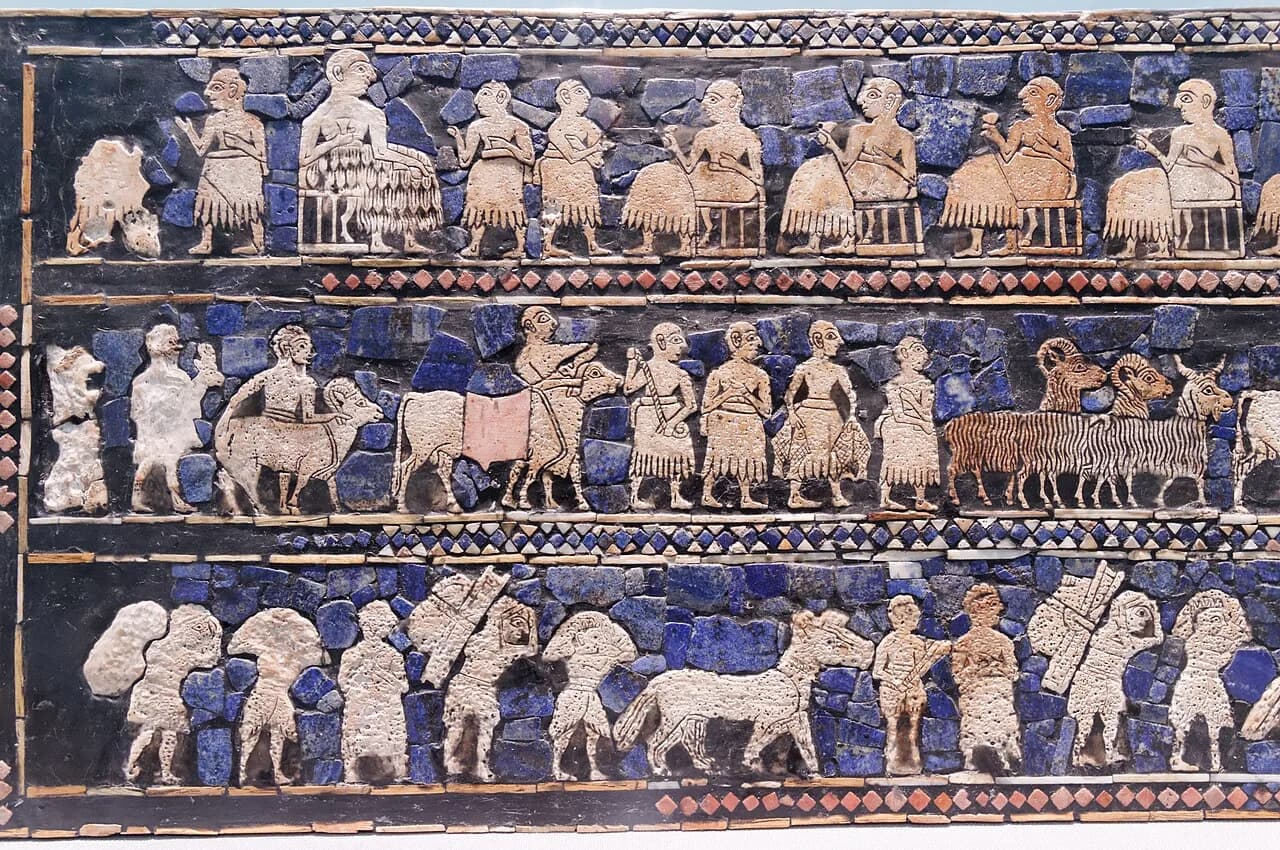
A box of shell and blue stone about 47 centimeters long and 20 centimeters high lay in the corner of a tomb chamber. It rested against a man's right shoulder.
The wood inside it had rotted away and the bitumen that held the pieces had turned to powder. The first thing the excavators saw was a scatter of tiny squares and triangles in the soil.
The traditional view
The British Museum dates the object to about 2600 to 2400 BC. It says the object came from "one of the largest graves in the Royal Cemetery at Ur." I read the caption through the museum's picture library, because the collection page refused my request. The caption says the object lay in the corner of a chamber above the right shoulder of a man.
Leonard Woolley found it in grave PG/779. In his 1934 report he lists it as U. 11164, length 0.47 meters and height 0.20 meters. He describes the tomb as a four-chambered stone building that "had been plundered from above." The corner holding the Standard had been left alone.
Woolley says the object lay "right way up" with the War side facing up. The wood core "had vanished" and the bitumen holding the pieces "had gone to powder." The two main panels had fallen together as the wood decayed. Stones from the roof had broken one end.
He says the team could clear only "a square inch or so" at a time. They poured boiling wax over the pieces, laid waxed muslin on top and lifted the panel in one piece. He writes that the man beside it wore a cap covered with thousands of tiny lapis beads.
The mosaic has three registers on each of its two long sides. One side shows a king, soldiers, chariots and bound captives. The other shows a feast and lines of men bringing animals, fish and goods. Woolley named them the War and Peace sides, and the names stuck.
The Penn Museum article by Tosi and Piperno reports on fifteen tesserae from the central register of the War scene. Four of them showed furrows made by flint blades. They read that as a sign the lapis came to Mesopotamia in blocks or semi-processed masses.
Sumer Arrives Organized
In Earthly Enigmas I write that Sumer emerged with writing, base-60 math, law, irrigation and administration already in place. I say it has no developmental trail and that it has a starting line. I also write that scholars have catalogued 39 distinct cultural firsts in the Sumerian record.
Woolley calls the War side "the first record that we possess of the Sumerian army, its weapons and its organization." I do not write about the Standard or about Sumerian warfare. It is one place to ask what an organized state looks like in a picture.
The lyre and the game board from the same cemetery have their own articles. You can read them in The Great Lyre's Bull Head and The Royal Game of Ur.
What the Picture Cannot Tell Us
Both views lean on questions the evidence cannot yet answer. Three of them stand out.
What was it for?
The British Museum caption reads "Its original function is not yet understood." It adds that Woolley imagined the object "was carried on a pole as a standard, hence its common name." It then says "Another theory suggests that it formed the soundbox of a musical instrument."
Woolley was frank about his own doubt. He wrote "What it really was it is hard to say." He judged that it was "not likely to have been a box, though it apparently was hollow." He settled on a standard because it lay "against and above the right shoulder of a man as if it had been carried by him on a pole." He called that suggestion "the most reasonable."
Wikipedia says that Paola Villani suggests the object was a chest that held funds for warfare or civil and religious works. I use Wikipedia here only as a lead. I have not found Villani's own paper. A blog called Sumerian Shakespeare says her reading rests on a small door in one end panel. I have not checked that. Woolley describes the end panels as largely restored.
What would settle whether it was carried, played or filled?
How much is original, and how much was put back?
Woolley wrote that "Taken as a whole, the standard is unusually authentic." He says that apart from the broken end, one corner of the Peace panel and the animals' heads, "there has been no reconstruction of the standard." He adds that the repairs to the border are "undisguised."
The same chapter lists what was guessed. Of one end triangle he writes "reconstruction is little more than guesswork." Of the other he writes "the top register is particularly unconvincing." The lower right corner of the Peace scene was rebuilt from pieces found scattered, and he says "the whole corner therefore is a reconstruction."
He first set three figures in the wrong order. Legrain pointed out the error in print and Woolley rearranged them. The core is gone, so wood strips and vulcanite now fill the borders.
The Penn article records that the Standard was restored again in March and April of 1973. I have not found a published account of what that work changed.
Which parts of the picture did the maker set, and which did a restorer decide?
Whose victory is it?
Woolley wrote "The two main scenes are probably connected." In his reading a Sumerian king triumphs in one and celebrates in the other. He placed the enemy as "a non-Sumerian enemy, probably one whose home was farther to the north." That is his inference from the clothing and from the wild animals on the Peace side.
The tomb does not name its occupant. Moorey, writing in Penn's Expedition magazine, says the evidence for calling the sixteen tombs royal is thin. He says tomb 779 "offered no definite clues" on whether the main burial was a man or a woman. I read his article through a page summary and I have not checked that line against the page.
Woolley also admits a gap in his own reading. He wrote "It is difficult to establish any relation between the historical scenes on the sides of the Standard and the mythological or genre subjects on its triangular ends." Wikipedia, again as a lead only, mentions a reading of the two sides as one continuous narrative. I have not seen the scholar behind it.
What in the picture itself says it records one king's war?
The questions I can't put down
Some questions need more room than one article gives them. Two of them keep pulling me back.
How firm is the date? In 1934 Woolley suggested 3500 to 3200 B.C. for the early cemetery. He wrote that his chronological theories "have not won the assent of all scholars." The British Museum now says 2600 to 2400 BC. Moorey wrote in 1977 that the royal tomb levels were dated to roughly 2600 to 2500 B.C. The date moved by about nine hundred years. In Chapter 7 I give about 4500 BCE for the emergence of Sumer and I ask what a starting line looks like when the dates keep moving. I follow that question through Earthly Enigmas.
How did blue stone from a remote mountain range reach a shell mosaic? Tosi and Piperno name the Afghan source and say the tesserae show the stone was cut with flint blades. In Chapter 5 I write about sites in seven countries that share the same long-cycle awareness of the sky. I say they were not in contact by any route mainstream archaeology accepts. Lapis is a case where an accepted route exists. The lyre article follows the lapis trail further. You can read a free sample of the book before you decide. The articles section has more subjects in the same format.
Sources
- British Museum caption text for the Standard of Ur, 1928,1010.3, as hosted by BM Images (the museum's own collection page refused my request)
- Woolley, Ur Excavations II: The Royal Cemetery (1934), full text at the Internet Archive
- Tosi and Piperno, Lithic Technology Behind the Ancient Lapis Lazuli Trade (Expedition 16:1, 1973)
- Moorey, What Do We Know About the People Buried in the Royal Cemetery? (Expedition 20:1, 1977)
- Wikipedia: Standard of Ur (used to locate leads only)
- Sumerian Shakespeare: The Standard of Ur? (a blog; opinion, not checked)