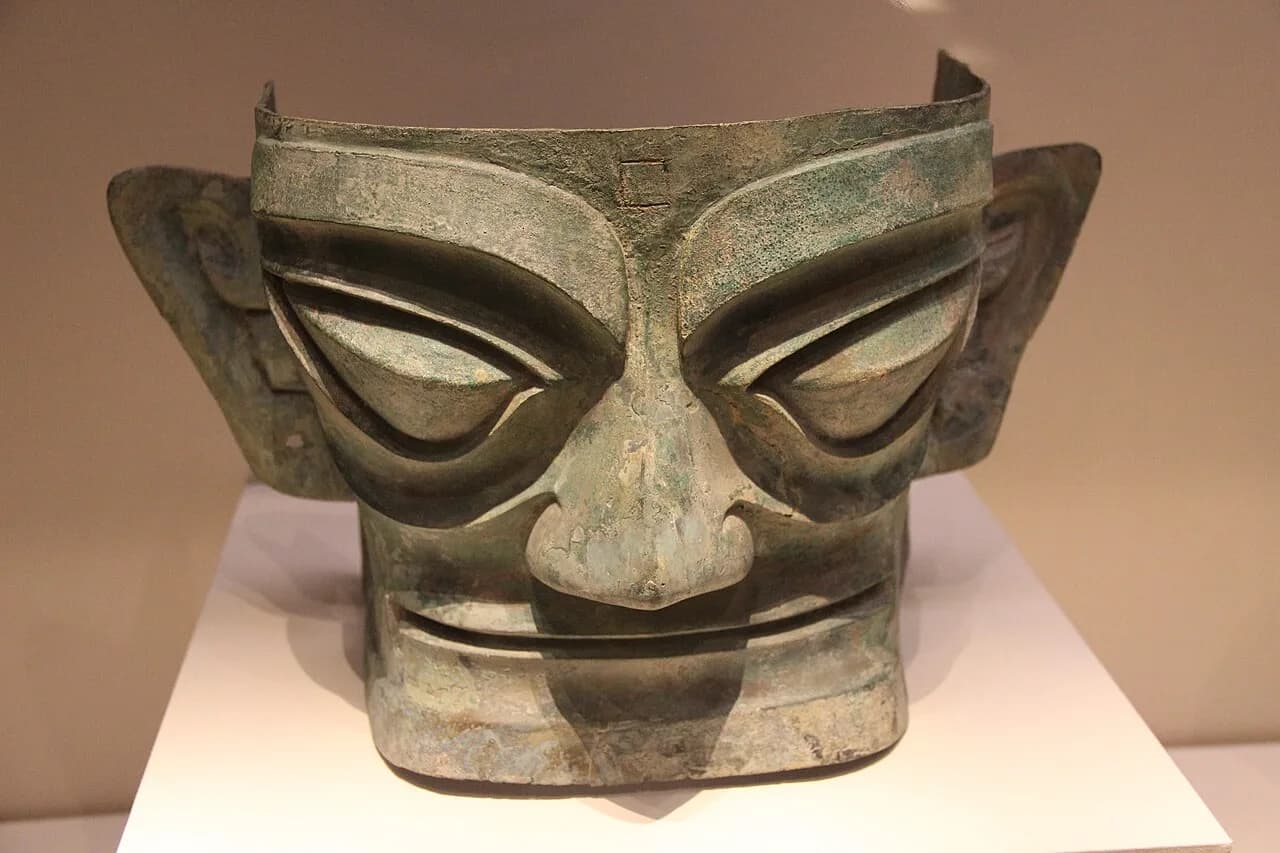
One bronze mask from Sanxingdui is 1.31 meters wide and 71 centimeters high. It weighs about 65 kilograms.
The Sanxingdui Museum says masks like this are too big to wear on a human face. Somebody cast it in pieces, joined it and then buried it in a pit among thousands of other objects.
The traditional view
Sanxingdui lies in Guanghan, in Sichuan Province. Two pits found in 1986 held more than 900 objects of bronze, gold, jade and ivory, according to the Antiquity report on the site. Six more pits came to light from 2019 on. Ling Xin writes in Archaeology that the eight pits were all rectangular and arranged on the same axis.
The dates vary with the source. Antiquity places Pits 1 to 4, 7 and 8 at about 1200 to 1000 BC and Pits 5 and 6 probably at 1046 to 950 BC. CGTN reports that Pits 3, 4, 6 and 8 have a 95.4 percent probability of burial between 1201 and 1012 BC. Archaeology says 60 samples of bamboo ash pinned the burial to between 1100 and 1050 BC.
Archaeology describes nearly 1,000 bronzes "most of which had been purposely broken into pieces" and covered in ash from a fire "intentionally set." Lian and colleagues write that excavators think the objects "had been intentionally damaged and burned before deposit."
The faces are the most famous finds. The Sanxingdui Museum says the protruding eyes of the largest mask are "considered as the symbol of 'Can Cong', the first group of leaders in Ancient Shu." Charles Higham writes in World Archaeology that the masks are "thought to depict Cancong, the mythical first king of Shu." The museum adds that the masks "might be a way for Ancient Shu people to memorialize their ancestors or gods."
Jay Xu of the Asian Art Museum says each bronze head "was probably mounted on a wooden human figure" and that the wood decayed.
What the Evidence Does Not Settle
In Earthly Enigmas I describe Göbekli Tepe as buried on purpose, and the Göbekli Tepe article sets out that case.
The Gaps in the Record
Both views lean on questions the evidence cannot yet answer. Three of them stand out.
Where were they cast?
Lian and colleagues analyzed 39 clay casting core samples from bronzes in Pits 1 and 2. They write that "the casting origins of Sanxingdui bronzes remains unresolved, as no contemporaneous casting workshops have been identified either at Sanxingdui or elsewhere in Sichuan Province."
Their results point two ways. They write that "non-vessel bronzes were likely cast locally near Sanxingdui, while vessel artifacts show connections to the middle and lower Yangtze River region." The masks fall in the first group. They add that further exploration "will be necessary to pinpoint the exact production location."
Earlier scholars disagree with one another. According to Lian and colleagues, Shi and Li argue that all the bronzes were cast locally. Others suggest the vessels came from the middle Yangtze, the Hanzhong Basin or were made to order at Anyang. I have not read those original papers.
Workshops with confirmed evidence stand mainly in Henan, Shaanxi, Shanxi, Hubei, Anhui and Jiangxi. Where is the foundry at Sanxingdui?
What were they doing with all that metal?
Higham calls the burial a disposal of "a vast store of accumulated wealth." He writes that "Ritual is often cited as a reason when no other can be forwarded," and that no such treasure pits are known from the Shang or Zhou sites of the Central Plains.
Tianlong Jiao and Shengyu Wang told World Archaeology that "it is certain that some kind of ritual was involved." Others have gone further. Hua Sun suggests in Archaeology that "the secular group may have defeated the religious group." Jay Xu says "Destroying deities perceived as ineffective and then creating new ones to replace them is a well-documented practice in ancient China."
Archaeology notes that the burial window of 1100 to 1050 BC coincides with the Shang and Zhou war, which ancient texts place around 1046 BC. It adds that some scholars suspect the war was a factor. Each reading is an inference from the pits.
What were they doing?
Who were these people if they left no words?
History.com reports that archaeologists have yet to uncover any skeletal remains or writing from the site. The Shang and Zhou peoples left extensive writings, as Archaeology points out.
Yu Lei says in Archaeology, "It's hard to imagine that the people could create their city and complex bronzes without any written records." He adds that writing on silk or other fragile materials would likely not have survived Sichuan's humid climate. In the same World Archaeology interview with Matthew Symonds the curators say that reconstructing ritual and religion without writing "is always a puzzle for any archaeologists."
Both statements can stand together. The writing may never have existed or it may simply have rotted. What would a reading of this culture look like without its own words?
The questions I can't put down
Some questions need more room than one article gives them. Two of them keep pulling me back.
Whose face is it? The museum calls the protruding eyes a symbol of Cancong. Archaeology magazine says the Chronicles of Huayang, which records the Kingdom of Shu, dates to the fourth century A.D. That is more than a thousand years after the pits were filled. In Chapter 7 of the book I write about traditions around the world that carry a memory of a prior age, including China's. I follow that wider question through Earthly Enigmas.
Where did the people go? History.com reports that some researchers point to a change in religion, a change in the landscape or a massive earthquake. Rowan Flad thinks the community may have moved toward Chengdu, where the Jinsha site produced a gold mask with wing-like ears. Higham says we must defer to future research for the "missing centuries." I have not checked the earthquake proposal in its original paper. In the book I follow knowledge carried forward after a disaster. You can read a free sample before you decide. The articles section has more subjects in the same format.
Sources
- Lian et al., Deciphering the origins of Sanxingdui bronzes through petrographic and elemental analysis of casting cores (revised manuscript, University of Cambridge repository; published in ScienceDirect, article S0305-4403(25)00061-5, which I did not open)
- Antiquity: New discoveries at the Sanxingdui Bronze Age site in south-west China (page text read through an extraction tool, not the full paper)
- Ling Xin, The Many Faces of the Kingdom of Shu, Archaeology, November/December 2024
- Charles Higham, The Treasures of Sanxingdui, World Archaeology 110
- Matthew Symonds, The lost world of Sanxingdui, World Archaeology 122
- CGTN: Exact dating of the sacrificial pits at Sanxingdui site officially released
- Sanxingdui archaeology portal: the Pit 3 mask
- Sanxingdui Museum on Google Arts & Culture: The Faces of Sanxingdui
- History.com: Why Was This Ancient Chinese City Abruptly Abandoned?
- Wikipedia: Sanxingdui (used only to locate sources; no claim rests on it)