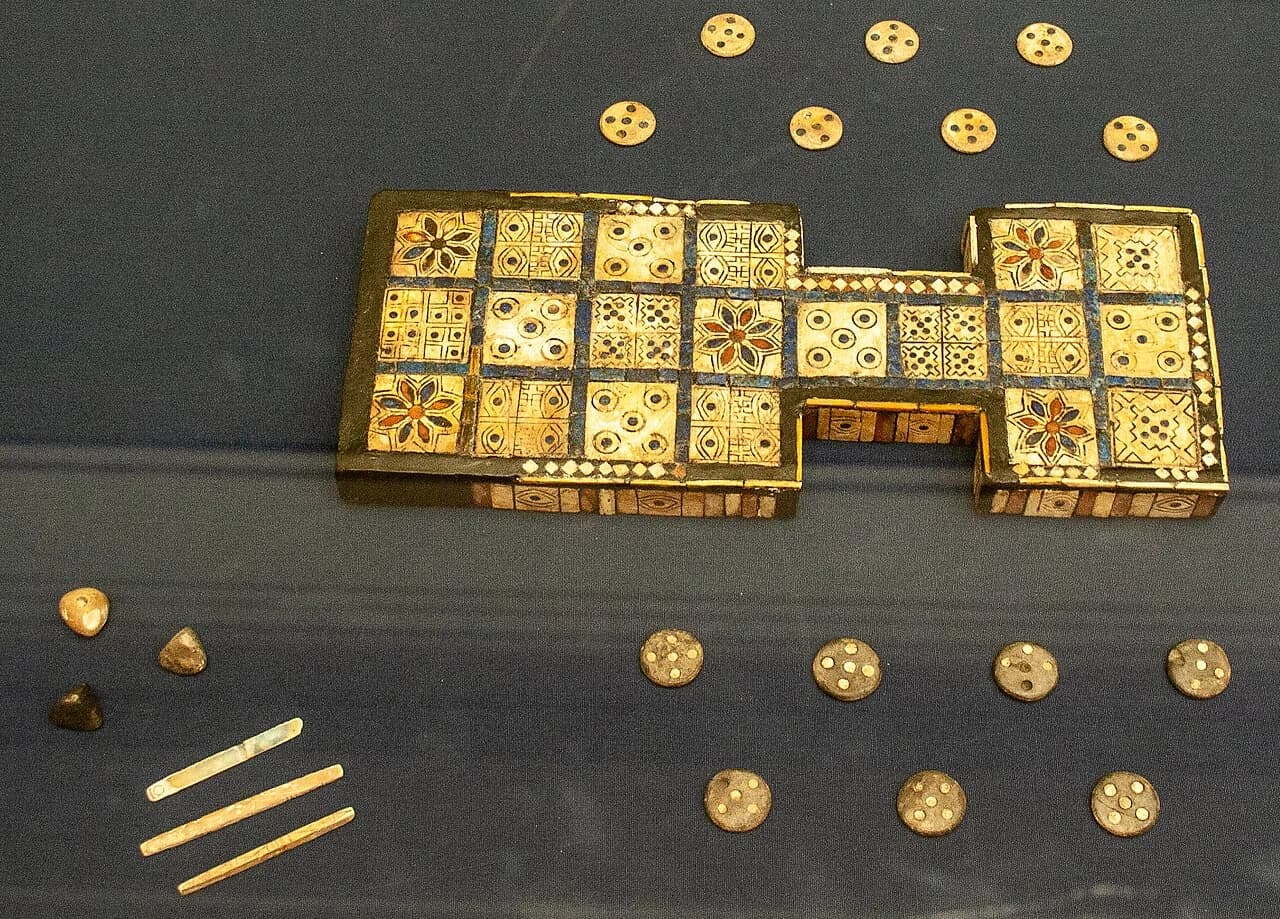
A box about thirty centimeters long sits in a case in London. The lid is a game board of twenty squares, inlaid with shell, red limestone and lapis lazuli. The wood beneath it rotted away in the ground at Ur.
A scribe in Babylon copied out a set of rules in 177 or 176 BCE. Irving Finkel of the British Museum argues that they belong to the same game of twenty squares. That date falls more than two thousand years after the board went into the grave.
The traditional view
The British Museum catalogs the board as Early Dynastic III, about 2600 to 2400 BCE, from the Royal Cemetery at Ur. I read the museum's text on Google Arts & Culture, because the museum's own pages refused my requests. It says the wood had decayed "but the inlay of shell, red limestone and lapis lazuli survived in position so that the original shape could be restored." It also says the gaming pieces for this particular board do not survive.
Leonard Woolley found the board in grave PG/513. In his 1934 report he calls PG/513 a grave of the early cemetery and the board "the most striking example found." It lay face upwards on a slant. The plaques had sunk into the space where the wood had been.
Woolley's team poured hot wax over the inlay as they worked along it. They secured it with waxed cloth and lifted it. Woolley describes the boards as hollow boxes, with the squares inlaid on the lid and the pieces kept inside.
He saw the same equipment in several graves. The pieces came "in two sets coloured black and white respectively for the two players," and they "number seven a side." He thought the small shell triangles with two dotted corners were "perhaps dice."
The rulebook is a clay tablet, BM 33333B. Finkel writes that the scribe Itti-Marduk-balatu finished it in Babylon on 3 November, 177 to 176 BC. It names five "flying" pieces after birds. It lists two knucklebones, one from an ox and one from a sheep. It gives the throw each piece needs to enter the board.
Finkel calls it "by far the oldest attested example of rules for a board game." The museum text says two players raced their pieces from one end of the board to the other. It says pieces entered only on specific throws and that rosette spaces were lucky. It cites "references in ancient documents" for that.
Finkel counts over one hundred boards of the same kind from Iraq, Iran, Israel, Syria, Jordan, Lebanon, Turkey, Cyprus, Egypt and Crete. He also notes that the boards changed shape early in the second millennium BC.
Rules Lost and Recovered
In Earthly Enigmas I write about knowledge that was lost and then partly rebuilt. At Carnac I say the builders "knew the target" and were "not always certain of the method." In Chapter 11, under the heading "Oral Traditions Encoding Lost Knowledge," I call oral tradition "a technology."
I do not write about the game boards of Ur, Sumerian games or this tablet. The Royal Game of Ur is one place to test the idea. Its rules were lost, and a modern reader rebuilt them from a tablet that came centuries after the board.
The lyre from the same cemetery has its own article, so I leave the music and the lapis there. You can read it in The Great Lyre's Bull Head.
What the Rulebook Cannot Tell Us
Both views lean on questions the evidence cannot yet answer. Three of them stand out.
How much of the rulebook belongs to this board?
Finkel says the rules fit a later board. In his account the older board has a block of four by three squares joined by a bridge to a smaller block. Early in the second millennium BC the smaller block was straightened into a central run of twelve squares. He applies the tablet to that later form.
The equipment differs too. Finkel notes that the tablet's five pieces are different from one another in form. He writes that this "contrasts directly with the archaeological evidence for the seven identical pieces used for the third-millennium game." The dice differ as well. Ur gave tetrahedra and stick dice, and the tablet names knucklebones.
On the route a piece takes, Finkel writes that "there is no evidence on the point." The Encyclopaedia Iranica entry by Schädler and Dunn-Vaturi gives its own diagram of the track and notes that Finkel proposed a different one. The same entry says "the names and the rules of ancient games remain unknown."
Finkel also asks why the tablet exists. He suggests the details it preserves are "in some way unusual, perhaps reflecting a more complex game, or one with some subtle difference." Everybody, he writes, knew how the ordinary game went.
Which of the rules we play today did a person at Ur ever follow?
Can a board found in a grave tell us how the living played?
Woolley writes that the boards were found "chiefly" in the royal tombs. He could not read the rules from them. The designs on three complete boards do not match, and he concludes that "the arrangements do not seem to help towards an understanding of the rules."
He reasons that only the three rosettes may matter to play and that the other designs are decoration. Grave PG/261 was, in his words, a simple inhumation grave. It held counters but no inlaid board. Woolley infers a plain wooden board there, "the squares and marks being merely engraved."
Finkel argues that the spread of the grid across the ancient Near East "points overwhelmingly to its primary use as a board game played for entertainment." He also reports other scholars' suggestions that the Ur boards served the dead or the diviner. He names Meyer and Andrea Becker. A reviewer in Bryn Mawr Classical Review says Becker connects the game to divination through the shape of sheep-liver models. I have not read Becker.
TIME wrote in 2008 that the finest board in London "was buried with a princess to entertain her in the afterworld." Those are the magazine's words and not Finkel's quotation. I did not find an occupant named for PG/513 in the Woolley passages I read.
The Iranica authors say the animal-shaped boards from Jiroft "appear to have never been used for playing," and they read them as made for the grave.
What came before the boards at Ur?
The museum text says boards of this kind date "from about 3000 BC." The Ur board itself is dated to 2600 to 2400 BCE. Finkel says the Ur finds have been paralleled only once, by a carved wooden board from the near-contemporary cemetery at Shahr-i Sokhta in Iran.
He then raises the dice. Of the stick dice he writes that they "do not appear in other Mesopotamian contexts." He calls their presence at Ur "similarly suggestive of a possible external origin." He makes the same observation of the tetrahedra, which "do not crop up in later Mesopotamian archaeology." The Iranica entry treats the Shahr-i Sokhta board as following the earlier Ur examples. Finkel calls the two cemeteries near-contemporary.
TIME writes that traders, soldiers and missionaries spread the game. That is the magazine's summary. I did not find a board older than the Ur group that scholars agree on. A paper titled "What are the odds? Neolithic 'game boards' from the Levant" suggests the question of earlier boards is still argued. I have read only the title.
What came before the boards at Ur?
The questions I can't put down
Some questions need more room than one article gives them. Two of them keep pulling me back.
Why do the pieces have bird names? Finkel proposes that the names stand for constellations, and perhaps for the five planets visible to the naked eye. He writes that the planet identifications "cannot yet be supported from other cuneiform texts." The tablet's diagram ties twelve squares to the zodiac. The Iranica authors say one "would be tempted" to read the game astrologically. In the book I follow the same sky across sites in seven countries, in the section "The Same Sky, Everywhere." I follow that question through Earthly Enigmas.
How does a game outlast the civilization that made it? The museum text says a version survived in the Jewish community of Cochin in South India "until modern times." TIME reports that a woman who grew up there remembered playing it with her aunts. She used cowrie shells for dice, and each player had twelve pieces. I have not checked that account against Finkel's own publication. In the book I ask what a memory can carry across thousands of years. You can read a free sample before you decide. The articles section has more subjects in the same format.
Sources
- British Museum: The Royal Game of Ur, 1928,1009.378 (text as hosted on Google Arts & Culture)
- Woolley, Ur Excavations II: The Royal Cemetery (1934), full text at the Internet Archive
- Finkel, On the Rules for the Royal Game of Ur, in Ancient Board Games in Perspective (2007), PDF copy hosted at the University of Waterloo
- Schädler and Dunn-Vaturi, Board Games in Pre-Islamic Persia, Encyclopaedia Iranica
- TIME, Big Game Hunter (2008)
- Bryn Mawr Classical Review, review of Ancient Board Games in Perspective (2008)
- What are the odds? Neolithic "game boards" from the Levant (ScienceDirect), title only