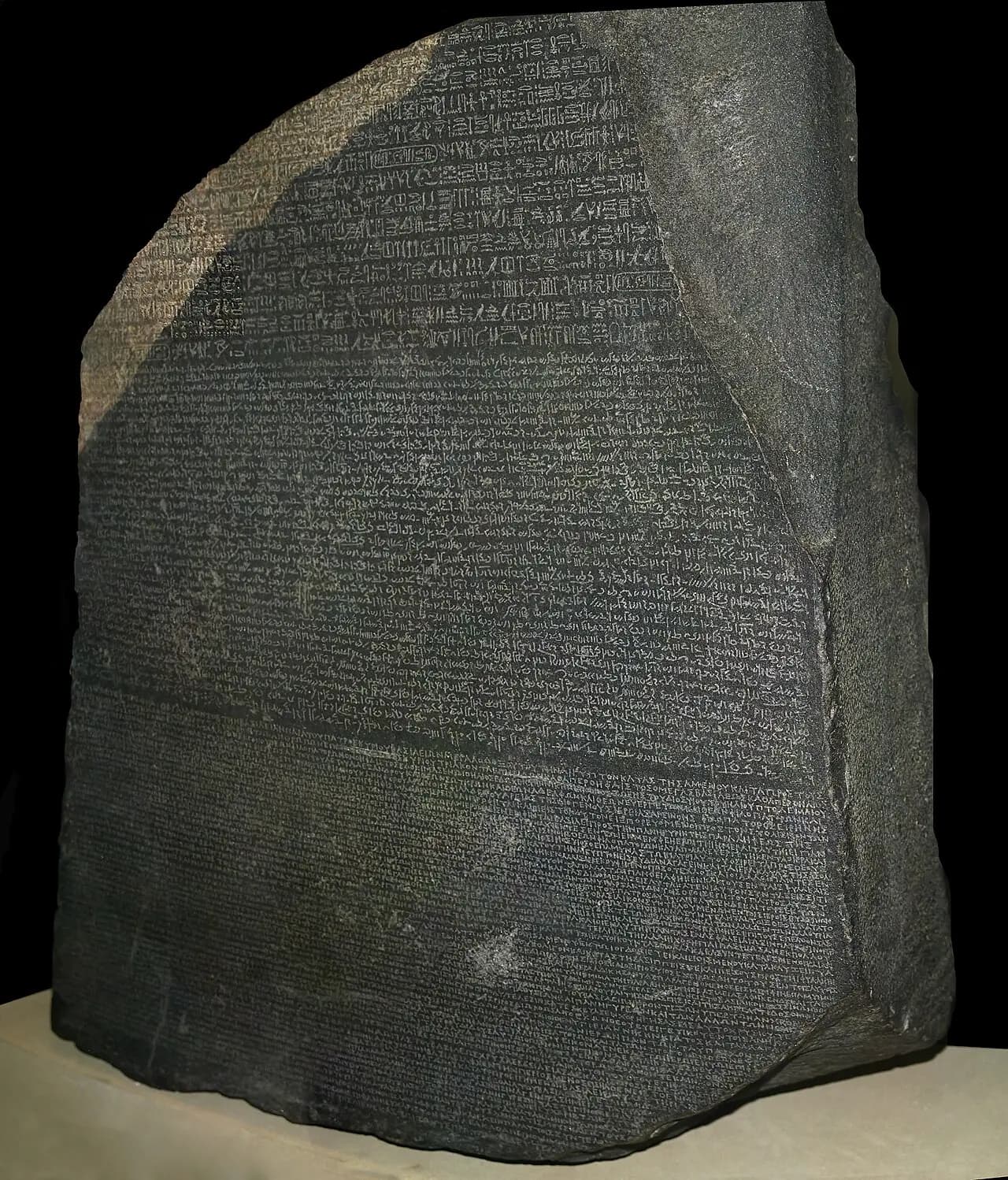
The Rosetta Stone stands about 112 centimeters tall and weighs an estimated 762 kilograms. It carries one decree three times, in three kinds of writing.
French troops found it in July 1799 during work on a fort near Rashid, which Europeans called Rosetta. The foreword to the British Museum's 1999 exhibition book says true knowledge of the writing it helped to read "had been lost for over thirteen centuries."
Today the stone is also at the center of a dispute over where it belongs.
The traditional view
Richard Parkinson wrote the British Museum's exhibition book on the stone. He calls the stone a fragment of a stela inscribed with a priestly decree. The decree concerns the cult of King Ptolemy V Epiphanes and is known as the Memphis Decree.
The surviving text runs to 14 incomplete lines of hieroglyphs, 32 lines of demotic and 54 lines of Greek. Parkinson writes that more than half of the hieroglyphic section is lost. He estimates it once ran to 29 lines.
The decree orders copies of itself for the temples. Parkinson translates the hieroglyphic version as "in the script of god's words, the script of documents, and the letters of the Aegeans." The Greek version says sacred, native and Greek characters.
The French surrendered Egypt to British and Ottoman forces in 1801. Robert Wilson printed the capitulation in his 1803 history of the British expedition. Article 16 covers the Arabian manuscripts, the statues and other collections made for the French Republic. The reply says they "shall be considered as public property, and subject to the disposal of the generals of the combined army."
Budge writes that the stone reached Portsmouth in February 1802. Parkinson says it has been part of the British Museum's collections since 1802.
The Reverend Stephen Weston read the first translation of the Greek text to the Society of Antiquaries in April 1802, according to Budge. Silvestre de Sacy and Åkerblad worked on the demotic that year. Parkinson writes that by 1816 Thomas Young could identify the name Ptolemy as a cartouche in the hieroglyphic section.
Jean-François Champollion read his Letter to M. Dacier at the Académie des Inscriptions on 27 September 1822.
What The Evidence Does Not Settle
I do not discuss the Rosetta Stone in Earthly Enigmas. The standard account itself leaves several points open, and I set them out here.
Budge wrote in 1913 that the demotic section gives the original form of the decree and that the hieroglyphic and Greek versions were made from it. Parkinson writes that Philippe Derchain and Heinz Josef Thissen have argued that all three versions were composed simultaneously. Stephen Quirke sees in the decree "an intricate coalescence of three vital textual traditions."
Parkinson writes that the stone "cannot have been originally placed at Rosetta." Labib Habachi suggested the city of Sais. Parkinson thinks it probable that the stela was already broken when it was moved to the place where it was found.
The decree asks for copies in the temples of the first, second and third rank. Parkinson adds that it is uncertain how literally this proclamation is to be understood.
In Chapter 11 of Earthly Enigmas I follow a chain of preservation from Göbekli Tepe through Stonehenge and Carnac to oral tradition and the mystery schools. I call oral tradition a technology. I also write that Pythagoras studied in Egypt for over twenty years.
What The Stone Cannot Settle
The traditional account and the open points above lead to questions the evidence cannot yet answer. Three of them stand out.
How does a script go unread?
Clement of Alexandria describes how educated Egyptians learned their writing. In the Ante-Nicene Fathers translation they learned the Epistolographic first and the Hieratic second. The Hieroglyphic came "last of all." He says one kind of it "by the first elements is literal" and the other is symbolic.
Parkinson adds that in antiquity "most of the literate could only read" the everyday cursive scripts.
He gives 24 August 394 at Philae for the last securely dated hieroglyphic text and 11 December 452, also at Philae, for the last known demotic inscription. He writes that "it is uncertain exactly when the last person to use, or at least to read, the ancient scripts will have lived."
Champollion's letter was read on 27 September 1822. By my count that is 1,428 years after the Philae inscription.
Coptic, the language of Christian Egypt, is a descendant of the language of pharaonic Egypt, Parkinson writes. Budge wrote that "the knowledge of Coptic has never been lost." Parkinson says the relevance of Coptic to the hieroglyphs "was, however, underestimated" because people believed hieroglyphs could not record language directly. He says that from the Renaissance on, attempts at decipherment meant "explaining the mystical significance of hieroglyphs rather than trying to read them."
How does a script go unread for more than thirteen centuries while a descendant of the language it wrote stays in use?
What did the stone itself unlock?
Champollion wrote in his 1822 letter that the hieroglyphic text of the Rosetta inscription "ne présentait, à cause de ses fractures, que le seul nom de Ptolémée." In my translation, it showed only the name Ptolemy because of its fractures. An obelisk from the island of Philae gave him a second cartouche, which he took for the name of a queen.
He also wrote that reading the demotic text by means of the Greek had shown him something else. Egyptians used some demotic signs to write sounds, in proper names and foreign words.
Parkinson writes that the three versions "cannot be matched word for word." He adds that decipherment therefore involved greater difficulties than scholars expected from "what was apparently an exact bilingual and triscript key." He also writes that the decipherment "eventually came from examination of these copies rather than from the Stone itself," meaning the prints and copies made soon after the discovery.
The French called the stone "the gem of antiquity," Wilson reported in 1803, "as being the key to the hieroglyphic language." Zahi Hawass's repatriation page says, "Working backwards from Greek, French scholars were able to begin deciphering hieroglyphics."
The credit is also in dispute. Young wrote in his 1823 account that he could not resist "the natural inclination" to "make a public claim to whatever credit may be my due." After the 1822 reading he wrote to Sir William Hamilton. It "may be said," he wrote, that Champollion "found the key in England which has opened the gate for him." He also wrote that he would feel "nothing but exultation" at Champollion's success.
Champollion wrote that Young's idea of whole syllables skewed much of his phonetic analysis, though Young had still recognized the values of four signs. Parkinson says the rivalry of the two men has obscured the story and that the work of other scholars "has been repeatedly underplayed."
What did the stone give the decipherers, and what did they have to find somewhere else?
What did the 1801 surrender settle?
Ownership of the stone is disputed. Each party is quoted below in its own words.
Article 16, quoted above, does not name the stone. Wilson reports that General Menou claimed the stone as his private property and "at last abandoned the claim to the stone." Parkinson says General Hutchinson was determined to secure it and denied the claim.
Wilson prints the signatures of Admiral Keith, General Hutchinson, the Ottoman Capitan Pacha and the French General Menou, with Lieutenant Colonel Kempt as secretary.
The British Museum told the Associated Press in 2022 that the treaty "includes the signature of a representative of Egypt." AP says this refers to an Ottoman admiral who fought alongside the British. The museum also said Egypt's government has not submitted a request for the stone's return. It added that there are 28 known copies of the decree and 21 of them remain in Egypt. I have not checked that count against Parkinson's list of other copies.
The Repatriate Rashid petition was organized by Monica Hanna, Nashwa Elbendary and colleagues. It says the treaty was "not signed by a single Egyptian-based entity." It calls the stone "a spoil of war and an act of plunder." Hanna told AP that "the British Museum's holding of the stone is a symbol of Western cultural violence against Egypt."
Zahi Hawass, who is Egypt's former minister for antiquities affairs according to AP, argues that Egypt had no say in the agreement. On his own site he writes that the stone "must come to the Grand Egyptian Museum where it will be safe." He gives as his reason news that over 2,000 artifacts had been stolen from the British Museum. I have not checked that figure. He also writes that he does not hold that every Egyptian artifact belongs in Egypt.
A UK Parliament petition on the same subject was rejected on 26 September 2022. The rejection says repatriation is "a matter for the Trustees of the British Museum, not the UK Government or Parliament."
Attorney Nicholas Donnell told AP that "given the treaty and the timeframe, the Rosetta stone is a hard legal battle to win." AP reports that he sees no common international legal framework for such disputes.
What did the 1801 surrender settle about the stone, and what did it leave to be decided later?
The questions I can't put down
Some questions need more room than one article gives them. Two of them keep pulling me back.
Who was the hieroglyphic version for? Parkinson says the three scripts matched three supposed audiences, "the gods and priests," the Egyptian-speaking literate public and the Greek administration. In Chapter 6 of Earthly Enigmas I ask who the Nazca figures were drawn for, given that they are only visible from above. The stone raises a question of the same shape. I take up the Nazca question in the Nazca article and follow it through Earthly Enigmas.
What do "words inscribed on stones" mean? Parkinson quotes the Hermetic Asclepius, which says that "only words will survive inscribed on stones that narrate your pious accomplishments." He comments that these "words inscribed on stones" later came to indicate "something mysterious and unintelligible." I have not read the Asclepius myself. In Chapter 11 I follow a message carried in stone, in memory and in the mystery schools. You can read a free sample of the book before you decide. The articles section has more subjects in the same format.
Sources
- Richard Parkinson, Cracking Codes: The Rosetta Stone and Decipherment (British Museum Press, 1999), full text scan
- E. A. Wallis Budge, The Rosetta Stone (British Museum, 1913)
- Robert Wilson, History of the British Expedition to Egypt (1803)
- Champollion, Lettre à M. Dacier (1822)
- Thomas Young, An Account of Some Recent Discoveries in Hieroglyphical Literature (1823)
- Clement of Alexandria, Stromata V.4, Ante-Nicene Fathers translation
- Associated Press, Egyptians call on British Museum to return the Rosetta stone (30 Nov 2022, PBS NewsHour)
- Repatriate Rashid campaign
- Zahi Hawass, Repatriation
- UK Parliament petitions, Decolonize and Repatriate the Rosetta Stone (rejected 26 Sep 2022)
- The British Museum's own object pages could not be opened when this draft was written. No Wikipedia text is used.