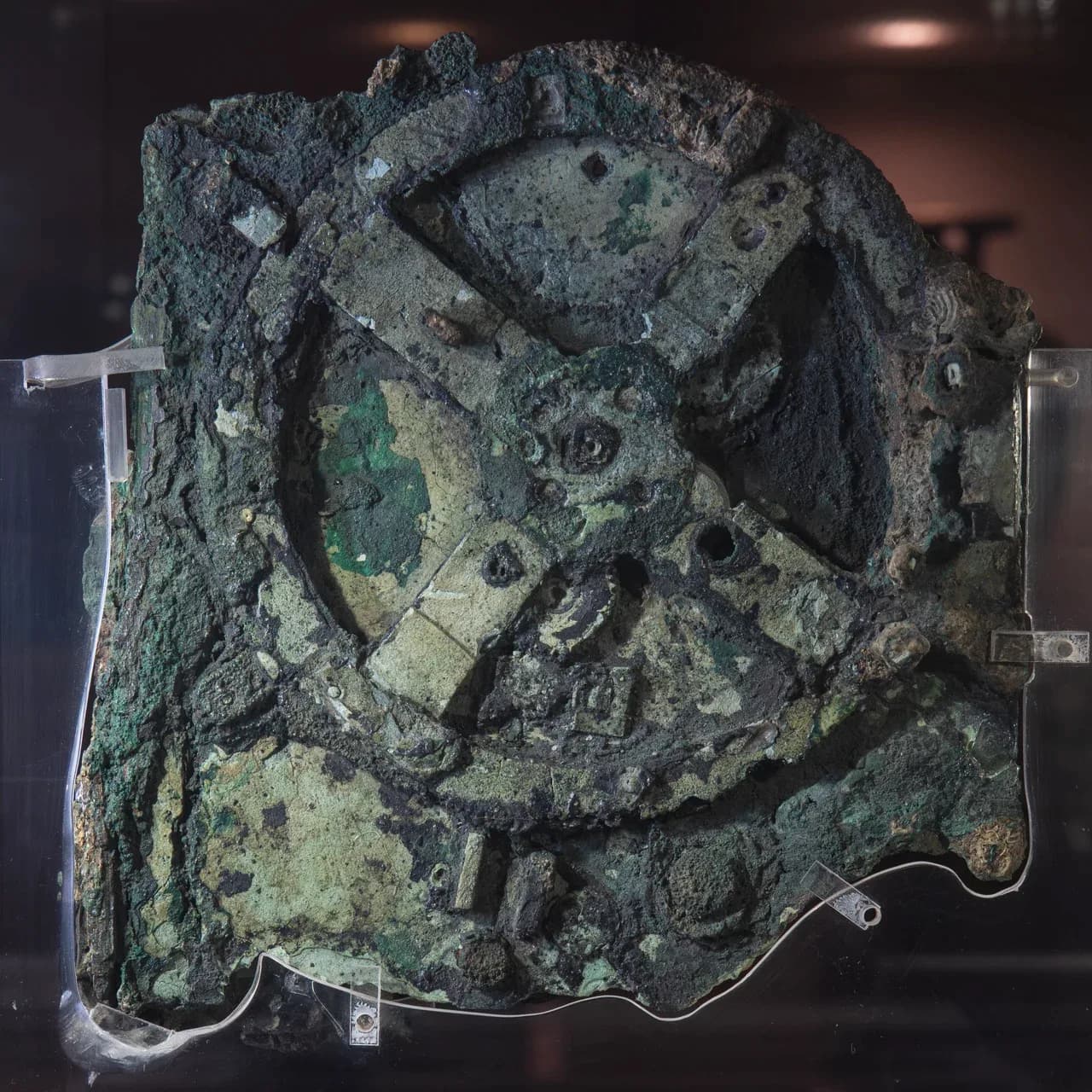
Divers and archaeologists lifted a lump of corroded bronze from a shipwreck near the Greek island of Antikythera in 1900 and 1901. It came up with marble statues, jewelry and glass.
Inside the lump were gears. The fragments hold 30 bronze gearwheels, and researchers read them as the remains of a calculator for the Sun, the Moon and the five planets known in antiquity.
The traditional view
The National Archaeological Museum in Athens says the ship sank sometime between 75 and 50 BC. It describes a freighter of about 300 tons that was probably heading for Italy.
The museum says the mechanism "comprises toothed gear wheels, axes, dials and pointers" made of bronze and housed in a wooden case. It calls the device an instrument of scientific research, a means for the prediction of eclipses and a calendar, and probably an accessory of astrology and navigation.
Freeth and colleagues write that the device is now split into 82 fragments and that only a third of the original survives. X-ray tomography in 2005 decoded the rear of the machine. It also revealed inscriptions that describe the motions of the Sun, Moon and all five planets known in antiquity.
The museum's guide to the cycles explains why the machine counted what it counted. Nineteen years hold 235 lunar months, and the museum calls that the Metonic cycle. It says the Babylonians had observed that eclipses repeat after 223 lunar months.
The 2006 study in Nature reports that the mechanism "predicted lunar and solar eclipses on the basis of Babylonian arithmetic-progression cycles." Its authors call the device "technically more complex than any known device for at least a millennium afterwards." I have read only the abstract of that paper, because the full text is behind a paywall.
What the Evidence Does Not Settle
In Earthly Enigmas I name Hipparchus, the astronomer of the second century BCE. I write that "Precession was not officially discovered by Western science until Hipparchus in approximately 127 BCE." I also argue that encoding precession implies earlier astronomical knowledge.
In Chapter 10 I write that the model of steady progress has a problem and that the timeline does not work. I close the chapter with the line "We are not progressing, we are recovering." I ask how much we have lost, and how much is still down there, waiting.
What Nobody Can Fully Rebuild
Both views lean on questions the evidence cannot yet answer. Three of them stand out.
How much of the machine is evidence?
Freeth and colleagues say plainly that their 2021 model is a model. They write that "we cannot claim that our model is a replica of the original." They list a Dragon Hand and an Index Letter Scheme as hypothetical features. They also say their solution "draws powerful support from the logic of our model and its exact match to the surviving evidence."
They also say the evidence limits what a model can be. In their words, "the constraints created by the surviving evidence are stringent and very difficult to meet." They add that earlier reconstructions did not match all the known data.
The 2006 paper had already said that the machine's functions "remained controversial" because the gears and inscriptions are "only fragmentary." Freeth and colleagues note that Carman, Thorndike and Evans independently built a model with simpler gearing, limited to the basic planetary periods. I have not read those papers.
How much of the front display is evidence, and how much is design?
When was it made, and by whom?
The museum dates the mechanism around 150 to 100 BC. The 2006 Nature paper says it was constructed "around the end of the second century bc."
In 2014 Carman and Evans studied the eclipse dial. Their abstract says the eclipse predictor "would work best if the full Moon of month 1 of the Saros dial corresponds to May 12, 205 BCE."
Alexander Jones reaffirms a calendar start in 205 BCE in his 2020 paper. He adds that the design decisions "could plausibly have been made by a designer as late as the c. 60 BCE archeologically determined date of the shipwreck."
Aristeidis Voulgaris and Andreas Vossinakis argue in a paper on Academia that the start of the Metonic dial was probably the winter solstice of "December 23rd 178BC." I have not checked whether it has been peer reviewed.
The place is also open. The 2008 Nature paper by Freeth, Jones, Steele and Bitsakis found Corinthian month names. It calls the Corinthian colonies of northwestern Greece or Syracuse in Sicily "leading contenders."
Paul Iversen argues in 2017 that the calendar cannot be that of Syracuse. His abstract suggests the machine "was built on Rhodes, possibly for a client from Epiros." The museum ties the technology to "the successors of Archimedes and the School of Poseidonios in Rhodes."
Jones also reports that a few authors have argued the mechanism is a modern object. He names Francis Nimal and Frédéric Lequèvre. He writes that "none of these arguments have been presented in any medium that has passed through peer review or other competent scholarly scrutiny." He points to photographs and written descriptions that place the fragments in the museum from May 1902. I have not read the authors he names.
When was it built, where and for whom?
What else did its makers build?
The Science Museum Group holds a Byzantine sundial-calendar made between 400 and 600. The museum calls it "the second oldest known of its kind" and adds that "the earliest known example is the Antikythera Mechanism."
Freeth and colleagues write in 2021 that the mechanism is "the first known device that mechanized the predictions of scientific theories." They say it "challenges all our preconceptions about the technological capabilities of the ancient Greeks."
Jones sees the matter differently. He writes that "we have numerous explicit references to such devices in Greco-Roman literature starting in the first century BCE." He cites Cicero, who in the Loeb translation mentions "the orrery recently constructed by our friend Posidonius." Jones says the mechanism "fits well within the known contexts of ancient science and technology" and is also "a remarkably advanced artifact."
What else did its makers build, and what became of it?
The questions I can't put down
Some questions need more room than one article gives them. Two of them keep pulling me back.
Whose records fed the gears? The museum says the cycles came from "systematic observations and mathematical calculations." Freeth and colleagues say the machine combines "cycles from Babylonian astronomy, mathematics from Plato's Academy and ancient Greek astronomical theories." The 2006 paper adds that the gearing realizes a lunar theory of Hipparchos. In the book I follow what astronomers knew and when through Earthly Enigmas. The Giza article covers the alignment evidence.
What else is on the seabed? The Woods Hole Oceanographic Institution reported in 2014 that new finds from the wreck "prove that much of the ship's cargo is indeed still preserved beneath the sediment." The museum says the underwater research continues today. In the book I ask how much we have lost and how much is still down there. You can read a free sample before you decide. The articles section has more subjects in the same format.
Sources
- National Archaeological Museum, Athens: The Mysteries of the Mechanism of Antikythera, "Archaeologist"
- National Archaeological Museum, Athens: What is the Mechanism and what does it consist of?
- Freeth et al., Decoding the ancient Greek astronomical calculator known as the Antikythera mechanism, Nature 444 (2006) (abstract only)
- Freeth, Jones, Steele and Bitsakis, Calendars with Olympiad display and eclipse prediction on the Antikythera Mechanism, Nature 454 (2008) (abstract only)
- Freeth et al., A Model of the Cosmos in the ancient Greek Antikythera Mechanism, Scientific Reports 11 (2021)
- Carman and Evans, On the epoch of the Antikythera mechanism and its eclipse predictor, Archive for History of Exact Sciences 68 (2014) (abstract only)
- Jones, The Epoch Dates of the Antikythera Mechanism, ISAW Papers 17 (2020)
- Iversen, The Calendar on the Antikythera Mechanism and the Corinthian Family of Calendars, Hesperia 86 (2017) (abstract only)
- Voulgaris and Vossinakis, The Initial Calibration Date of the Antikythera Mechanism (Academia) (abstract only)
- Science Museum Group: Byzantine sundial-calendar
- Cicero, De Natura Deorum II.73 to end, LacusCurtius (Loeb translation)
- Woods Hole Oceanographic Institution: Stunning Finds from Ancient Greek Shipwreck (2014)