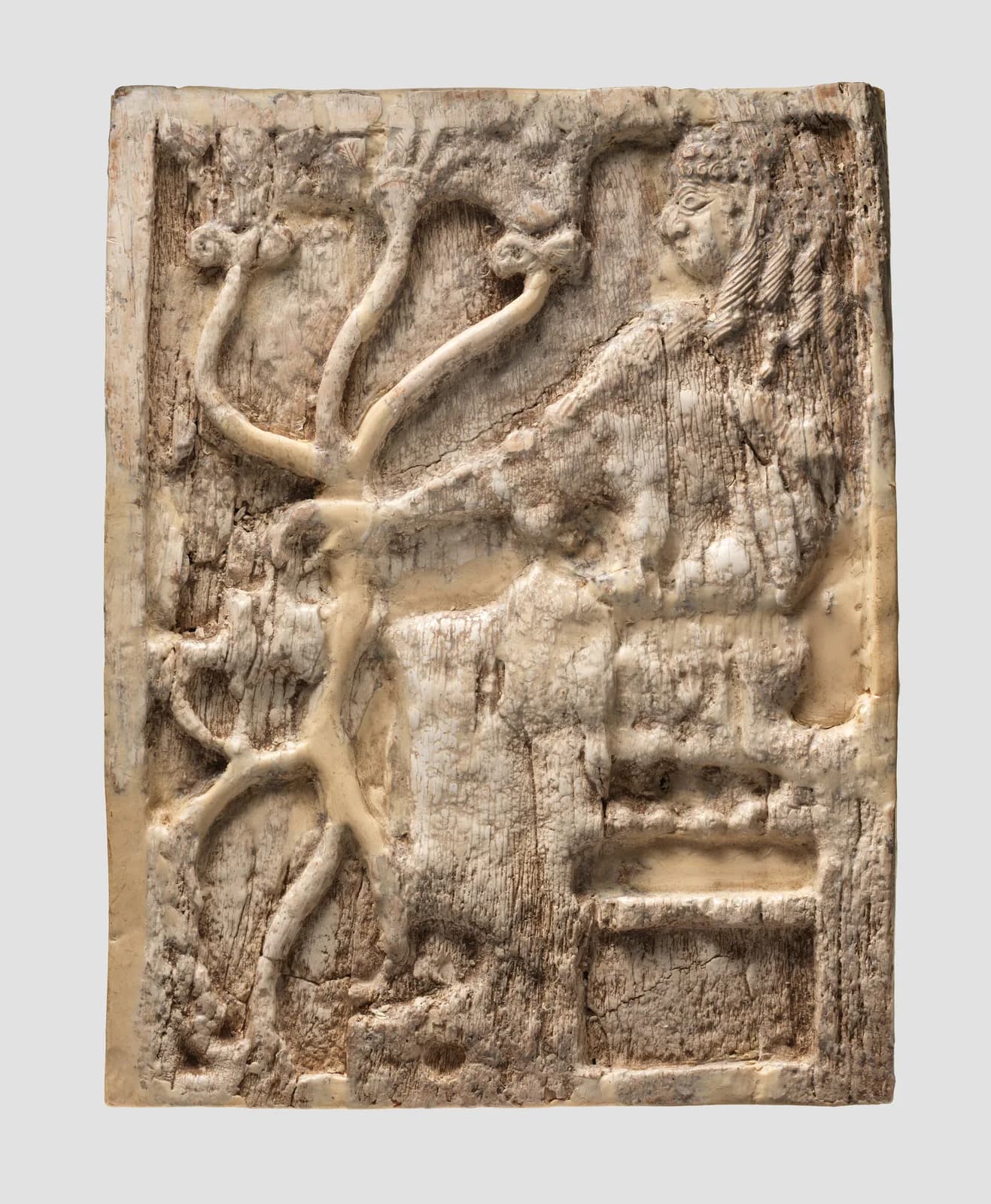
A worn ivory plaque shows a seated woman facing left, with a curling plant in front of her. It measures about seven inches by five.
It was one of four plaques set side by side in the back of a piece of furniture. The wood that held them has not survived.
The traditional view
The Metropolitan Museum's record for 59.107.10 says the plaque was found in a storage room in Fort Shalmaneser. The record describes the fort as a royal building at Nimrud used to store booty and tribute collected by the Assyrians on campaign.
The Met says twenty pieces of furniture were found stacked in orderly rows in that room. They had been stored before the Assyrian palaces were destroyed in 612 BCE. The record dates the plaque to about the eighth century BCE and classifies it as North Syrian in style.
Irene Winter, in a 1976 study from the Met's own journal, writes that the group came to about nineteen decorated pieces. She lists this plaque as the third plaque of number 51 in the excavators' catalogue.
That catalogue is Max Mallowan and Georgina Herrmann's 1974 volume on the furniture from Room SW7. It describes the third panel of that set as a lady seated on a throne with her feet on a footstool. Its measurements are 17.6 by 13.5 centimeters, which matches the Met's figures.
Winter argues that the whole group was carved in Sam'al, a small kingdom in North Syria, around 740 to 730 BCE. She suggests it may have reached Nimrud as tribute from a vassal of the Assyrian king.
Georgina Herrmann and Stuart Laidlaw add that most Nimrud ivories were not made in Assyria. In their 2013 article they say the kings brought them in as gift, tribute or booty.
The Tree That Travels
Winter reads all the furniture from Room SW7 as one design. In her words the theme of a seated or standing figure with a tree and some form of the winged disk remains constant.
She traces the winged disk step by step. It carries the curls of the Egyptian goddess Hathor. She says it first took this form in Anatolia under the Hittite Empire and then turned up at North Syrian sites. Each step rests on named monuments.
David Oates, who ran the dig in the field in 1958, described the plants on these plaques as the symbolic tree of life. Winter calls the same plant the sacred tree. She also writes that she cannot be certain any of the figures are gods, though their attributes seem to associate them with the divine.
In Earthly Enigmas I write that history books treat the ancient world as a series of isolated experiments. In Chapter 5 I list the Tree of Life among the patterns that recur across unrelated traditions. The tree on the plaque is a plant with tendrils and the Tree of Life in my list is a geometric figure. I have drawn no line between them.
Where the Sources Part Ways
The specialists agree on the find and disagree on almost everything that came after. Three questions stand out.
What was the furniture?
Oates wrote in his 1959 report that the excavators could only hazard a guess. He thought the panels were perhaps the heads of beds or couches. Mallowan and Herrmann reopened the question in 1974. They say the evidence lets them suggest, though not prove, what the furniture was, and they argue that all of it may have been chairs.
Part of their case comes from this very set. The men on two of its four plaques sit on chairs with sharply sloping backs.
Winter agrees that chairs fit better. She also writes that we cannot definitely say there were no beds in this period with rectangular head or foot boards. The Met record keeps the whole range open and names a chair back, a couch back or the headboard of a bed.
Herrmann and Laidlaw write of rows of what proved to be chairs. Oates wrote that the backing was almost certainly wood, though no trace of it survives.
Which kind of furniture was this plaque made to decorate?
Where and when was it made?
Winter places the group in Sam'al because its closest parallels are carved reliefs at Zinjirli and Sakçe Gözü, two sites about twenty kilometers apart. She gives the date as the reign of the Assyrian king Tiglath Pileser III.
Herrmann takes a more cautious line about the Nimrud ivories she discusses. She writes that finding them at Nimrud tells us nothing about where or when they were made. With Laidlaw she calls the corpus an enormous jigsaw puzzle.
The labels do not always agree. The Met, Winter and the 1974 volume treat this group as North Syrian. A page from the Nimrud Project at Oracc says the set that includes this plaque was carved in the Phoenician style. I have not checked why.
The 1974 catalogue also says this set is smaller and more crudely carved than its neighbors. The authors still place it in the same group of workshops, by less skilful hands.
The backs of the plaques might help. Oates reported that some ivories carry Aramaic or Phoenician signs on their undersides as fitters' marks. Winter thinks they were probably not Phoenician. When the panels were found their backs were covered in protective bandages, and a footnote in the 1974 volume says the marks should become a subject for research. I have not found a report on whether this plaque carries any.
Where was this plaque carved, and who carved it?
Why was it never used?
Oates observed that the gold leaf had been removed before the furniture was stacked. He also thought looters in 612 BCE left the room alone because ivory had no appeal for them.
Mallowan and Herrmann date the stacking a year earlier, to 613 BCE, from a brief reoccupation between two sackings of the city. They arrived at that by historical reasoning. The Met says only that the furniture was stored before the destruction.
Several readings sit side by side. Oates wrote that the pieces went out of use or out of fashion for a reason impossible to determine. The Oracc authors say the intention may have been to reassemble or rework them. They add that the hoards lay untouched for decades or even centuries.
Herrmann asks the bluntest version. Did the Assyrian kings actually like or use the ivory they acquired in such quantities, or were they simply removing the attributes of kingship? With Laidlaw she notes that Assyrian-style ivories turned up near throne rooms and that none came from the storage magazines of the South West Quadrant.
Why was furniture like this gathered, stripped of its gold and stacked in a magazine?
The questions I can't put down
Some questions need more room than one article gives them. Two of them keep pulling me back.
Where did the tusks come from? The Met says almost certainly African elephants, although Syria had its own until they were hunted to extinction. Sources date that end to the ninth century, the end of the eighth century, or the eighth or seventh century. A 2025 study of ivory objects from the Southern Levant traced the elephant ivory to sub-Saharan Africa, but it did not test Nimrud. I have not read the full paper and I know of no test of this plaque. I follow the wider question of how far ancient exchange reached through Earthly Enigmas.
What is the woman reaching for? The Met says she grasps a long stalk of vegetation. The excavators' catalogue says her right hand is stretched out to a table. In the Met's photograph the surface is too worn for me to decide. Winter reads the scene as part of a program about abundance and finds no text that matches it. The book follows shared symbols across traditions, and you can read a free sample before you decide. The articles section has more subjects in the same format.
Sources
- The Met: Panel, 59.107.10
- Irene J. Winter, Carved Ivory Furniture Panels from Nimrud: A Coherent Subgroup of the North Syrian Style, Metropolitan Museum Journal 11 (1976)
- Mallowan and Herrmann, Ivories from Nimrud III: Furniture from SW7, Fort Shalmaneser (1974), British Institute for the Study of Iraq (includes Oates's report from Iraq XXI, 1959, as quoted there)
- Herrmann and Laidlaw, Assyrian Nimrud and the Phoenicians, Archaeology International 16 (2013)
- Georgina Herrmann, The Age of Ivory: The Nimrud Project (British Academy)
- Herrmann and Laidlaw, North Syrian Ivories (UCL Discovery)
- Horry and Robson, The Nimrud ivories: forgotten treasures (Nimrud Project, Oracc)
- Çakırlar and Ikram, When elephants battle, the grass suffers (Levant, 2016) (abstract only)
- Shochat and colleagues, A thousand years of Nubian supply of sub-Saharan ivory to the Southern Levant (Journal of Archaeological Science, 2025) (abstract only)