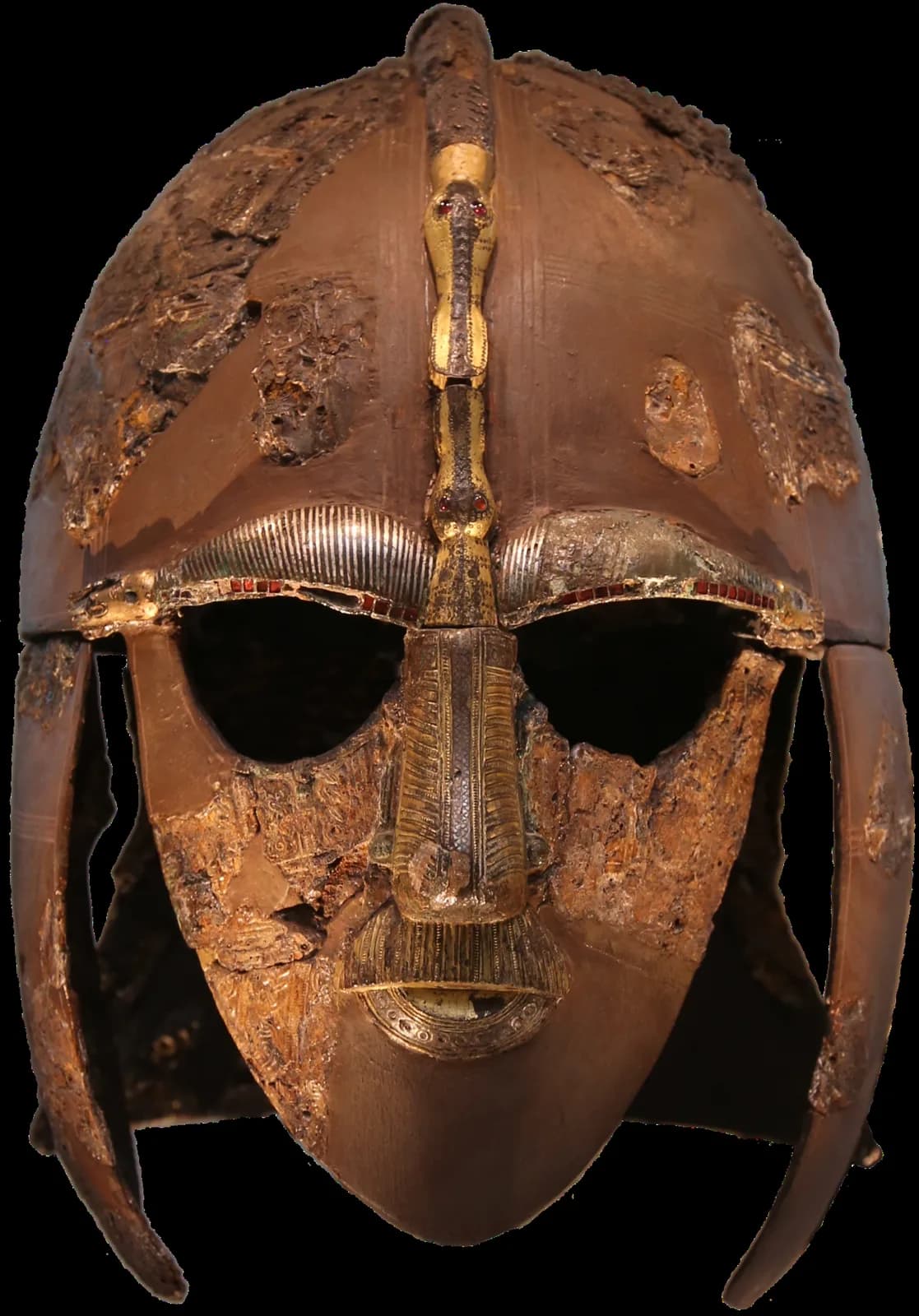
The Sutton Hoo helmet looks like one piece of metal. It has a crest, a face, a moustache and a pair of garnet eyebrows.
The British Museum describes it as "many individual fragments now built into a reconstruction made using jute textile and plaster." The face we know was assembled twice, and the first attempt was judged wrong.
The traditional view
Basil Brown, working in 1939 in Suffolk, revealed what the British Museum calls "the richest intact early medieval grave in Europe." It held the imprint of a ship 27 meters long and a burial chamber full of objects. Curator Sue Brunning places the death in the early seventh century. The coins in the grave point to the period around 610 to 635.
The helmet was wrapped in cloth and laid near the left side of the head. The soil was acidic, and the museum says any bodily remains were claimed by it. The museum adds that phosphate in the soil shows a human body once lay there. Brunning says "We can't name that king for certain," and calls Raedwald of East Anglia "a popular candidate."
The museum's object record describes iron with copper alloy fittings. The current form has a domed cap, cheek-pieces, a mask and a neck-guard, covered with panels of tinned copper alloy. The panels carry animal interlace and two warrior scenes known as "The Dancing Warriors" and "The Fallen Warrior." The museum says three dies were used for the figural scenes and two for the interlace. Black staining on the inside of the iron shows there was once a leather lining.
The museum dates the original components to the late sixth or early seventh century. It lists the place of production as Sweden (possibly) and England (possibly).
Herbert Maryon built the first reconstruction in 1946. The museum says it "was felt to be inaccurate." Nigel Williams completed the second in 1971, and that is the helmet in the case today. The conservators' account from Icon says more than 500 fragments lay on his workbench for over six months. It adds that the fragments were mounted on a heavy-duty textile covered with plaster, which both formed the shape of the helmet and supported the fragments.
A separate object sits near it. The museum also holds a replica made by the Royal Armouries in the 1970s, with a leather lining. A reader should know which one a photograph shows.
What the Evidence Does Not Settle
The facts above are not in dispute. The museum, Icon and the researchers below all agree that the helmet was rebuilt from fragments. They agree that the sources give no name for the person buried. They also agree that the burial was done with great care.
The disagreements start with what the pieces mean. Researchers read the same garnets and the same stamped panels and reach different places.
Where the Pieces Do Not Meet
Three questions stand out. Each rests on sources that disagree with each other or stop short.
Where does the ancient metal end?
Herbert Maryon wrote the first account of the work in Antiquity in 1947. His opening lines say the remains "covered a good-sized table." They list a gilded bronze nose and mouth piece, two gilded bronze dragon heads, parts of a silver crest, and "three or four hundred fragments of sand-encrusted rusty iron." He adds that "No photographs had been taken of them during excavation as their importance had not been realized at the time." I have read only that first page, because the article is behind a paywall.
The museum says the first reconstruction was felt to be inaccurate. Icon says the 1940s attempt "was highly contested." Williams spent a year studying the profile, color and shape of each fragment, including those omitted from the first attempt. I have not read the full accounts by Williams or by Rupert Bruce-Mitford. The museum lists both.
The museum gives the weight of the original as about 2.5 kilograms, estimated. It gives the weight of the Royal Armouries replica as 3.74 kilograms with its lining. I do not know why the two differ.
No researcher in these sources says the 1971 work is wrong. They say the shape came from decisions that someone had to make. How much of what we see comes from the metal and how much from those decisions?
Made where, and by whom?
The museum's own record leaves the place of production open between Sweden and England. Neil Price and Paul Mortimer write that the helmet and shield "bore a very close resemblance to those from the graves at Valsgärde, Vendel and Gamla Uppsala in Swedish Uppland province." A fragment from Gamla Uppsala is reported to look as if it came from the same die as the warrior on the helmet. I have not checked that claim against Bruce-Mitford, who is named as its source.
In March 2025 the National Museum of Denmark announced a stamp found by a metal detectorist on the island of Tåsinge. It is 4.5 centimeters wide. The museum says it "is much closer to the one on the helmet than the Swedish motifs." Curator Peter Pentz adds that if the likeness is this strong, the two "were not only made in the same place but even by the same craftsmen."
Pentz also says that "a small stamp that is only 4.5 cm wide could have travelled far and wide." He says "It is still too early to draw any conclusions." A 3D scan was planned and I have not found its result.
The British Museum's curator reads the find another way. The curator calls it "perhaps likelier to reflect a wider proliferation of this popular motif among the elites of Early Medieval Europe, rather than a strong indication that the Sutton Hoo helmet was made in Denmark." The curator also notes differences, such as the fallen figure carrying a shield, which the helmet panel does not show.
A die can travel, and so can a helmet. What would show where this one was made?
Why does only one eyebrow shine?
The garnets along the helmet's eyebrows are set in tiny cells. The museum counts 23 on the right brow and 25 on the left. Only the right brow has the gold foil backing that makes garnets glow.
Price and Mortimer report that Bruce-Mitford and Marzinzik both noticed this, and that Marzinzik speculated about a repair. Price and Mortimer write that a repair "seems unlikely in view of the minute quantities needed." They add that another garnet is also unfoiled, the left eye of the animal head on the crest. They write that "it is almost impossible to see this as coincidental."
Their paper argues that in a firelit hall the wearer would have looked one-eyed. Their abstract says the wearer "was seen as both war leader and war god, a literal personification of Odin." The paper presents this as an argument, with the words "It will be argued."
The British Museum uses more careful wording. It says only one eyebrow is backed, "perhaps a reference to the one-eyed god, Woden." I have not looked for a published rebuttal of the Odin reading. The sources here do not say who might have written one.
These readings concern the beliefs of people long ago. None of them says anything about the person in the grave. What would settle whether the missing foils were chosen?
The questions I can't put down
Some questions need more room than one article gives them. Two of them keep pulling me back.
Who was the message for? The museum says the mourners chose and arranged the grave goods to transmit messages about the dead person's identity and status. The body is gone and no name survives. In the book I follow a different deliberate burial, at Göbekli Tepe, and I ask who was on the other end of the message. I follow that question through Earthly Enigmas.
How old was the helmet when it was buried? The museum dates its original components to the late sixth or early seventh century. Wikipedia reports that Bruce-Mitford suggested it was about 100 years old at burial, which would make it an heirloom. I have not checked that claim. The museum notes that a silver platter in the same grave "was already a century old when buried." In Chapter 11 I look at how objects and knowledge pass down through generations. You can read a free sample of the book before you decide.
The buckle from the same grave has its own article. Read Sutton Hoo's Great Gold Buckle next. The articles section has more subjects in the same format.
Sources
- British Museum: The Sutton Hoo Helmet, 1939,1010.93 (read in a Wayback Machine copy, because the museum site blocks automated access)
- British Museum: Replica of the Sutton Hoo helmet, SHR.2 (same)
- British Museum: The Anglo-Saxon ship burial at Sutton Hoo (same)
- Maryon, The Sutton Hoo Helmet, Antiquity 21 (1947) (first-page preview only)
- Icon: Digging Deeper, Nigel Williams and the Sutton Hoo Helmet
- Price and Mortimer, An Eye for Odin? European Journal of Archaeology 17 (2014) (full text read in a copy hosted by a third party)
- National Museum of Denmark: New Find Links the Sutton Hoo Helmet to Denmark (27 March 2025)
- Wikipedia: Sutton Hoo helmet (used to locate sources and to relay the Gamla Uppsala die and heirloom claims, which I have not checked)