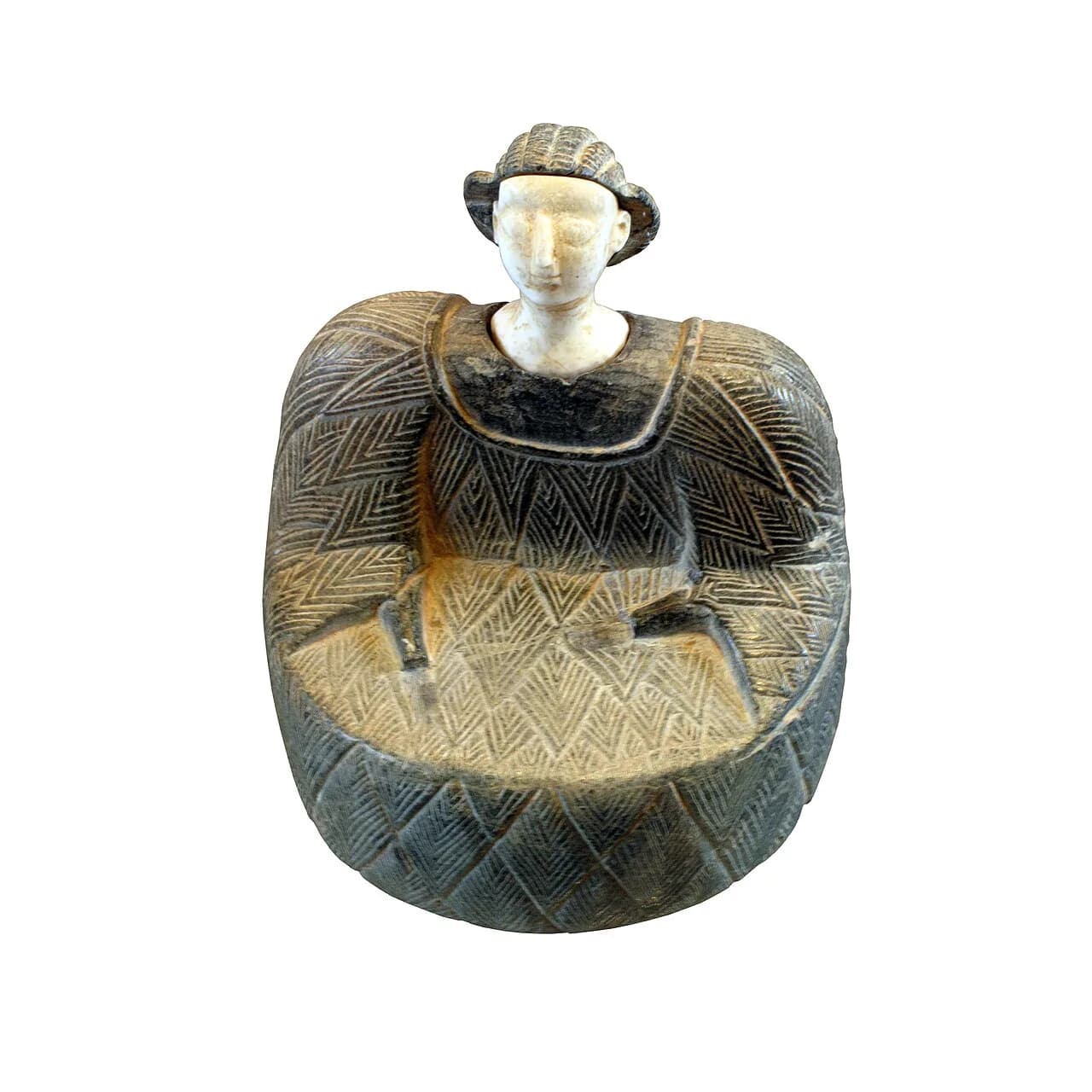
A figure about 13 centimeters tall sits in a museum case. Her head is pale stone and her robe is carved from chlorite.
The Louvre record gives her title as Princesse de Bactriane. The same record describes her as a female divinity.
The traditional view
The Louvre record for AO 31917 lists a composite statuette of chlorite and calcite, 13 centimeters high. It dates the figure to the Early Bronze Age, between 2500 and 1800 BC, and assigns it to the Oxus civilization. The record names Bactria as the place of discovery.
The Louvre catalogs several objects under the same title. This article follows AO 31917, the 13 centimeter figure.
Bactria names a region. The Ministry of Culture's Histoire des arts site says the Oxus civilization flourished from about 2300 to 1700 BC. It says the regions called Bactria and Margiana in antiquity correspond to northern Afghanistan and southern Turkmenistan. (That text is in French and the translation is mine.)
The Metropolitan Museum describes a group of stone female figures seated or squatting on a platform. It says they are "always composite figures of soft green chlorite or steatite, with heads of white limestone."
The Met adds that "Excavated examples of this figure type come from sites in Margiana in southern Turkmenistan, a possible center of their production." The Louvre record for AO 31917 records a gift from the Société des Amis du Louvre in 2003 and names a seller. It leaves the date of discovery and the object history blank.
Pierre Amiet wrote about the group in a 2010 article. He says they appeared around 1965. He says most come from tombs plundered by clandestine diggers, and that tombs at Gonur in Margiana were later explored in reference excavations. In his words, that gives them an at least potentially funerary character, although a few turn up in dwellings. (The article is in French and the translations are mine.)
The Network Question
In Chapter 5 of Earthly Enigmas I write that history books treat the ancient world as a series of isolated experiments. I argue for a network that links cultures with no documented contact. I also list Mohenjo-Daro among the 17 sites on Jim Alison's great circle.
Amiet does tie these figures to faraway places. He says such statuettes must have been exported to the cenotaph at Quetta and even to the Indus city of Harappa. He says comparable composite works turned up in Palace G at Ebla in Syria. He also reports half a composite wig from Susa in Iran.
Amiet then writes that the wider contacts of the Gonur elite reach toward Harappan India, Crete, Hittite Anatolia and, indirectly, Egypt. In his words, all of this is relatively sporadic and raises the problem of distant vectors, different from simple long-distance trade.
What the Record Cannot Settle
Both views lean on questions the evidence has not answered. Three of them stand out.
Was she a princess, a goddess or a mother?
The Louvre's description of AO 31917 calls her a female divinity dressed in a kaunakes, a garment of stylized woolly tufts. The popular title says princess. The Met says similar seated women on cylinder seals from southwestern Iran "appear to depict royal figures." It adds that the attributes of the figure on seals from western Central Asia "could indicate a divine quality."
Amiet says the statuettes remain enigmatic. He says no literary reference exists and no sign marks them as portraits or as deities. He proposes that the elite may have wanted a protective "Gracieuse Mère" in the tomb, an idea he draws from an Elamite ruler's inscription. He then offers the reverse reading and leaves the debate to his colleagues.
Amiet also notes that the name "Bactrian princess" was adopted by Agnès Benoit for the Louvre statuettes. Lyonnet and Dubova write in a 2020 volume that they prefer the term "Oxus Lady." I have only seen that line in a search excerpt of their text.
What would show whether she was a ruler, a goddess or a protective mother?
Why do the statues show only women?
Amiet calls the composite statues exclusively female. He writes that the society looks fundamentally masculine in its official art, which exalts hunting, war and agriculture on parade vessels. He adds that royal effigies are entirely absent from the statuary.
The Louvre lists a 2016 article by Benoit on the disparity of treatment between male and female images in Oxus art. I have only seen its title.
A general-audience blog, voir-et-savoir, says no male composite statuette has been found. It makes an exception for the Balafré, a scarred dragon-serpent figure from Iran. I have not checked that. Amiet leaves the Balafré statuettes out of his survey because their provenance remains too uncertain.
Why does a society that shows hunters, warriors and farmers on its parade vessels set only women in its statuary?
Where was she found, and what would that tell us?
The Louvre record gives a region and leaves the discovery date and the object history blank. Amiet says the type appeared on the market around 1965. The Met says its own figure was known on the art market by 1976.
Excavated examples do exist. The Met places them in Margiana and Amiet points to Gonur. A similar form can place an object in a tradition. It cannot return an object to a trench or a grave.
The Ancient Merv article covers Gonur and the oasis around it.
What can the excavated figures tell us about one with no findspot, and what can they never tell us?
The questions I can't put down
Some questions need more room than one article gives them. Two of them keep pulling me back.
How did one style travel so far? Amiet places composite statues or their parts at Ebla, Susa, Quetta and Harappa. He says simple long-distance trade leaves a problem of distant vectors. In Chapter 5 I follow the question of connections between distant cultures through Earthly Enigmas. The Rhinoceros Seal article looks at a single Indus object in detail.
How do you date a figure with no layer? The Louvre gives 2500 to 1800 BC for AO 31917 and 2100 to 1900 for a related head, with a question mark. Amiet says the statuary seems to peak in the early centuries of the second millennium. He also says the archaic dress could point to a form already present in the time of Akkad. In Chapter 4 I discuss how monuments are dated, including dating by style. You can read a free sample of the book before you decide. The articles section has more subjects in the same format.
Sources
- Louvre: Princesse de Bactriane, AO 31917 (and its JSON record)
- Louvre: cylinder seal AO 32493, the record's listed analogy
- Louvre: Princesse de Bactriane, AO 22918, AO 28056 and AO 26490
- Metropolitan Museum: Seated female, Bactria-Margiana Archaeological Complex
- Histoire des arts: Princesse de Bactriane (Ministry of Culture, text from RMN, in French)
- Pierre Amiet, Princesses de Bactriane ou "Gracieuses mères" trans-élamites ? (Revue d'assyriologie 104, 2010) (in French)
- voir-et-savoir.com: La Princesse de Bactriane et la Déesse bienfaitrice (secondary, general audience, in French)
- Lyonnet and Dubova, The World of the Oxus Civilization (2020), Academia page (search excerpt only)