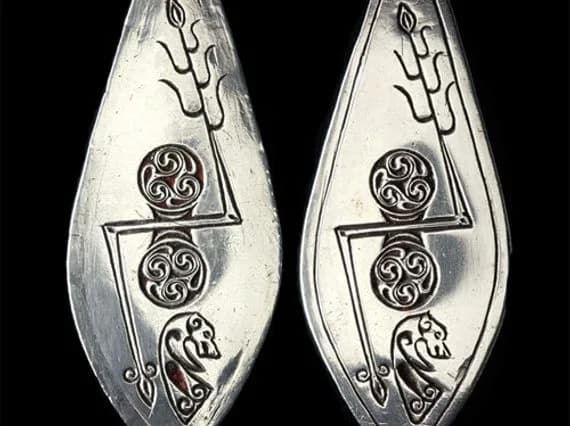
Someone digging sand at the foot of a prehistoric mound in Fife found a hoard of silver in or about 1819. Nobody knows who the finder was.
The silver went to a peddler and then to jewelers who sold it as scrap. Most of it was melted down. The records of what it contained were written twenty years later, from memory.
The traditional view
James Graham-Campbell describes the find in the Proceedings of the Society of Antiquaries of Scotland. He quotes the antiquarian Joseph Anderson on the site, a tumulus "remarkable alike for size and situation" on a ridge near Largo. The silver turned up while sand was being dug at its base.
The first accounts are from 1839 and 1840. One of them says the silver was found "about the year 1819" in "a stone coffin," although "no bones, ashes or human remains" were seen. Anderson later called the coffin "clearly an inference."
Graham-Campbell writes that a peddler sold the silver for scrap. A jeweler in Cupar named Robertson bought part of it and a larger portion went to another buyer in Edinburgh. The earliest estimate of the weight was "not much under 400 ounces of pure bullion," which Graham-Campbell converts to nearly 12.5 kilograms.
The landowner, General Durham, saved 153 objects and fragments that weighed about 750 grams. Graham-Campbell calls that "only about one-seventeenth of the original treasure by weight." National Museums Scotland now speaks of some 170 pieces. Its research fellow Alice Blackwell calls the collection "one of the most significant archaeological survivals from early Medieval Scotland."
Graham-Campbell concluded in 1991 that the hoard was "predominantly Pictish silver, with some Late Roman elements." He thought it was deposited "most probably during the second half of the seventh century."
The museum's exhibition page puts the silver in a larger story. It says that in the first millennium AD "silver was the most powerful material in Scotland." Roman silver was "hacked and melted down" to make early medieval treasures.
Gordon Noble and colleagues write that the Pictish symbols on the plaque are undeciphered. They say the symbols probably mark personal identities. The Aberlemno article covers the same symbols on stone.
What the Silver Leaves Open
Noble and colleagues write that the hoard was deposited at what was already an ancient monument in the Pictish period. In Chapter 11 I write about Stonehenge and Carnac, which are prehistoric sites.
What Cannot Be Checked
The silver was dispersed before it was catalogued. Graham-Campbell notes that "there is no 19th-century inventory" in the museum. Three questions follow from that.
When was it buried?
The specialists give dates that sit centuries apart, and Graham-Campbell sets them out in turn. Robert Stevenson dated the oval plaques "no earlier than c 700." Lloyd Laing considered the hoard "one of a series of silver treasures dating from the late fourth or early fifth century."
Graham-Campbell rejects Laing's view. He writes that the Traprain Law treasure and Norrie's Law "appear completely mismatched." The first is "massive and ornate" and the second is "generally slight and largely plain."
In 2016 Noble and colleagues wrote that the best parallel for the plaque symbols is the Rhynie 5 stone. They report that more than 20 radiocarbon dates point to a fifth to sixth century date for the settlement at Rhynie. They conclude that "an earlier date for both hoards must be considered." They add that "the evidence for re-dating is tentative."
The museum's exhibition page labels the left-hand plaque of the pair as sixth to seventh century. I have not checked whether the museum has published a date for the burial itself.
What would fix a date for a hoard that was melted down before it was catalogued?
Which pieces are original?
Blackwell reports that the hoard holds three pairs of near-identical objects. Each pair is "a worn original and a direct copy." The question was when the copies were made.
Her team analyzed the silver. They found that one plaque and one hand-pin are "totally unlike the rest of the hoard in terms of their silver composition." They contain very few trace elements. The team concluded that these two are probably made from relatively modern silver.
The archive points to George Buist, who investigated the find in 1839. He had pewter copies made of some pieces. The museum traced them to St Andrews Museum. Blackwell writes that Buist's silver "rescued" plaque and pin are the ones the analysis questions. She writes: "We think however that he was misled."
She names the Cupar jeweler Robertson as the maker of the pewter copies. She writes that he had the moulds and "we can only speculate as to a potential motive."
Some of the dating rested on these pieces. Noble and colleagues report that Graham-Campbell compared the Z-rod on the back of a hand-pin and the cross on its front with Class II cross-slabs "dating to the seventh century or later." They write that this hand-pin is "a nineteenth-century copy" with a Z-rod added. One of the two plaques is also a copy.
Graham-Campbell quotes Stevenson calling the oval plaques "perhaps the freshest objects in the hoard." Noble and colleagues dispute his comparison of the beast head on the surviving plaque to a Lindisfarne dog. They write that it "is more readily identifiable as some form of sea- or water-creature."
I have not read Goldberg and Blackwell's 2013 chapter, only its abstract. I have not checked how the other two pairs were tested.
How much of the old dating still stands once the copies are set aside?
What was in the missing silver?
The lost pieces are known only from memory. Graham-Campbell writes that the jeweler's account came from "the twenty-year-old memories of Robertson." He adds that Robertson "was convinced from the outset that it comprised a set of silver armour."
Robertson described a shield with a man on horseback, a helmet and a sword handle. Buist drew them from that description. Graham-Campbell says Buist's reconstruction of the sword handle deserves little credence. He suggests the shield may have been a Late Roman dish or the covering of a parade shield, and the helmet a crushed vessel.
Rosemary Cramp wrote in 1989 that the objects "appear to have been part of the burial deposit of a Pictish warlord." Graham-Campbell calls this a revival of a nineteenth-century notion that Anderson countered when he wrote that it "rests upon no basis of evidence, or even probability."
Leighton reported that there were also "coins" marked "with symbols similar to those on the oval plates." Graham-Campbell cautions that they may not have been Roman coins at all. In 2016 Noble and colleagues said that late fourth-century Roman silver coins had been identified from an early drawing.
What did the other sixteen seventeenths look like?
The questions I can't put down
Some questions need more room than one article gives them. Two of them keep pulling me back.
Why bury silver at an old mound? Noble and colleagues note that both Norrie's Law and Gaulcross are isolated, with no known Pictish settlements or symbol stones nearby. They write that "that wealth was accumulated and buried, but never reclaimed." They suggest the deposit may have connected an emerging elite to a deep ancestral past, and for Gaulcross they mention a tradition of votive offerings. In Chapter 11 I write about Stonehenge and Carnac, which are prehistoric sites. I follow that through Earthly Enigmas.
What were the plaques for? In 1849 Albert Way asked whether they were "destined for some mystic or magical purpose." Graham-Campbell lists other readings, among them Roman phalerae and Roman votive plaques. The double-disc and Z-rod on the Norrie's Law plaque also appears on the Aberlemno stone. In Chapter 14 I ask "Why geometry?" about symbols that recur. You can read a free sample before you decide. The articles section has more subjects in the same format.
Sources
- Graham-Campbell, Norrie's Law, Fife: on the nature and dating of the silver hoard, Proceedings of the Society of Antiquaries of Scotland 121 (1991)
- Noble, Goldberg, McPherson and Sveinbjarnarson, (Re)discovering the Gaulcross hoard, Antiquity 90 (2016)
- Alice Blackwell, The Glenmorangie Research Project: Norrie's Law, National Museums Scotland blog (2015, read in an archived copy)
- National Museums Scotland: Scotland's Early Silver
- Goldberg and Blackwell, The different histories of the Norrie's Law hoard (2013, abstract only)
- Goldberg, The curious case of the Norrie's Law hoard fakes, History Scotland (2013, abstract only)