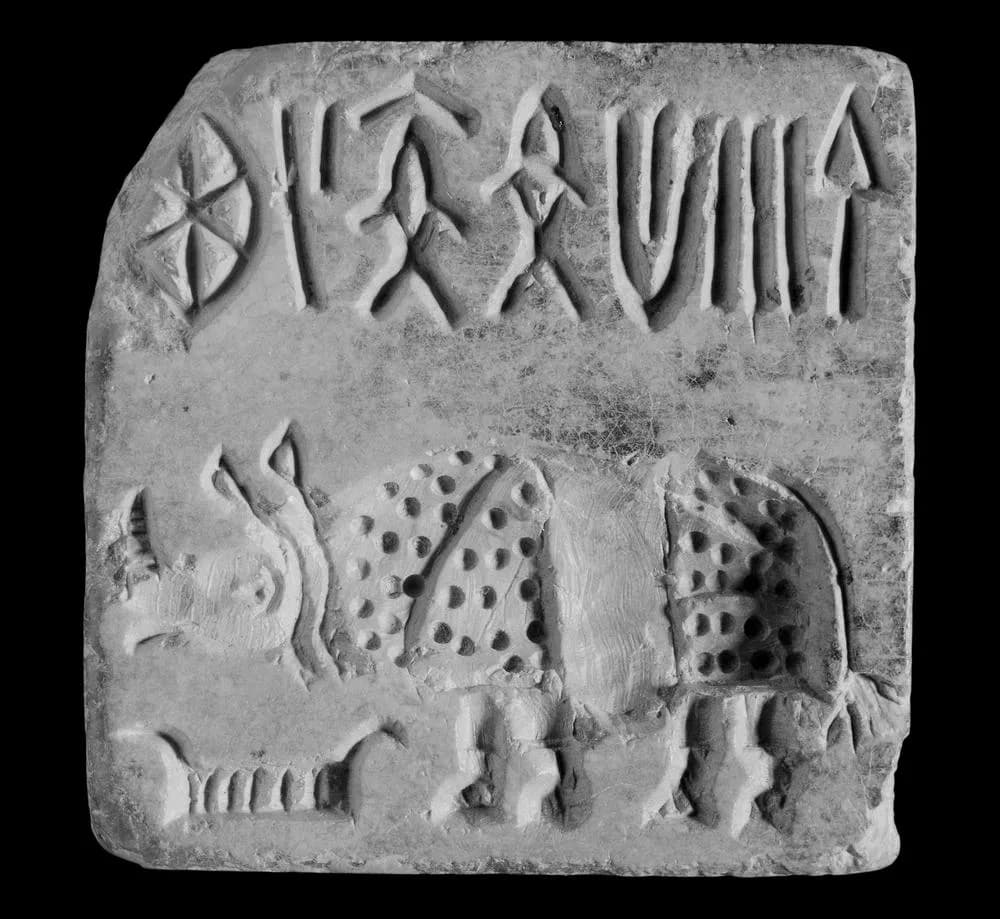
The seal measures about 3.3 centimeters on each side. A carver cut a rhinoceros into grey steatite and put a short line of signs above it.
That line of signs has never been deciphered.
The traditional view
The British Museum holds the seal. Its record describes an Indus stamp-seal carved from grey steatite, with a face that represents a rhinoceros and a short inscription in Indus script. It dates the seal to 2500 to 2000 BC. It was dug up at Mohenjo-daro in Pakistan and donated by Sir Mortimer Wheeler in 1947.
UNESCO calls Mohenjo-daro the best preserved urban settlement in South Asia, dating back to the beginning of the 3rd millennium BC. It says the lower town was laid out according to strict rules.
Marta Ameri describes the standard Indus stamp seal in a 2013 chapter. It usually shows a single animal facing left and a line of inscription above its head. The animal generally stands before a standard or trough.
The rhinoceros is a rare choice. Her table of published seals counts 12 rhinoceros seals out of 802 at Mohenjo-daro and one out of 96 at Harappa. The unicorn fills about 80 percent of the seals at both cities.
The rhinoceros is also carved with care. Shibani Bose, quoted by Harappa.com, says the animal on the seals is always the one-horned rhino. Ernest Mackay noted the thick hide with its wrinkles and folds. Bose says the detail suggests a close familiarity with the subject.
Same Hands, Different Continents
In Earthly Enigmas the Indus Valley appears in Chapter 5. There I write that history books treat the ancient world as a series of isolated experiments. I cite the planned cities of the Indus Valley as one of the cases. I also mention a second great circle that connects Giza, Nazca, Easter Island and the Indus.
In the book I do not take up the seals or the script.
What the Seal Leaves Open
The experts do not agree on three things about this small object. They are set out below with the sources.
What was the animal for?
Bose says the archaeologist John Marshall read the troughs in front of the animals as food offerings. On that reading the animals were objects of worship.
Bahata Ansumali Mukhopadhyay reads the seals differently in a 2023 paper. The paper notes that seals with different animals, the rhinoceros among them, carry the same inscriptions. It suggests that different guilds, rulers or governing bodies may have used different emblems. It says the feeding troughs must have had some symbolic significance.
The paper adds a puzzle of its own. On clay sealings the inscription stays visible while the animal is often "not or barely recognizable," in the words of Frenez, whom the paper quotes. I have not checked Frenez.
What did the rhinoceros stand for?
Why is it rare on seals and common elsewhere?
Ameri's counts come from the published corpus only. Within that corpus the rhinoceros is almost absent from the seals.
Bose reports that rhinoceros figures made up 6.3 percent of the terracotta collection at Harappa. Bose calls the figure striking because it is more than double the share of sheep and goat. I have not checked Bose in the original.
The same city made the animal in clay far more often than it carved the animal on a seal.
Why did a favorite figurine become a rare seal?
Is the line above it writing?
Steve Farmer, Richard Sproat and Michael Witzel argue that it is not. Their 2004 paper says the symbols were "not even evolving in linguistic directions after at least 600 years of use." I have read only the abstract.
Asko Parpola disagrees in his reply. He reports their argument that the inscriptions are too short, at about five signs on average. He concludes that "None of these arguments is conclusive, and can be easily controverted."
Rajesh Rao and colleagues add a statistical test. They report in Science that the script's conditional entropy is closer to that of natural languages than that of various nonlinguistic systems. Parpola reports that Sproat agreed in a 2005 e-mail that statistical tests alone can prove neither side. I have not read Sproat's later paper in Language on the same test.
The script remains undeciphered. The unicorn seal carries most of this argument and has its own article, The Indus Seal.
Is the line above the rhinoceros writing?
The questions I can't put down
Some questions need more room than one article gives them. Two of them keep pulling me back.
How far did the Indus reach? The British Museum holds a stamp seal with a bull and a line of Indus script that Sir Leonard Woolley excavated at Ur in southern Iraq. The museum marks its culture with a question mark. In Chapter 5 of the book I write about how history books treat contact between ancient cultures. I follow that question through Earthly Enigmas.
Who drew the plan? UNESCO calls Mohenjo-daro the most ancient planned city on the Indian subcontinent. In the book I list the Indus Valley planned cities among my cases, and I do not have a name for the planner. You can read a free sample before you decide. The articles section has more subjects in the same format.
Sources
- British Museum: stamp-seal 1947,0416.4 (rhinoceros, Mohenjo-daro)
- British Museum: stamp-seal 1929,1017.725 (Indus script, excavated at Ur)
- UNESCO World Heritage Centre: Archaeological Ruins at Moenjodaro
- Marta Ameri, Regional Diversity in the Harappan World: The Evidence of the Seals (2013)
- Harappa.com: The Rhinoceros in Indus Times (quoting Shibani Bose, The Story of India's Unicorns, 2018)
- Mukhopadhyay, Humanities and Social Sciences Communications (2023)
- Farmer, Sproat and Witzel, Electronic Journal of Vedic Studies 11 (2004)
- Asko Parpola, Study of the Indus Script (response to Farmer et al.)
- Rao et al., Science 324 (2009), abstract