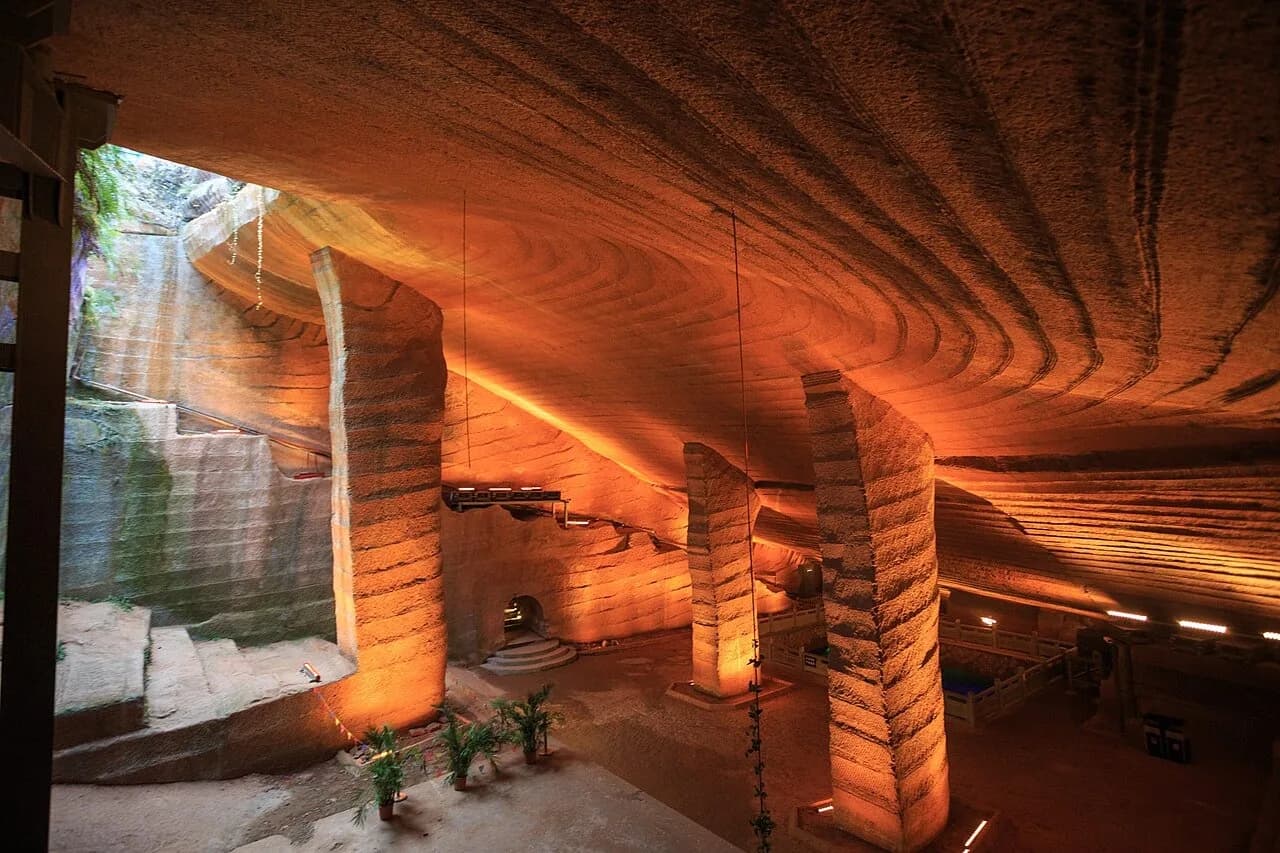
In June 1992 four farmers in Longyou County, Zhejiang, pumped the water out of a village pond. After 17 days of continuous pumping they were looking into a large underground room with a rock staircase, stone pillars and regular marks cut into the walls.
Four more ponds nearby gave up four more rooms. The Zhejiang provincial government says archaeologists and academics have been asking ever since who made the caves, when and why.
The traditional view
The caves sit in a small hill on the northern bank of the Qu River. The Zhejiang provincial government describes a complex of 24 artificial caves cut into the sandstone of Fenghuang Hill. It counts five large caverns and 19 smaller caves.
In a 2011 paper in the Journal of Rock Mechanics and Geotechnical Engineering, Zhifa Yang, Zhongqi Yue and Lihui Li summarize twelve years of investigation. They write that the caverns were carved in siltstone of Cretaceous age by ancient people about 2,000 years ago. Ten of the 24 are complete and the other 14 have partly or fully failed.
Yang and his colleagues reconstruct the work in steps. The builders cut a portal first and then carved each cavern from the top down in layers. They guess the tools were short steel chisels and hardwood hammers, and they report four short steel chisels unearthed in caverns 1 and 5.
The walls, ceilings and pillars carry regular imprints. Straight troughs run 500 to 600 millimeters apart, and short curved troughs sit between them.
The same authors explain why so many chambers survived. Water filled the ten complete caverns through their vertical portals. They write that this full water occupation is the key natural factor that kept the caverns stable for more than 2,000 years.
On the date, the provincial government says archaeologists recovered glazed clay pots from the silt on a cavern floor. It dates the pots to the Western Han Dynasty, 206 BC to AD 23, and concludes that the caves were built earlier and are around 2,000 years old.
Other published figures run older. Chikaosa Tanimoto and colleagues at Osaka University published a 2008 study of ground electric resistivity at the site. Their abstract says the 24 caves "are presumed to have been constructed around 2300-2400 years ago."
Every study I read treats the caverns as made by people.
What the Record Leaves Open
The provincial government says few historical records or datable evidence have been found to answer who, when or why. Yang and his colleagues are plainer about the date. They write that undisturbed soil or wood samples were not obtained for radiocarbon dating. In their words, "Therefore, the cavern construction time cannot be determined and confirmed."
They list the purposes that archaeologists and others have proposed. These are stone quarrying, a mausoleum, underground storage, a Taoist home, a secret military camp, a place for offering sacrifices and a palace. They write that "there is no consensus about the construction purpose of the large rock caverns."
A 2005 feature on CCTV.com lists more. It records a proposal of an underground palace from a former head of the Dunhuang Academy's cave research institute, a Daoist blessed-land idea and a megalith-culture idea. It also records that some people trace the caves to Goujian, a king of the state of Yue. They rely on a line in an old text that says the Yue state had stone chambers. The same feature records a suggestion that extraterrestrials made them. On the question of who built the caves it says each guess sounds reasonable at first and turns out on closer inspection to be a tree without roots. The translation is mine.
Reinoud De Jonge, an independent researcher, ties the caves to a comet. His paper on Academia.edu begins with the line "Dating the Longyou Caves appears to be not very difficult." He ties the date to a comet whose "periodicity" he gives as "c.580 years" and writes that "the Caves may date from the 13th Dynasty." I could see only the opening lines of his paper in a search excerpt and have not read the rest. I do not know which dynasty list he means.
Popular accounts go further than the specialists. Ancient Origins says scientists "have absolutely no idea how the Longyou Caves were built, by whom, and why." Yang and his colleagues do offer a reconstruction of how, even though they say the who and the when stay open.
In Earthly Enigmas I write about Derinkuyu, the underground city in Cappadocia. I write that when Derinkuyu was first built has never been satisfactorily answered. I also write that the usual attribution to the Phrygians does not address why it was built. The Longyou Caves leave the same two questions open.
The Chambers With No Paper Trail
Both readings lean on questions the evidence cannot yet answer. Three of them stand out.
When were they cut?
Yang and his colleagues describe how the pots came to light. On October 19, 2001, workers cleaning silt out of cavern 2 found pieces of glazed clay ware. Archaeologists put them together into two incomplete pots and confirmed them as typical of the Western Han Dynasty.
The authors then add that "Based on the assumption that they were put into the cavern No.2 two thousand years ago, the rock cavern No.2 would be constructed earlier."
They also report a relief of a horse, a bird and a fish on a wall of cavern 1. Some archaeologists and historians judged that it was carved between 206 BC and AD 589. The authors write that "For an ease of communication" they adopted a construction time of 2,000 years ago. They say further evidence may lie in the mud left on the cavern floors, together with radiocarbon dating.
The CCTV feature reports other readings. Some people infer from the pictures on the cavern walls that the work may belong to the Liangzhu culture period. Others argue from the likely uses that the caves are more than 2,000 years old and probably date to the Spring and Autumn or Warring States periods. The feature says most of these uses are assumptions without enough evidence behind them.
A similar site gives a different kind of answer. The Wikipedia article on the Longyou Caves says the Huashan Grottoes in Anhui somewhat resemble them. It cites a 2013 paper in the Journal of Archaeological Science by Cheng Zhu and colleagues. Their abstract uses lichen growth on the rock to place the main Huashan excavation in the middle and late Ming Dynasty, between 1552 and 1667 AD. I have read only the abstract and have not checked whether the paper compares the two sites.
What would date the cutting itself?
Where did the rock go?
The 24 caverns lie inside a hill of about 350 by 280 meters. The five caverns the farmers drained have plane areas between 367 and 1,057 square meters, according to Table 1 of the Yang paper.
The CCTV feature asks the question directly. It estimates the stone cut from the 24 caverns at 80,000 cubic meters and asks where it all went.
Ancient Origins gives a much larger number. It says the rock removed is estimated at nearly 1,000,000 cubic meters. It adds that "there is no archaeological evidence revealing where that quantity of stone went." I saw figures of 900,000 and 1,000,000 cubic meters in Chinese-language news excerpts as well. I have not found the source of either figure.
The two estimates differ by more than twelve times.
Yang and his colleagues do describe how blocks were taken out. They found a relic of unfinished block carving in a small cavern next to a collapsed one. They reconstruct four deep troughs around a rectangular block and a row of drilled holes along the base. Chisels were driven into the holes one by one, with the last step "finally removing the rock block." The papers I read do not say where the removed rock ended up.
The highlights of the Huashan paper name the tremendous demand for stone materials as the purpose of that excavation.
How much stone came out of Longyou, and where did it go?
What were they for?
Yang and his colleagues read the water traps, drainage channels and staircases in the complete caverns as intrinsic parts of the original design. They write that these features "can be the evidence to show that the ancient people tried to dry the caverns or use the caverns in dry conditions."
The same paper explains that each complete cavern has a vertical portal that lets rain and runoff in and keeps the chamber full of water. The authors conclude that the builders did not plan the caverns for their stability over 2,000 years. They call the survival "a consequence of coincidental combinations of human effort and natural factors."
Finds point in different directions. The paper reports the pots and the four steel chisels. The 2005 CCTV feature says that apart from a headless stone statue not a single cultural relic had been found. I cannot tell from my sources how to reconcile the two statements.
Ancient Origins says no funeral objects, tombs or traces of habitation have been found. I have not checked that.
What were these rooms for?
The questions I can't put down
Some questions need more room than one article gives them. Two of them keep pulling me back.
Why is the written record so quiet? Yang and his colleagues say the county was established in 223 BC. They found one written record about the caverns, a poem written by Yu Xun between 1626 and 1676. They also found two poems from the Song Dynasty that may refer to them. I have not read the poems. The CCTV feature says histories, local gazetteers and classics hold no record of the project and that even folk tradition is silent. It adds that the caverns later served as a release pond for fish at a Ming temple on the hill. In the book I write that Derinkuyu's date has never been satisfactorily answered and that its builders left no written record of what they feared. I follow that question through Earthly Enigmas.
How did they measure underground? The wall between caverns 1 and 2 is 0.55 to 1.3 meters thick, 16.5 meters long and 5 meters high. Yang and his colleagues write that the caverns were well positioned and did not interfere with each other. They suspect a compass-like tool. They also write that no relic has been found about how the regular imprints were carved. In Chapter 3 I write about the precision of the stonework in the Andes and about the tool marks Jean-Pierre Protzen documented at Ollantaytambo. The Puma Punku article looks at how the stone was cut on another site. You can read a free sample of the book before you decide. The articles section has more subjects in the same format.
Sources
- Zhejiang Provincial Department of Foreign Affairs: Longyou Caves
- Yang, Yue and Li, Design, construction and mechanical behavior of relics of complete large Longyou rock caverns carved in argillaceous siltstone (Journal of Rock Mechanics and Geotechnical Engineering, 2011)
- Tanimoto et al., The Consideration about Ground Electric Resistivity at the Longyou Grottoes of China (Journal of the Society of Materials Science, Japan, 2008) (abstract)
- Zhu et al., Lichenometric dating and the nature of the excavation of the Huashan Grottoes, East China (Journal of Archaeological Science, 2013) (abstract only)
- CCTV.com feature on the Longyou grottoes (2005, in Chinese)
- Ancient Origins: Ten Enduring Mysteries of China's Longyou Caves (secondary)
- Reinoud De Jonge, Longyou Caves, China (Academia.edu) (search excerpt only)
- Wikipedia: Longyou Caves (secondary, used only to locate the Huashan paper)