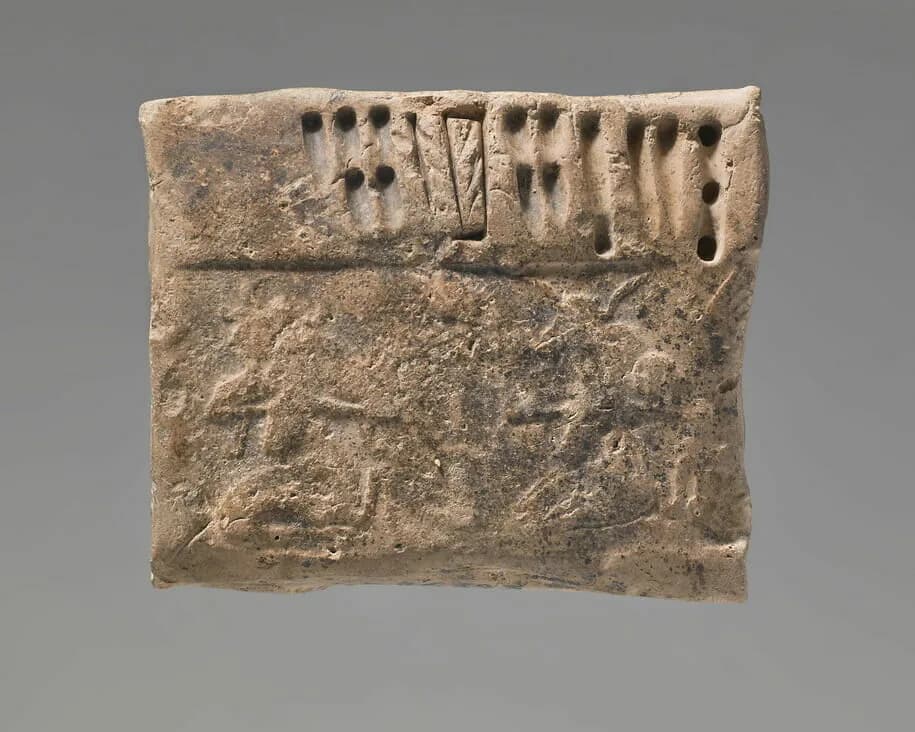
A tablet of baked clay is kept in the Louvre. It is 57 millimeters high and 70 millimeters wide.
The Louvre catalogues it as SB 6393 and says it came from Susa. Rows of signs and numbers cover the clay, along with the prints of seals that show kneeling wild bulls.
The traditional view
The Louvre record names Jacques de Morgan as the excavator and gives 1907 as the year of discovery. It dates the tablet to Susa III, which it equates with Proto-Elamite, from 3100 to 2600 BC. The record lists the tablet as not on display. The catalogue warns that its room information may be out of date.
The record describes the object in French as an economic tablet with seal impressions of kneeling wild bulls and Proto-Elamite signs. That is my translation. The Louvre cites the older publications by Vincent Scheil and a 2024 volume called The Met at the Louvre.
Robert Englund of UCLA surveyed the state of decipherment in a 2001 preprint. He counts a corpus of "just over 1600 pieces" with about 10,000 lines of text. He says "Proto-Elamite" is an artificial term built from the later name of the region.
Kathryn Kelley's 2026 survey for Cambridge University Press says the script "remains only very partly deciphered." Her summary counts about 1,700 tablets from Iran dating from 3300 to 2900 BCE. She says the tablets "use a complex system involving hundreds of symbols to count commodities, people, and institutions."
Englund describes a standard layout. He writes that "Many texts begin with a heading, a sign or a sign combination which qualifies all transactions recorded in the text and which never contains a numerical notation." Individual entries follow and a total closes the account.
The numbers are the part specialists can read. Englund shows that the Proto-Elamite number signs have the same forms as those in the proto-cuneiform tablets of Mesopotamia. He also finds a strictly decimal system for counting animals and laborers. He says that system "finds no parallel" in the proto-cuneiform corpus apart from six possible exceptions that he calls unlikely.
Some goods were counted in base 60, the same family of counting that Mesopotamia used. Englund says the base 60 system at Susa had "an obviously restricted field of application."
The Numbers Come First
In Chapter 7 I describe Sumer as a starting line, with writing and base 60 mathematics already in place when the record begins.
The Susa tablets count some goods in base 60 and others in base 10, and they date to the same few centuries as the first Mesopotamian tablets. Englund says the shared number signs show that the scribes used systems with "at the very least the same quantitative order" as the Mesopotamian ones.
Where the Specialists Part Ways
The Louvre and the specialists I read treat the tablet as an account. They disagree about almost everything past that. Three of the disagreements stand out.
Is it a language or a ledger?
Englund wrote in 2001 that "the syntax of these texts would seem more to represent the structure of a system of bookkeeping than the division of a spoken language into distinct semantic units." He added that there was "little reason to be optimistic about an eventual language decipherment of proto-Elamite." He credits Gelb with the same view.
Jacob Dahl of Oxford takes a different line. The abstract of his 2009 paper in Iran says that "proto-Elamite can be deciphered, since it is a true proto-writing system." I have seen that abstract only in a search result and have not opened the paper.
François Desset and his coauthors went further in 2022. They propose that Proto-Elamite and the later Linear Elamite "were probably not two different writing systems, but the same system at two different chronological stages of evolution." Linear Elamite was a syllable script, so on their view some Proto-Elamite signs would stand for sounds.
A team led by Kathryn Kelley tested that idea on the Susa corpus in a 2022 paper. They write that the hypothesis of a syllabary in Proto-Elamite "remains as yet unproven" and that overall conclusions on the proposed sound values are "premature." Most of the proposed matches, 61 of 86, are signs that can stand on their own in an entry.
A 2026 preprint by Logan Ross claims much more. The abstract says three small language models read the script and ends with the line "This dictionary reads it." The preprint is on Zenodo and I have not seen a review of it by a specialist. I have not checked its method.
What would a reading of a ledger have to show before both camps accepted it?
Where did it come from, and why did two neighbors never share a site?
Dahl's abstract says the import of accounting tools from southern Iraq "led to the invention in Iran of a short-lived, and indigenous writing system." Englund sees the debt differently. He thinks the more developed split between meaning and syntax in the Proto-Elamite texts is "a strong indication of the antecedence of the proto-cuneiform corpus."
The Harappa.com summary of an article by Desset reports that he calls the two systems "sister" writing systems. It also reports that texts in the two scripts have never turned up in the same place, though the regions are nearly adjacent. It quotes Desset asking whether the separation reflected "the redundancy and pointlessness to use two different systems" or "any identity border." I have read only the Harappa quotation and not the original article.
Both views start from the same tablets. Which script came first, and why would two neighbors keep their records apart?
What happened when the writing stopped?
Englund puts the whole span of the script at "a relatively short period of literacy, beginning around 3100 and ending around 2900 B.C." He adds that after it "no writing tradition existed." Linear Elamite comes "some eight centuries after the proto-Elamite age," and he sees "little graphic and no obvious semantic connection" between them.
Desset and his coauthors fill the gap with a middle stage they date from 3000 or 2900 to 2300 BCE. They call it "still inadequately documented" and say four documents represent it. In an interview with the London Review of Books Desset suggests the scribes may have used wood and wax that have not survived.
Dahl rejects that idea. In the same interview he says "Cultures with writing behave differently from those that don't." He adds that "for hundreds of years we have no seals, no styluses, nothing." In a 2023 paper he proposes that late third millennium scribes made a new script, using "recovered proto-Elamite tablets as part of their inspiration."
The sources give the gap as more than 500 years, as some eight centuries and as roughly 700 years depending on where each one starts the count. Did writing go quiet in Iran, or did it only leave nothing we have found yet?
The questions I can't put down
Some questions need more room than one article gives them. Two of them keep pulling me back.
Why did writing begin as accounting? Everything on the Susa tablets is a count of grain, animals, workers or goods. The Harappa.com summary of Desset says the tablets were "exclusively local administrative documents," and that no Proto-Elamite word list has turned up. In Chapter 7 of Earthly Enigmas I look at Sumer as a starting line with writing already in place. I follow that question through the book. The Sumerian King List article looks at one Mesopotamian text in detail.
How old is the tablet, really? The Louvre gives 3100 to 2600 BC. Englund gives 3100 to 2900 and Kelley gives 3300 to 2900 BCE. Englund also notes a report that radiocarbon dates from Uruk might push the early Mesopotamian tablets back about two centuries. The Louvre gives 1907 as the year of discovery, while its own bibliography lists a 1905 publication that carries this catalogue number. I have not resolved that. In Chapter 4 I describe how dates get fixed and where I think the methods are misused. You can read a free sample before you decide. The articles section has more subjects in the same format, including the undeciphered Indus Seal and the Enkomi Tablet.
Sources
- Louvre Collections: tablet SB 6393, Susa (cl010179904)
- Englund, The State of Decipherment of Proto-Elamite (Max Planck Institute preprint 183, 2001)
- Kelley, Proto-Elamite: Writing and Society in Early Iran (Cambridge Elements, 2026) (summary page only)
- Dahl, Early Writing in Iran, a Reappraisal (Iran 47, 2009) (abstract only, via a search result)
- Dahl, Proto-Elamite and Linear Elamite, a Misunderstood Relationship? (Oxford Research Archive, 2023)
- Desset, Tabibzadeh, Kervran, Basello and Marchesi, The Decipherment of Linear Elamite Writing (Zeitschrift für Assyriologie 112, 2022)
- Kelley, Born, Monroe and Sarkar, On Newly Proposed Proto-Elamite Sign Values (Iranica Antiqua 57, 2022)
- Ross, Reading Proto-Elamite (Zenodo preprint, 2026)
- Harappa.com: Proto-Elamite Writing in Iran (summary of an article by Desset)
- Stevenson, Beyond Mesopotamia: Linear Elamite Deciphered (London Review of Books, 2025)
- Wikipedia: Proto-Elamite script (used only to locate sources)