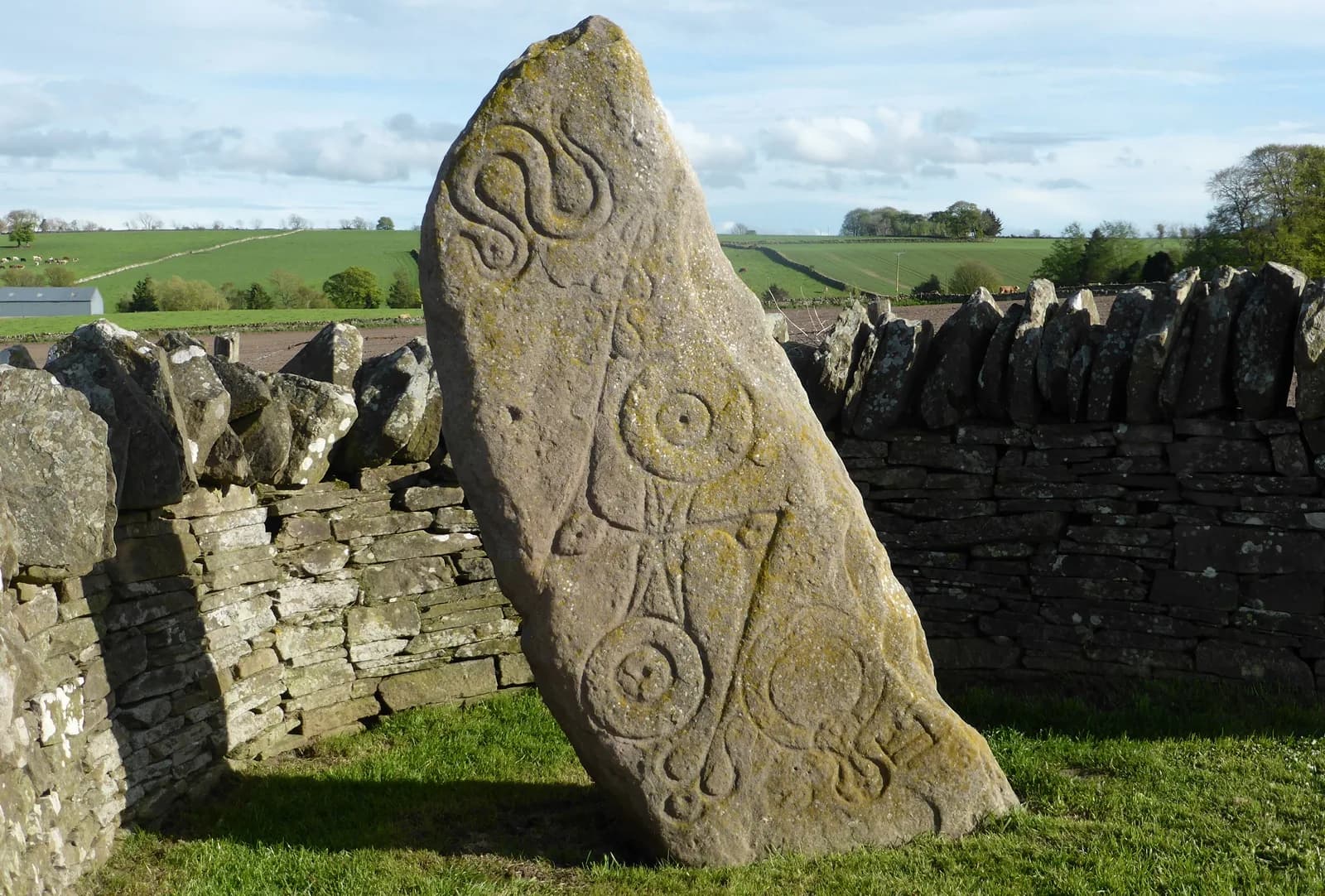
Beside a road in Angus, Scotland, a red sandstone pillar stands about 1.8 meters tall. The front carries a serpent, a double-disc and Z-rod, and a mirror and comb. The back carries cup marks that the keepers call probably prehistoric.
The symbols on the front remain undeciphered. Nobody can say for certain when either side was carved.
The traditional view
Historic Environment Scotland describes Aberlemno I as a Class I Pictish symbol stone of Old Red Sandstone. It stands 1.83 meters tall and dates to the second half of the first millennium AD. The agency says it was probably erected between the sixth and eighth century AD.
Class I stones carry incised symbols, usually on unshaped boulders. Gordon Noble and colleagues count over 200 stone monuments with symbols in eastern and northern Scotland. They say around 30 core symbols have been suggested.
The agency reads the cup marks on the back as a sign of reuse. Its visitor page calls the stone probably a prehistoric standing stone reused by the Picts. Its statement adds that reuse "is not uncommon" and that prehistoric monuments were perhaps significant to the Picts.
Noble and colleagues write that current consensus holds the symbol system to be a form of script, albeit undeciphered. They say its main purpose seems to be to communicate identities, most probably names.
The agency also notes a high concentration of Pictish carved stones in the Angus area.
What the Stone Leaves Open
In Earthly Enigmas I write about two things this stone carries.
In Chapter 3 I list cup marks among the rock art found on megalithic sites across Europe, the Middle East and Asia. In Chapter 14 I write that people began carving geometric symbols about thirty thousand years ago on every inhabited continent. I ask "Why geometry?" about symbols that recur.
The double-disc and Z-rod on the front of this stone is a geometric sign. The cup marks on the back are, in the agency's reading, an older kind of carving. I have not checked how old.
The Carvers Nobody Can Name
Historic Environment Scotland writes that assigning the name of a patron or carver, or even a date, to Aberlemno I is difficult. Three questions follow from that. Both views lean on them.
Why did the carvers choose this stone?
The agency gives two readings in one document. Reuse is not uncommon and suggests prehistoric monuments mattered to the Picts. The natural shape of the stone, as a prominent pillar, may also have attracted them to re-carve it.
The same statement names a stone at Nether Corskie that is probably a reused standing stone. The University of Aberdeen reports a later building near Aberlemno whose paving held Pictish stones and Bronze Age rock art. Noble describes that paving in the university's release. The agency calls the cup marks on Aberlemno I probable and gives no closer date for them.
Did the carvers choose an older stone for what it was, or for the shape it already had?
When was it carved?
The agency says the stone was probably erected between the sixth and eighth century AD. Its own timeline says the stone was carved and erected in the sixth or seventh century, "but precisely when and by whom is a mystery." The statement was published in 2017.
In 2018 Noble, Goldberg and Hamilton published radiocarbon work on other sites. They write that the larger standing stone monuments in eastern Scotland were set up from the late fourth to the early sixth century AD. They say the major obstacle to a firm chronology is the difficulty of obtaining absolute dates from stone monuments. They add that before their work, suggestions of dates earlier than the late sixth century rested entirely on art-historical analysis.
The two statements concern different things. One is about a single stone and the other is about a regional sequence. Noble and colleagues do not date Aberlemno I.
What would date this carving, and would the answer match either range?
Is it writing?
Richard Sproat answers a Royal Society paper by Rob Lee, Philip Jonathan and Pauline Ziman in a 2010 article in the journal Computational Linguistics. Their abstract says the Pictish symbols "exhibit the characteristics of written languages."
Sproat calls the statistical technique "useless for this purpose." He reports that the method classified 75 texts built from dice tosses as a syllabic writing system.
Historic Environment Scotland calls the symbols generally unintelligible and lists "What do the Pictish symbols represent on this carved stone?" as an open question. I have not read the Lee paper beyond its abstract. I have not checked whether its authors replied. The same entropy test and the same critic appear in the Indus Seal article.
How would anyone check a reading of a mirror and comb?
The questions I can't put down
Some questions need more room than one article gives them. Two of them keep pulling me back.
Did the stone ever move? The visitor page says the roadside stones "were found in a nearby field" and "have been moved to what may be their original sites." The scheduled-monument record says only the cross slab is thought to be in its original position. The statement says Aberlemno I is likely in its original location and then lists the question as open. A map of 1678 records three crosses, perhaps these stones, west of the road. They stand east of it now. In Chapter 3 I look at the Mudumal menhirs, where solstice alignments are part of the case. I follow that through Earthly Enigmas.
What does a double-disc and Z-rod stand for? The agency lists where it recurs, including Dyce, Dunnichen, the back of Aberlemno III and a silver chain terminal from Whitecleugh. Noble and colleagues list readings that range from religious icons to marks of rank, marriage alliances and memorials. The village hall's website calls the meaning of the double disc "unknown" and offers a quern-stone idea. That is a community page and I have not checked it. In Chapter 14 I ask "Why geometry?" about recurring symbols. You can read a free sample before you decide. The articles section has more subjects in the same format.
Sources
- Historic Environment Scotland: Aberlemno Sculptured Stones: Aberlemno I, Statement of Significance (2017)
- Historic Environment Scotland: Aberlemno Sculptured Stones, history and stories
- Historic Environment Scotland: scheduled monument record SM90004
- Noble, Goldberg and Hamilton, The development of the Pictish symbol system, Antiquity 92 (2018)
- Sproat, Ancient Symbols, Computational Linguistics, and the Reviewing Practices of the General Science Journals (2010)
- Lee, Jonathan and Ziman, Pictish symbols revealed as a written language through application of Shannon entropy (2010) (abstract only)
- University of Aberdeen: Rare Pictish symbol stone found near potential site of famous battle (2022)
- Aberlemno Village Hall: The Pictish Room (community page, secondary)