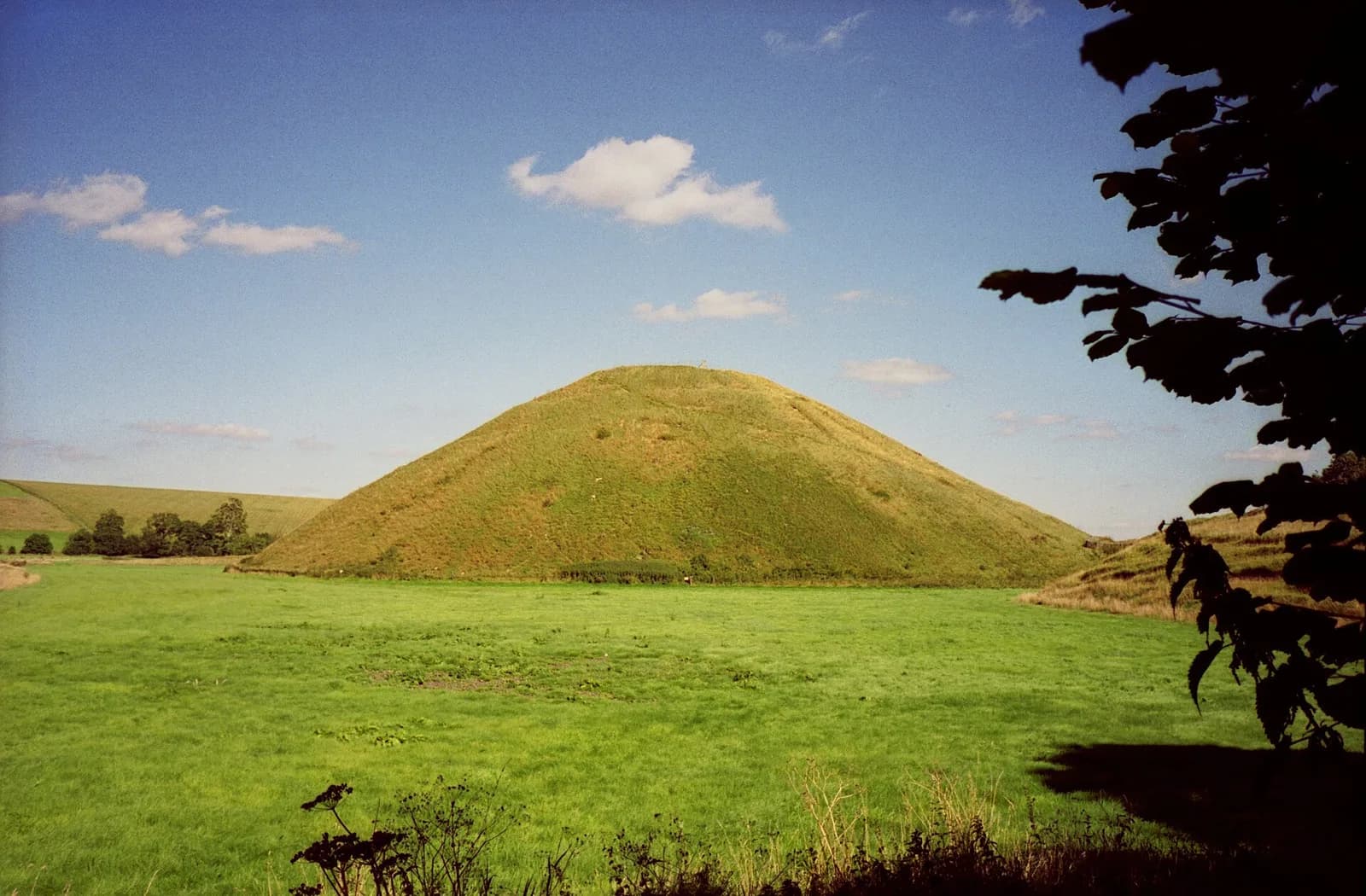
The first stage of Silbury Hill was a pile of gravel a little less than 1 meter high. Over time it grew into a mound about 30 meters high and 160 meters wide.
English Heritage says that nobody knows why it was built.
The traditional view
English Heritage calls Silbury Hill the largest artificial prehistoric mound in Europe. It stands in Wiltshire inside the Avebury World Heritage Site. It says the mound was probably built over a short period between about 2470 and 2350 BC.
The same page estimates about 4 million man hours of work. It puts the material at about half a million metric tons, mostly chalk.
English Heritage describes a slow sequence. People stripped the topsoil and stones, then raised the small gravel mound. They later set out a ring of stakes and tipped basketloads of mud and dark soil inside it. A mound about 35 meters across and 5 meters high came next. Then people dug a ditch about 100 meters across and backfilled and re-cut it a number of times.
Chalk banks followed, along with a second water-filled ditch. The page says the monument "was not conceived and built in a single campaign, but enlarged over several generations."
Digging began in the eighteenth century. The same source says Edward Drax's miners sank a shaft from the summit in 1776 and failed to find the central burial they expected. John Merewether drove a tunnel in 1849 and found no central burial either.
Richard Atkinson led a third investigation between 1968 and 1970 for the BBC. A crater opened on the summit in May 2000. English Heritage then ran a conservation project in 2007 that reopened Atkinson's tunnel and recorded the inside before filling every known void with chalk.
What the Evidence Does Not Settle
Researchers read the same mound in very different ways.
Current Archaeology says Atkinson saw four broad phases. The magazine adds that he believed the monument could be explained as "the grandiose vanity project of an individual chieftain or religious leader."
Jim Leary directed the 2007 fieldwork. He told the magazine "we found clear evidence that the mound evolved gradually, year after year, almost like a continuous project." He also said "I think we need to look beyond this notion that Silbury Hill was all about showing off power."
Leary offers a different reading of the material. He thinks the builders were "deliberately bringing parts of the landscape together." He also suggests that "Silbury could be a reaction to that by the old guard," meaning the people who held to the old ways when Beaker pottery and copper arrived.
Michael Dames put forward a goddess reading in 1976. In a 2019 essay he writes that "Silbury was built to celebrate Britain within a planet regarded as a sacred, organic entity, a divine being, even a goddess." He reads the surrounding moat as the outline of her reclining body.
Amelia Sparavigna posted a preprint on arXiv that links the hill to the bright star Alpha Crucis. She used Stellarium software to show it sinking below the southern horizon at Avebury latitude around the time she takes the building to have started. She writes "May be, the Hill was built as an astronomical observatory, to observe this phenomenon." I have not checked whether the paper was published in a journal.
The Hill That Never Finished
Both views lean on questions the evidence cannot yet answer. Three of them stand out.
When did the work start, and when did it stop?
English Heritage gives a start and finish of about 2470 to 2350 BC and says the monument was probably built over a short period. The same page says it was enlarged over several generations.
Leary gave the Marlborough News a longer figure. He said the new dating places the start in the second half of the twenty-fifth century BC. He said it took between 55 and 155 years. Current Archaeology adds that the midpoint is about four or five generations.
The Stonehenge and Avebury Research Framework reports the same modeling by Marshall and colleagues. It gives a start between 2490 and 2450 cal BC and final phases between about 2400 and 2260 cal BC.
Older figures are different. A Current Archaeology report from the 2007 work said there was "some dispute as to when the third and final phase was constructed." It raised the possibility of a pause of perhaps a couple of hundred years, with a finish as late as 2100 to 2000 BC.
Dames still writes in 2019 of a construction period of more than 300 years. Sparavigna takes the start from Atkinson's early date of close to 2750 BC. I have not checked either figure against the 2013 modeling.
Leary says "I think rather than being finished, people just stopped working on it." When did the work start, and why did it stop?
What was the work for when it began?
The early stages were small. Leary says "the early phases were very, very small. One of them was a knee-high gravel mound." English Heritage says "We do not know its purpose."
David Hinton wrote the Royal Archaeological Institute's visitor notes. He says it is debated whether the mound was begun "with an idea of what its ultimate appearance should be," or whether it was added to "with no end-product in mind."
The 2008 Current Archaeology report lists folklore of a burial for King Sil, a goddess, and an observatory or sundial that tracked the seasons with the shadow cast toward Avebury. It says Silbury is tied to nearby monuments through sight lines. It ends with the question "why?"
Leary points out that Silbury sits at the head of the River Kennet. The research framework adds the nearby Swallowhead springs and says that siting "may be of some significance."
If the first stage was a pile of gravel a person could step over, what was the project at that point?
What stood on top?
English Heritage says "The original shape of the summit is unknown." Current Archaeology reports that the flat top was probably cut back in the Saxon period, when an eleventh-century fortification was built there.
Atkinson found a fragment of bluestone on the summit. The report ties that rock to the Welsh Preseli hills, where the Stonehenge bluestones came from. The fragment lay loose in the topsoil. The 2007 excavation found three more small flakes, and none came from a secure Neolithic context.
Current Archaeology says one possibility is that a monolith once crowned the mound. It lists a second possibility, that the flakes came from the destruction of some Stonehenge bluestones.
The inside is now closed. In 2007 Leary said "what we are doing inside is the last chance anyone will ever get and no one will ever go back in."
What did the finished hill look like, and what stood on its summit?
The questions I can't put down
Some questions need more room than one article gives them. Two of them keep pulling me back.
Where did the workers live? The 2008 Current Archaeology report said no evidence of the large workforce needed to build Silbury Hill had yet been found. I have not checked whether later work has found one. In the book I write that megalithic sites show none of the archaeological traces of the observational tradition that must have preceded them. In Chapter 11 I write that conventional histories of Neolithic Europe do not adequately explain the organization behind Stonehenge and Carnac. I follow both ideas through Earthly Enigmas. The Carnac article asks a similar question about how long a stone landscape took to build.
How far did the stones travel? Leary says Stonehenge's great sarsen trilithons were raised at around the time Silbury Hill was built, and a bluestone fragment lay on its summit. In the book I write that the Stonehenge bluestones came from the Preseli hills, about 200 kilometers away. I also write that the moving of the stones has no fully confirmed account. English Heritage says Silbury was built when new pottery, new burial rites and the first metalworking arrived in Britain. The Lockington article looks at an Early Bronze Age pit that held gold armlets, a dagger and two upturned pots. You can read a free sample of the book before you decide. The articles section has more subjects in the same format.
Sources
- English Heritage: History of Silbury Hill
- English Heritage: Research on Silbury Hill
- English Heritage: Description of Silbury Hill
- Current Archaeology, The many faces of Silbury Hill (interview with Jim Leary, issue 293)
- Current Archaeology, Silbury Hill: A last look inside (2008)
- Marlborough News, More secrets of Silbury Hill revealed in the book of the 2007-2008 excavations
- Stonehenge and Avebury Research Framework, Avebury Resource Assessment
- Royal Archaeological Institute, Silbury Hill and West Kennet (visitor notes by David Hinton)
- Michael Dames, The Silbury Monument (2019 essay)
- Sparavigna, A possible role of Alpha Crucis in the astronomical landscape of Silbury Hill (arXiv preprint)