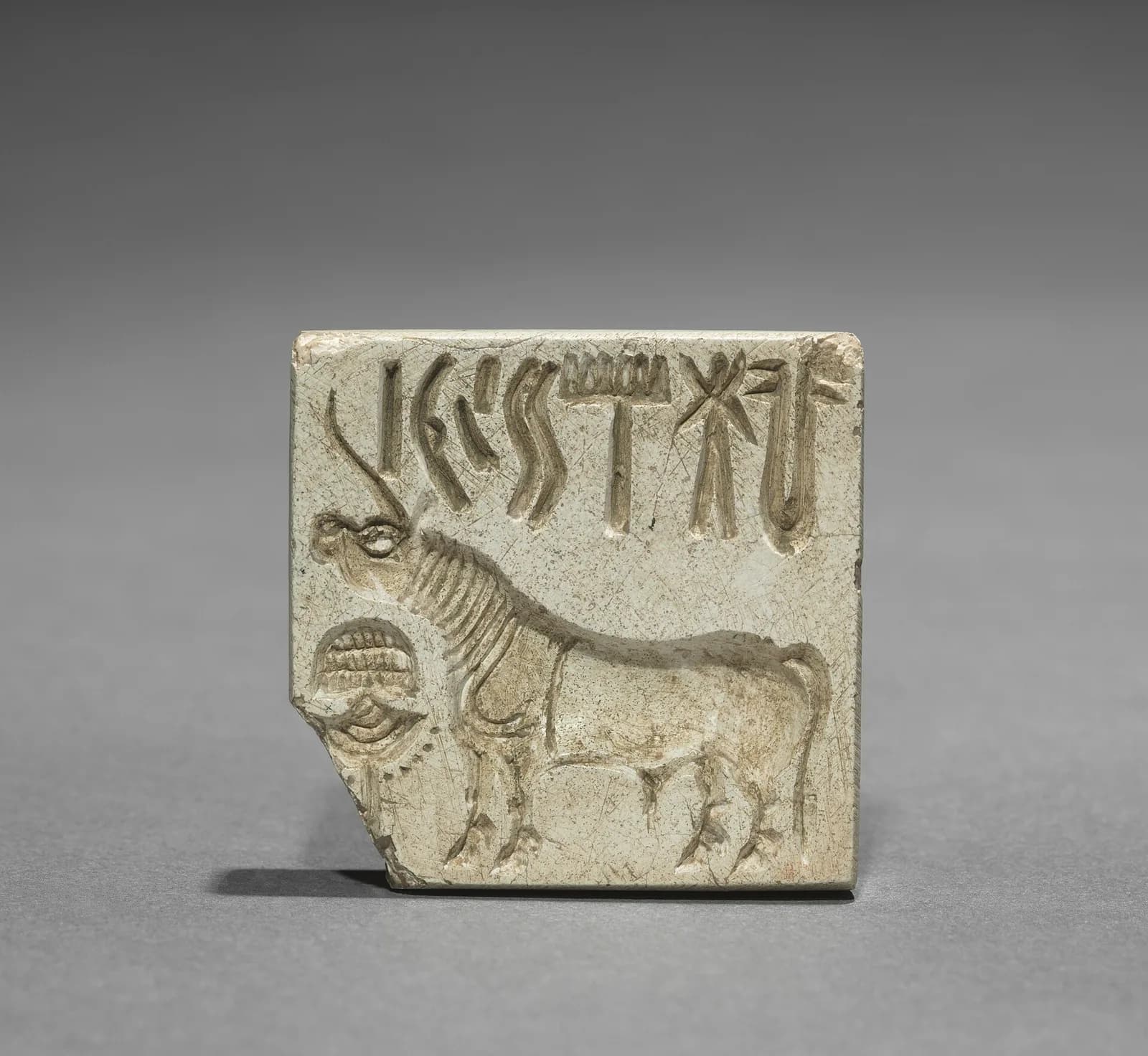
A square seal from Mohenjo-daro is about five centimeters across. It shows a one-horned animal with eight signs above it.
The script on seals like this one remains undeciphered. Nobody agrees on what the signs were for.
The traditional view
The Indus civilization flourished from about 2600 to 1900 BCE in what is now eastern Pakistan and northwestern India. Rajesh Rao and colleagues write that archaeologists have found samples of its writing on stamp seals, sealings, amulets and small tablets.
Iravatham Mahadevan gathered 2,906 inscribed objects in his 1977 concordance and reduced them to 417 signs. Harappa.com calls that the standard figure. The same page says a later database claims more than 700 distinct signs.
Rao and colleagues put the whole corpus at about 4,000 inscriptions. They say the average length is 5 signs and the longest on one surface is 17.
Most scholars have read the signs as writing. Rao and colleagues say the large number of signs and the many uses of the script led scholars to call it probably logosyllabic. That means each sign stood for a word or a syllable.
Asko Parpola adds that the seals were used to control economic administration and trade. He points to impressions of cloth and string on the backs of clay tags. He also reports over thirty Indus seals found in Western Asia.
The most common picture on the seals is the unicorn. Harappa.com says it appears to represent a mythical animal that Greek and Roman sources trace to the Indian subcontinent.
The Global Network
In Earthly Enigmas I write that history books treat the ancient world as a series of isolated experiments. I place the Indus Valley planned cities inside that argument in Chapter 5. I also list Mohenjo-Daro among the 17 sites on Jim Alison's great circle.
The Signs They Cannot Settle
Both views lean on questions the evidence cannot yet answer. Three of them stand out.
Are short inscriptions all the Indus ever wrote?
Steve Farmer, Richard Sproat and Michael Witzel published a 2004 paper whose title calls a literate Harappan civilization a myth. They write that the longest inscription on one surface has 17 symbols and that fewer than one in a hundred carries as many as 10. They give the average length of the 2,905 objects in Mahadevan's concordance as 4.6 signs.
They add that they know of no literate society that left no texts of significant length on durable materials. They read the Indus signs as a nonlinguistic system of religious and political symbols.
Parpola answers in a lecture text hosted by Harappa.com. He writes that these arguments "can be easily controverted." Thousands of seals come from Mohenjo-daro and less than one tenth of that city has been excavated.
He also notes that the cotton the Harappans made has vanished except for a few microscopic fibers. He writes that the Harappans were not likely to have committed long literary texts to writing and may have restricted themselves to economic transactions and administrative affairs.
Both sides read the same short inscriptions. Are short inscriptions all the Harappans ever wrote or only all that survived?
Can statistics settle it?
In 2009 Rao and colleagues published a short report in Science. They compared how Indus signs follow one another with sequences in Sumerian, Old Tamil, Sanskrit, English, human DNA and other systems. They found that Indus inscriptions closely match linguistic systems and sit far from the biological ones. They conclude that the result increases the probability that the script represents language. Mahadevan is one of the authors.
Farmer, Sproat and Witzel responded that the nonlinguistic comparison rested on two artificial systems the authors invented. They add that conditional entropy has never been claimed as a test of whether a sign system is linguistic.
Rao and colleagues replied in 2010 that they never claimed proof. They say their figure also includes DNA, protein sequences and computer code as nonlinguistic data. In the 2004 paper Farmer and his coauthors had already written that studies of sign frequencies cannot by themselves decide between a mixed script and a nonlinguistic system.
Sproat says he and his coauthors sent a letter to Science about the report. In a post on Language Log he reproduces the editor's reply. It says the journal could not publish the letter because of space limits and invites a Technical Comment. They did not follow up. I have not seen the editor's note from Science itself.
Sproat later published a longer comparison in the journal Language. I have not read it. What would a test look like that both sides would accept?
Can anyone check a reading of the signs?
Parpola has proposed readings. He reads the fish sign through a Proto-Dravidian word that means both fish and star. He calls "god" a reasonable guess for its intended meaning. In his reading the number 6 plus the fish sign gives the Old Tamil name for the Pleiades. The number 7 plus the fish sign gives the name for Ursa Major. He says he has presented coherent interpretations of more than twenty signs.
Farmer, Sproat and Witzel write that the Dravidian model has failed to produce verifiable linguistic readings of a single Indus sign. The Harappa.com introduction to Parpola's lecture says that Gregory Possehl does not accept the interpretations and that Mahadevan adds to them.
Parpola sets his own test. He writes that whether the signs are script depends on whether anyone can demonstrate that the rebus principle was used. A rebus uses a picture for the sound of its word. He adds that a successful demonstration would amount to a partial decipherment.
Archaeologist Massimo Vidale is quoted by Rao and colleagues as seeing no acceptable scientific demonstration that the Indus sign system is not writing. I have not read Vidale's original.
What would count as a check on a reading?
The questions I can't put down
Some questions need more room than one article gives them. Two of them keep pulling me back.
What does the unicorn stand for? It is the most common motif on the seals and it sits above signs nobody has read. Smarthistory reports a theory that the animals were emblems of persons and merchant guilds and that the signs record ownership. I have only seen that in a search excerpt. In the book I follow a different seal, the VA243 cylinder seal from Mesopotamia in Chapter 7. Some read it as a diagram of the solar system and scholars debate that reading. I follow that question through Earthly Enigmas.
How many signs are there? Mahadevan's standard list has 417. Harappa.com says a later database claims more than 700. Farmer, Sproat and Witzel report that Bryan Wells counts over 600 and that S.R. Rao argued for no more than 20. In Chapter 5 I give a computed fit for the great circle and I write that anyone can check it. The Rhinoceros Seal article looks at a single seal in detail. You can read a free sample of the book before you decide. The articles section has more subjects in the same format.
Sources
- Farmer, Sproat and Witzel, The Collapse of the Indus-Script Thesis (EJVS 11-2, 2004)
- Farmer, Sproat and Witzel, A Refutation of the Claimed Refutation (2009)
- Rao et al., Entropic Evidence for Linguistic Structure in the Indus Script, Science 324 (2009)
- Rao et al., Entropy, the Indus Script, and Language: A Reply to R. Sproat (Computational Linguistics, 2010)
- Asko Parpola, Introduction to Study of the Indus Script (Harappa.com)
- Harappa.com: An Indus Concordance and Tamil Potsherds, Now Online
- Harappa.com: Unicorn Seal, Mohenjo-daro
- Richard Sproat on Language Log (letter to Science)
- Smarthistory: An Indus Seal (search excerpt only)