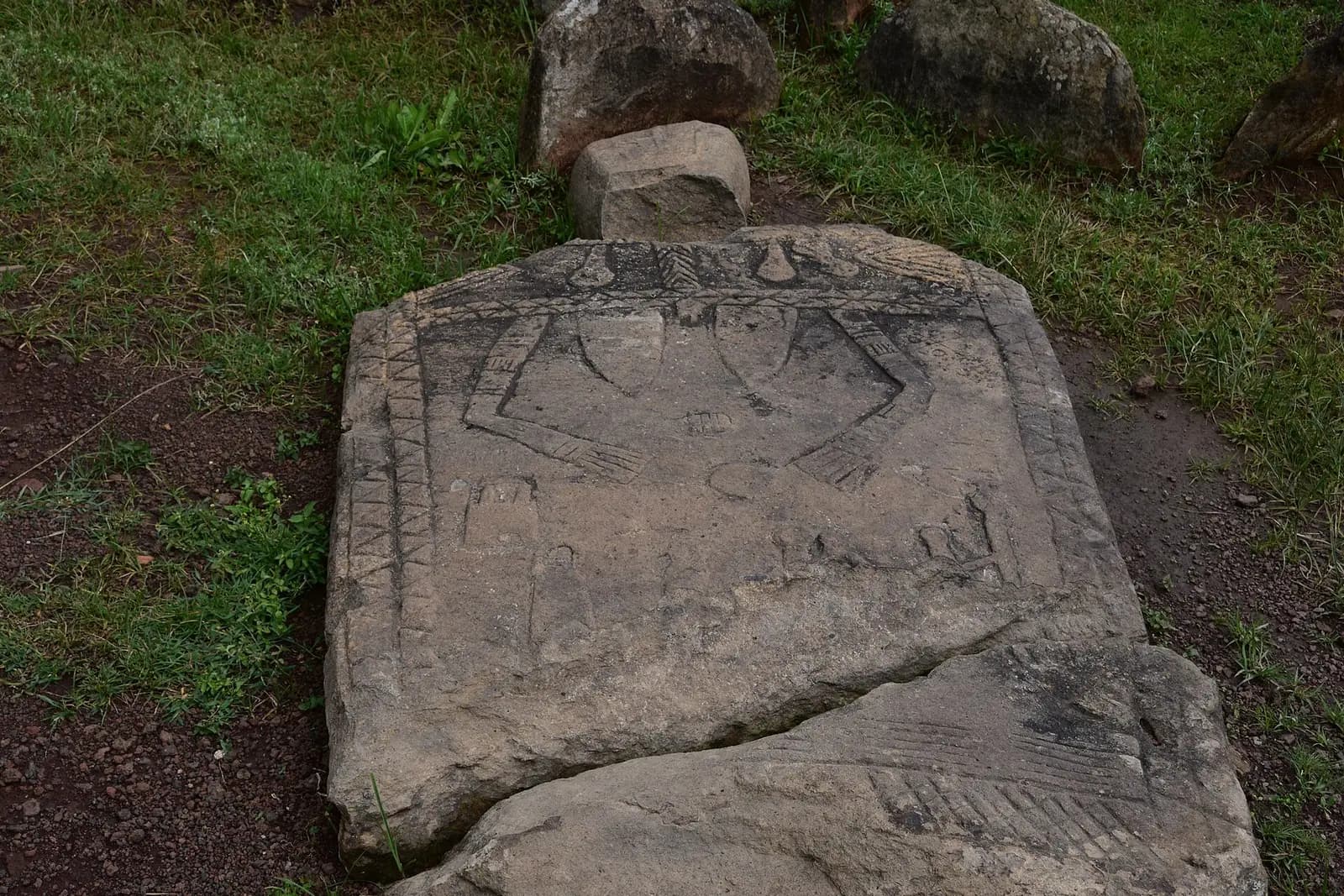
One carved stone at Tiya can show as many as nineteen swords. They are cut side by side into a slab that stands at a grave.
UNESCO says most of the symbols at the site are difficult to decipher. What was a sword on a gravestone counting?
The traditional view
UNESCO calls Tiya "among the most important of the roughly 160 archaeological sites discovered so far in the Soddo region, south of Addis Ababa." It lists 36 monuments, including 32 carved stelae, and inscribed the site in 1980. The site sits in the Gurage Zone of Ethiopia's Southern Nations, Nationalities and Peoples Region.
A second UNESCO page says "Originally forty-six stelae were erected in the cemetery between the tenth and fifteenth centuries." It adds that "Archaeological excavations show that the site contains graves." It describes carvings "representing swords and various enigmatic signs quite unlike those of other regions."
The British Museum's African Rock Art project places Tiya among the sword stelae. It describes plain stones "in which groups of swords (up to nineteen) are depicted along with dots and other unidentified symbols." It says most stelae in the region "seem to have a funerary function." For Tiya it says "it seems evident that the stela marked the graves of important personalities within their communities."
Roger Joussaume, who wrote on the French excavations, describes the graves in a 2012 article. In the English text he writes that "At Tiya, the bodies were deposited in more or less deep cylindrical pits located toward the back of the decorated stele that indicates the merit of the person who is buried there."
The stones have also been moved. UNESCO's plan of action lists the "re-erection of some fallen stelae already completed." Bertrand Poissonnier reports in the abstract of a 2000 article that two sites were restored in 1996, 1997 and 1998. In my translation the abstract says they were restored after recent archaeological digs. The Tiya figure caption shows the manual straightening of stele number 2 in April 1998.
What the Evidence Does Not Settle
In Earthly Enigmas I do not discuss Tiya or the stelae of Ethiopia. One part of the book bears on the question of dates.
In Chapter 4, "The Dating Game," I explain that stone cannot be radiocarbon dated. Organic material found near it is dated instead. I write that "That inference is frequently wrong."
At Tiya the dated material comes from the graves. The Aksum's stelae article looks at another set of Ethiopian stones dated by what lies near them. The Lalibela article covers churches attributed to a king of the late 12th and early 13th centuries, the same stretch of time.
Where the Accounts Part Ways
Both views lean on questions the evidence has not settled. Three of them stand out.
What was dated, the stone or the grave?
UNESCO's list entry says the stones belong to a culture "whose age has not yet been precisely determined." Its activity page says they were erected between the tenth and fifteenth centuries. The same page says "some date from before our era," and that sentence is about megalithic monuments across Ethiopia.
The British Museum gives "the 10th to the 13th centuries." It adds that the stelae are "sometimes with one type of stela superimposed on another and in other cases with old types being reused in later tombs."
Joanna Pyrgies, writing on the Archaeotravel site, explains how such dates are reached. She writes that "Stones themselves cannot be dated in that way as they do not contain an organic material." She says the dating relies on bones from the burials. She reports radiocarbon dates by Roger Joussaume that put the use of Tiya between 1200 and 1400 AD. I have not checked that against Joussaume's own publication.
A bone dates a burial. A stone shows when someone chose to carve and raise it. Which stone does each date belong to?
What was a sword counting?
UNESCO says the symbols are "difficult to decipher." The British Museum says "unidentified symbols." Joussaume reads the stele as indicating the merit of the person buried behind it.
Pyrgies lists readings she attributes to other researchers. She cites a 2008 study by Worku Derara. The swords may point to the occupation of the men buried beneath the stones. A lance may mark a hunter or a warrior. The number of daggers "would signify the rank of the warrior or the number of killed enemies." She also reports that the decoration matches the sex of the person buried below. I have not read Derara or the excavation reports behind that.
A Wikipedia article on megaliths in Ethiopia says the reading of swords as rank or enemies killed is "dubious and debatable." I use Wikipedia here only to locate the claim.
Pyrgies also reports a recurring set of three signs that Joussaume called the symbolic triad. They are a zigzag, an X and discs. I have not read his 1995 volume.
Several readings sit beside each other and none has been tested against the others. What would settle a reading of the swords?
Whose stones are these?
The British Museum says "It is difficult to determine who the groups that carved these stelae were." Given the dates, it writes that "it seems that they could have been Cushitic or Nilotic-speaking pastoralist communities absorbed by the Oromo expansion that took place in the sixteenth century." It adds that "A lot of research has still to be done about these graveyards and their associated living spaces."
Wikipedia, citing a volume edited by Katsuyoshi Fukui, reports that local residents in the Gurage and Hadiya zones call such stones Yegragn Dingay, or "Gran's stone." The name refers to Ahmad ibn Ibrahim, a sixteenth-century general. The article says the stones were made centuries before his time. I have not checked Fukui.
Pyrgies quotes the view that style differences between the phallic stelae and the highly decorated stelae of the Soddo region "suggest social and cultural differences between the societies that erected the megaliths."
These are graves, and people live in the region now. Ethiopian custodians and communities connected to the site are part of any answer. Who can say whose stones these are, and who has been asked?
The questions I can't put down
Some questions need more room than one article gives them. Two of them keep pulling me back.
How many stones were there, and where did they stand? UNESCO's list entry counts 36 monuments and 32 carved stelae. Its activity page says forty-six stelae were erected at first. Pyrgies writes of 41 monoliths. A pattern read off today's layout depends on stones that were lifted back into place in the 1990s. The articles section has the neighboring Ethiopian case in Aksum.
What are the perforations at the base for? Pyrgies says many sword stelae have holes near the bottom, and that one stone found in place showed they had once been below ground. She cites a 2020 book by Sada Mire for a reading about ancestor spirits in the form of snakes. I have not checked that. In the book I follow a different question, who an image was made for, and I look at the Nazca lines through it. I follow that question through Earthly Enigmas. You can read a free sample of the book before you decide.
Sources
- UNESCO World Heritage Centre: Tiya
- UNESCO World Heritage Centre: Tiya - Prehistoric site
- British Museum African Rock Art: The Country of the Standing Stones
- Roger Joussaume, The Superimposed Cemeteries of Tuto Fela in Gedeo Country (Ethiopia), and Thoughts on the Site of Chelba-Tutitti (Palethnologie 4, 2012) (read through a page extraction; recheck wording)
- Bertrand Poissonnier, Restauration des sites a steles decorees de Tuto Fela et Tiya (Annales d'Ethiopie 16, 2000) (abstract and figure caption only)
- Joanna Pyrgies, Language of the Megalithic Tiya and its Translation (Archaeotravel) and Dressed Stones of the Region of Soddo (secondary; read through a page extraction)
- Wikipedia: Tiya (archaeological site) and Megaliths in Ethiopia (used only to locate claims)