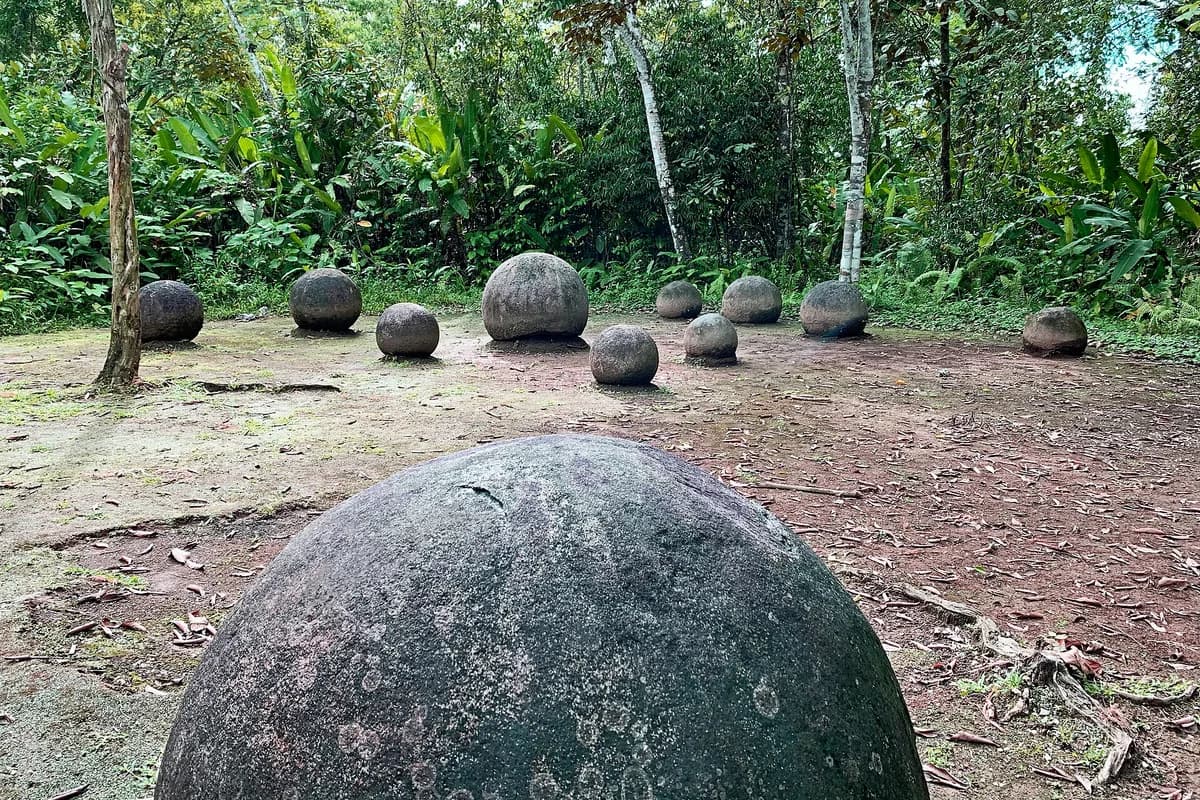
Two short rows of stone spheres lie in an open field at Finca 6 in southern Costa Rica. The biggest are about 1.9 meters across. The people who set them there left no written record of why.
The traditional view
UNESCO added the Precolumbian Chiefdom Settlements with Stone Spheres of the Diquís to the World Heritage List in 2014. It covers four sites in the Diquís Delta, dated to 500 to 1500 CE. UNESCO says the spheres range from 0.7 to 2.57 meters across and that their "meaning, use and production remain largely a mystery."
Museum archaeologists Francisco Corrales and Adrián Badilla report more than 120 spheres in the delta set in linear, curved or triangular groups (my translation). They write that each group is unique and that most were altered after they were recorded. Their English abstract says "the spheres have been removed, altered or destroyed."
John Hoopes of the University of Kansas says the balls stayed unknown until a fruit company began clearing land for banana plantations. His FAQ says railways carried them across the country. He writes that virtually all known balls have been moved from their original locations.
Hoopes writes that the balls were most likely made by the ancestors of native peoples who spoke Chibchan languages. He lists the Boruca, Téribe and Guaymí among their modern descendants. The Metropolitan Museum of Art says craftspeople with no metal tools pecked and ground the surface with stone implements.
The National Museum's booklet says it is postulated that the spheres were used primarily as symbols of rank, power and ethnicity. At Finca 6 a sphere stood at each end of the ramp to a house mound. Corrales and Badilla say this reinforced the hypothesis that spheres marked rank (my translation).
What The Evidence Does Not Settle
In Earthly Enigmas I argue that precision stonework and astronomical alignments turn up in cultures with no documented contact (Chapter 5). The spheres raise both points. UNESCO calls them distinctive for their perfection, and one excavator reports a solar alignment at Finca 6.
Hoopes reports two claims that go well beyond the museum's account. Ivar Zapp suggested that the alignments were navigational devices pointing to Easter Island and Stonehenge. George Erikson and others have implied that the balls may date as early as 12,000 years ago. Hoopes calls the first suggestion almost certainly wrong and says there is no evidence for the second. I have not read Zapp and Erikson's own text.
What The Stone Cannot Say
The sources I read agree that people of southern Costa Rica shaped the spheres by hand. Three questions stay open.
What are the rows lined up with?
UNESCO says Finca 6 is the only one of the four sites that still holds spheres in linear arrangements. Corrales and Badilla describe two rows, one of three spheres over 77 meters and one of two spheres 11 meters apart. They write that the rows run approximately east to west and that earlier digs found no structures beside them (my translation).
The museum's booklet says the approximate east-west orientation "has suggested possible associations with celestial phenomena." It adds that groups of spheres could be tied to the observation of celestial events and calendars, "an aspect that has not yet been corroborated."
Ifigenia Quintanilla has worked at Finca 6. In a 2015 newspaper article reposted on her blog she writes that the two rows are oriented 80 degrees northeast. She says that she and the anthropologist Federico Guevara found that the rows, as they are now, coincide with the two zenith dates of the sun. She calls it a tentative proposal that the people of Finca 6 marked those dates with the spheres (my translation).
The same text says the observation at the zenith itself is still pending, because the spheres are now below ground. It adds that archaeoastronomy in Costa Rica has often been speculative and without strong scientific footing (my translation).
UNESCO notes that nobody knows how far the forest was cleared in Precolumbian times. It says this "increases the difficulties in judging sight relations between different structures and landscape elements." Hoopes writes that all but a few of the alignments Samuel Lothrop recorded were destroyed when the balls were moved. In his words, "measurements made almost fifty years ago cannot be checked for accuracy." He also reports that one group of four balls was found in a line oriented to magnetic north.
What evidence would settle whether the rows were set for the sun?
What does a date describe?
UNESCO dates the four sites to 500 to 1500 CE. The museum's booklet says between 300 and 1500. Corrales and Badilla assign the pottery from the Finca 6 mounds to the Chiriquí period, 800 to 1550 CE. They add that pottery at the sphere rows was scarce (my translation).
A stone cannot be radiocarbon dated. At El Silencio the date Corrales and Badilla report came from a drainage canal 110 centimeters below the surface, not from the largest sphere. It calibrates to 550 to 650 CE. They write that dating the Chiriquí occupation is still pending (my translation).
Hoopes explained the limit in a 2010 University of Kansas release. The method "tells you the latest use of the sphere" but "doesn't tell you when it was made." His FAQ says the balls could have been made anytime during an 1800-year period.
In Chapter 4 I write about the same problem for stone in general. Stone cannot be radiocarbon dated, so the date comes from organic material found near it. What does the date of a nearby pot say about when the sphere was made?
How round is perfect?
UNESCO calls the spheres "distinctive for their perfection." The Metropolitan Museum of Art writes of "the perfect spheres" made with stone tools. The UNESCO text gives no figure for how close to round they are.
Hoopes quotes Lothrop's 1963 study. Lothrop wrote that the larger balls were "so nearly perfect" that his tape and plumb-bob measurements "did not reveal imperfections." He measured circumferences with a tape and the diameters "have been computed mathematically." I have not read Lothrop's book.
Hoopes says the published diameters are calculated estimates and not direct measurements. He writes that some balls are known to vary by more than 5 centimeters. He adds that fire damages the surface. He says of the largest ball, "It is therefore impossible to know how precisely formed this ball might have been."
Who has measured a whole sphere, and how closely?
The questions I can't put down
Some questions need more room than one article gives them. Two of them keep pulling me back.
How do you move 26 tons? Corrales and Badilla give the largest known sphere, at El Silencio, a diameter of 2.66 meters and a weight of about 26 tons. They say rock outcrops about one kilometer away would have been the source, and that four of the seven tools found near the sphere were hammerstones (my translation). UNESCO says researchers are still "speculating about the method and tools of their production." The booklet says it is possible that semi-finished blocks were moved to the site where the finishing was done. In the book I write that the logistics of moving the Western Stone at the Temple Mount have not been demonstrated. I follow that question through Earthly Enigmas.
Why make the shape a sphere? Hoopes says his own thinking is that the spheres "represented human participation and control in the shaping of nature," as quoted by History.com. The same article quotes Corrales, in a 2021 paper, suggesting that groups of spheres served as readings of constellations or as foundations for narrating creation myths. I have not seen the full text of that paper. In Chapter 5 I follow shapes and proportions that keep turning up in cultures with no documented contact. You can read a free sample of the book before you decide. The articles section has more subjects in the same format.
Sources
- UNESCO World Heritage Centre: Precolumbian Chiefdom Settlements with Stone Spheres of the Diquís
- Corrales and Badilla, Asentamientos precolombinos con esferas de piedra en el Delta del Diquís (Vínculos 35, 2015) (first 25 of 50 pages read)
- Corrales Ulloa, Asentamientos cacicales con esferas de piedra del Diquís (Museo Nacional de Costa Rica, 2015) (read in a third-party copy)
- Quintanilla Jiménez, Las esferas del Diquís en un día muy especial (La Nación 2015, reposted 2022)
- Hoopes, Frequently Asked Questions About the Stone Balls (archived 2013)
- Hoopes, Errors and Misinformation (archived 2013) (quotes Lothrop 1963, which I have not read)
- University of Kansas release via EurekAlert (2010)
- Metropolitan Museum of Art: A Stone Sphere from Costa Rica
- History.com: What Are the Mysterious Stone Spheres of Costa Rica? (2025) (secondary, for the Hoopes and Corrales 2021 lines)
- Wikipedia was used only to find the archived Hoopes pages. Nothing in this draft rests on it.