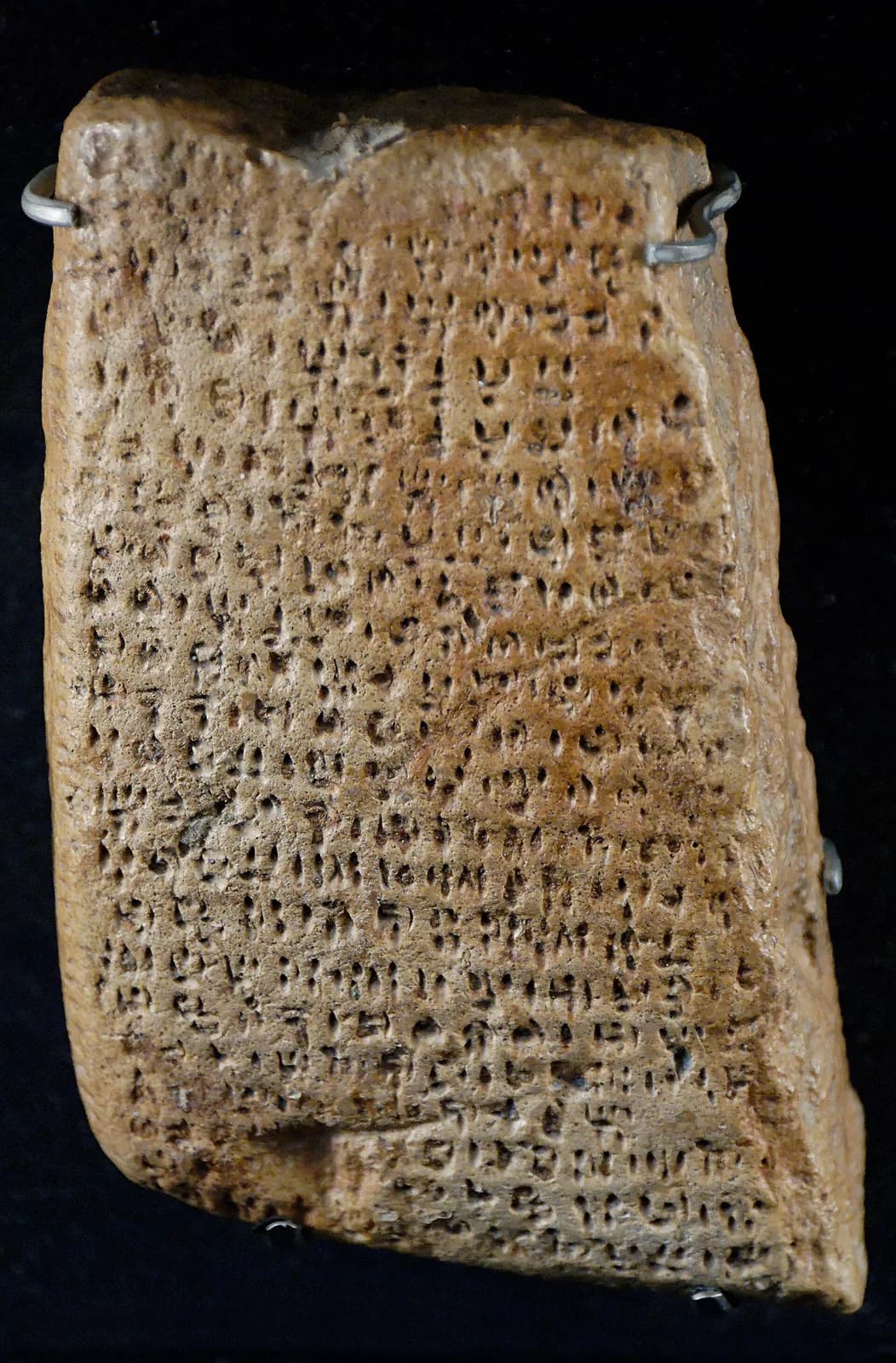
A tablet of baked clay sits in a case in the Louvre. It is eight centimeters high and a little more than twelve centimeters long.
Lines of small signs cover the clay. Nobody can read them.
The Louvre catalogues the tablet as AM 2336. It came from Enkomi in Cyprus and carries the excavation number Enk. 53 5.
The traditional view
The Louvre record dates the tablet to the Late Cypriot III period, from 1230 to 1050 BC. It names Claude Schaeffer as the excavator and gives 1953 as the year of discovery. It lists the script as Cypro-Minoan.
Mnamon, a scholarly guide to ancient writing systems, calls Cypro-Minoan "a group of scripts, closely connected by a number of similarities." It says Arthur Evans coined the name in 1909 and that the name points to a direct link with Linear A of Crete. It adds that "there is not total agreement about this in the scholarly community."
The corpus is small. Mnamon counts little more than two hundred inscriptions and says most are very short. A review of Silvia Ferrara's 2012 study says her corpus holds 243. Mnamon says plainly that the script "is still undeciphered."
Specialists sort the inscriptions into groups. This tablet belongs to the group called CM2. Mnamon says CM2 survives on three fragmentary clay tablets from Enkomi. It says they carry "texts of a certain length, written in continuous script by an apparently expert hand." In its list of online resources Mnamon names AM 2336 as "a long inscription in Cypro-Minoan 2."
Philippa Steele writes that the three tablets are all broken and have considerable surface damage. She reports that Jean-Pierre Olivier estimates the surviving fragments of the three hold about 2,000 signs. About 1,500 of those signs are legible. He thinks the original tablets may have held about 3,600.
What the Evidence Does Not Settle
In Chapter 5 I write that history books treat the ancient world as a series of isolated experiments.
The sources here tie the script to Linear A of Crete, though Mnamon says scholars do not fully agree on that link. The script turns up on Cyprus and at Ugarit in Syria. A few examples come from Tiryns in Greece.
What the Clay Does Not Say
The specialists lean on questions the evidence cannot yet answer. Three of them stand out.
Is it one script or three?
Steele credits Émilia Masson with laying out the division into CM1, CM2 and CM3 in detail. Michael Scarborough's review of Ferrara's book says Masson also read CM2 and CM3 as two different languages. He names Hurrian for CM2 and a Semitic language for CM3.
Ferrara questions the division. Scarborough quotes her "tentative suggestion" that the cohesion across the groups "could point to the possibility that Cypro-Minoan may constitute only one script."
In 2022 Michele Corazza, Fabio Tamburini, Miguel Valério and Ferrara tested the division with an unsupervised neural network. Their abstract says the results point toward "a unitary, single Cypro-Minoan script, rather than the current division into three subgroups." They add that the use of different media "skews to a large extent the uniformity of the sign shapes." They also say this state of affairs "is not consensually accepted by the experts."
Steele reaches a different view in her 2014 paper. She writes that the inscriptions are "almost certainly written in more than one script." She tested the three Enkomi tablets against the Enkomi cylinder, which is usually counted as CM1. About a quarter of the cylinder's signs do not occur in the tablets' assumed near-complete sign list. She says this "points to the conclusion that the cylinder is written in a different script." She also says the three tablets give the appearance of belonging to one writing tradition.
Corazza and colleagues name two scholars on the other side. They write that Steele has defended CM2 as a separate script and that Yves Duhoux has done the same for CM3. I have not read Duhoux. The abstract of Thomas Palaima's 1989 survey, as posted on Academia, calls the whole classification invalid. I have not read the paper itself.
Beatrice Pestarino reviews a 2024 book by Cassandra Donnelly. She reports that Dikaios and Schaeffer, the two archaeologists who led the Enkomi excavations, disputed whether certain signs were the work of "Aegeans" or "Semites." She says this ethnic framing ultimately led to the three-way division of the script. I have not read Donnelly's text on this point.
Is the Louvre tablet written in the same script as the rest of Cypro-Minoan?
Who wrote it, and who was meant to read it?
Very few tablets exist. Scarborough says Ferrara counts four tablet fragments from Enkomi that make up the whole of CM2. Ninety of the 243 inscriptions in her corpus are clay balls.
Donnelly's abstract says there are few clay tablets and that Cypro-Minoan writers "wrote on mercantile objects, outside of scribal schools." I have read only that abstract because the book is behind a paywall.
Pestarino reads the tablets differently. She writes that the discovery of the tablets "attests to the probable presence of professional scribes, at least in certain locations and periods." She says Donnelly could have given more attention to "the exceptionality of the tablets." Mnamon speaks of an "apparently expert hand."
Steele says the three tablets were found in different places and that their contexts are obscure. The Louvre record cites AM 2336 as number 209 in the editions by Olivier and Ferrara. Steele reports that number 209 was found in Quartier 4E "on a rocky surface out of original context." She places number 208 next to the Sanctuary of the Horned God, in a layer of broken pottery used as a hearth base. I have not matched the field number Enk. 53 5 to an excavation report.
Who wrote it, and who was meant to read it?
What would it take to read it?
Mnamon says that without bilingual inscriptions and with a small corpus of mostly short texts, "every attempt at an even partial interpretation is premature."
Nobody agrees on how many signs the script has. Corazza and colleagues give Olivier's inventory as 96. Scarborough says Ferrara proposes a tentative standard repertoire of 74. Pestarino says Polig and Donnelly present an integrated signary of 112 signs with variants. She adds that scholars have not agreed on whether some forms are "mere graphic variants or an entirely distinct syllabogramme."
Pestarino also reports that comparing nine to eleven signs with Linear A, Linear B and the later Cypriot syllabary has produced "plausible phonetic values." She says no method has yet produced definitive results.
Other readings of the script have been proposed. Richard Janko argues in a 2020 article that the Enkomi cylinder is an accounting document in which some signs are numerals. His abstract finds sign groups ending in -o-ti that resemble classical Eteocypriot texts. He says this "suggests linguistic continuity from the Bronze Age to the classical period." I have not read the paper, and it concerns the cylinder and not this tablet.
Giannhs Kenanidhs posted a paper on Academia titled Cypro-Minoan writing deciphered. Its abstract says Sumerians settled on Crete and Cyprus and that Sumerian pictography evolved into two types of syllabic script. I have not checked that claim.
What would two specialists need in order to check each other's reading of this tablet?
The questions I can't put down
Some questions need more room than one article gives them. Two of them keep pulling me back.
How do you date a tablet that lost its layer? The Louvre gives a span of 180 years, from 1230 to 1050 BC. Steele calls the tablets hard to date because of their obscure contexts and places them between the later 13th century and the mid-11th century BC. In Chapter 4 I describe circular, indirect and stylistic dating and I say each can be misused. I follow that argument through Earthly Enigmas. Another undeciphered script gets the same treatment in The Indus Seal.
What did the collapse take with it? Donnelly's abstract says administrative writing went with the eastern Mediterranean centers when they collapsed about 1177 BCE. She says Cypro-Minoan "remained in use." Mnamon dates the script to the 11th century BC at the latest. In Chapter 11 I write that the Homeric epics preserve accurate information about the Bronze Age Mediterranean. You can read a free sample before you decide. The articles section has more subjects in the same format, including the undeciphered symbols on Aberlemno I.
Sources
- Louvre Collections: tablet AM 2336, Enkomi (cl010131738)
- Mnamon: Cypro-Minoan
- Mnamon: Cypro-Minoan, online resources
- Aegeus Society: Ferrara, Cypro-Minoan Inscriptions Volume 1, abstract and contents
- Scarborough, review of Ferrara, Bryn Mawr Classical Review 2013.02.04
- Corazza, Tamburini, Valério and Ferrara, Unsupervised deep learning supports reclassification of Bronze age Cypriot writing system, PLOS ONE 17 (2022)
- Steele, Distinguishing between Cypriot scripts, Kadmos 53 (2014)
- Cambridge Core: Donnelly, Cypro-Minoan and Its Writers (2024) (abstract only)
- Pestarino, review of Donnelly, Bryn Mawr Classical Review 2025.11.24
- Academia: Kenanidhs, Cypro-Minoan writing deciphered (abstract only, via a related-papers listing)
- Academia: Janko, Eteocypriot in the Bronze Age? (Kadmos 2020) (abstract only)
- Academia: Palaima, Cypro-Minoan Scripts: Problems of Historical Context (abstract only)
- Wikimedia Commons: photograph of AM 2336, public domain release by the photographer (image record only)
